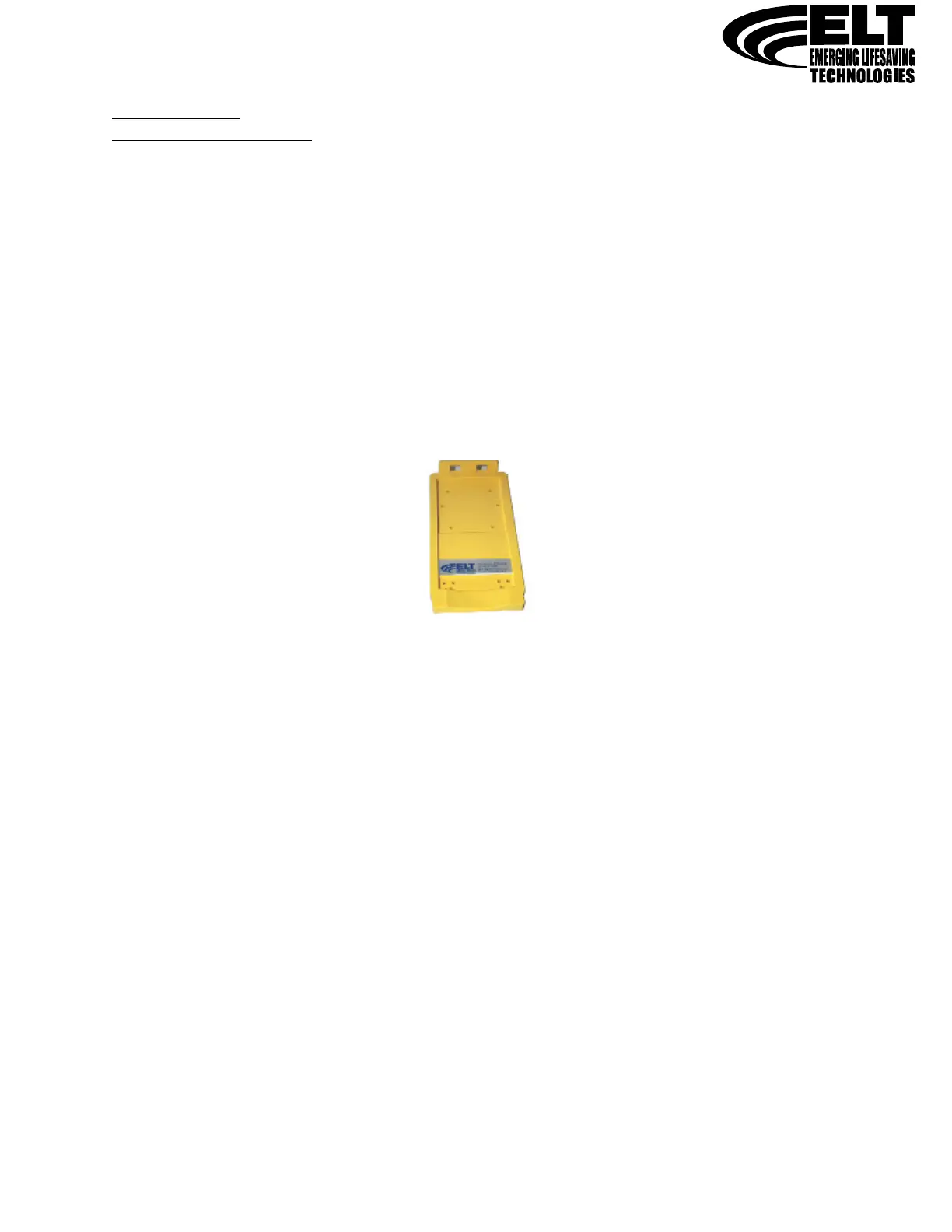
5.3 Elt Mounting
5.3.1 Existing Installations
ELT406s come with an interlocking base plate that holds the transmitter on with a Velcro strap.
This allows for quick and easy removal of the unit if needed. The base plate has been designed
to reuse many of the popular hole patterns of previously installed ELT’s
Compatible patterns include:
• Artex 100/110, G406, C406 and B406 series and Narco ELT-910, ELT-10
• Artex ELT-200 series
• Pointer model ELT 3000-series
Remove the old ELT and its mounting rack. A close inspection is required to ensure the
underlying structure is sufficient to mount the unit. You should consult the airframe
manufacturer’s structural repair manuals and
AC) 43.13-2 (Acceptable Methods, Techniques, and
Practices – Aircraft Alterations), specifically, Chapter 1 and 2 to determine if the structure meets the latest
approved data.
In order to ensure a high rate of survivability it has been determined that the ELT must meet the
current guidelines for loading in all three axes. The mounting location must conform to the
requirements of RTCA DO-204 and AC 43.13. DO-204 Sec 3.1.8 reads:
“The ELT shall be mounted to primary aircraft load carrying structures such as trusses, bulkheads longerons, spars,
or floor beams (not aircraft skin). The mounts shall have a maximum static local deflection no greater than 2.5 mm
(0.1 in.) when a force of 450 Newtons (100 lbs) is applied to the mount in the most flexible direction. Deflection
measurements shall be made with reference to another part of the airframe not less than 0.3 meters (1-foot) or more
than 1.0 m (three feet) from the mounting location.”
The use of the 8-32 X 5/8” Phillips, pan-head screws, nuts and flat washers to a sufficient
structure will provide the sufficient strength. Stainless steel hardware is acceptable because of
its ability to resist corrosion; however, all hardware used should conform to an accepted standard
such as AN or Mil-Spec.



 To Next Page