Installation and Maintenance Manual V 1.4
4. Mount the resolver bracket (1) on the back of
the motor. Make sure that it is seated in its
position, if necessary, use temporary bolts to
tighten it to the motor. (If the motor is liquid
or combined cooled, please make sure that
the coolant fittings are inserted, before
mounting the encoder bracket, please refer to
3.5).
5. Mount the resolver stator (6) to the mounting
flange of the resolver bracket (1). While
holding the resolver stator (6) down, use DIN
914 set screws (10) to bolt it down from the
side. Using threadlocker glue supplied with
the kit on the threads is recommended.
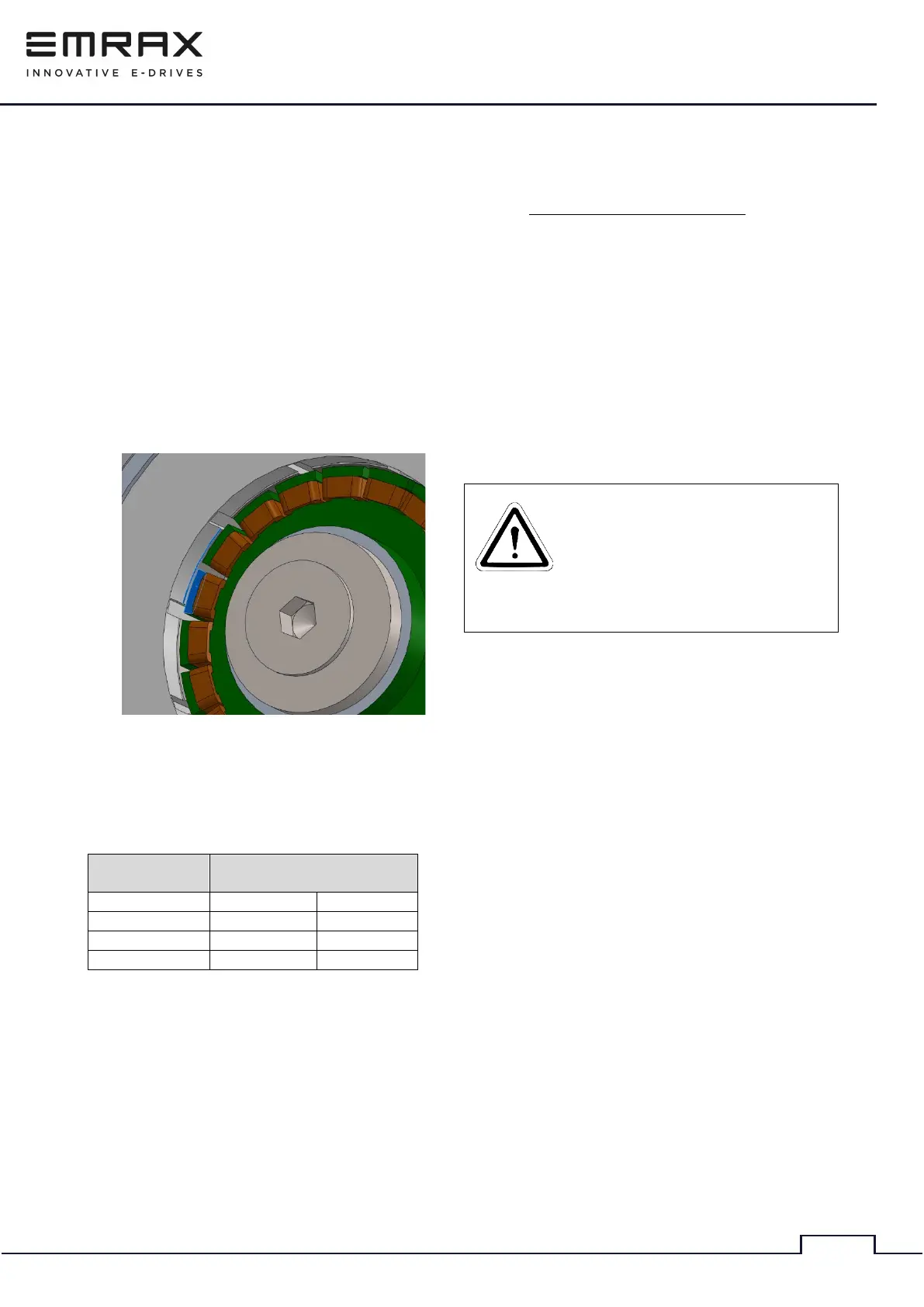
6. Make sure that the resolver stator and rotor
tooths are aligned as on the picture bellow.
Figure 7: Tooth alignment
7. Tighten the tapered sensor bolt (13).
8. Mount the resolver cover (4) on the back of
the resolver stator (6). Tap it gently with a
hammer until it is firmly seated in place.
3. Motor installation
3.1. General space requirements
Electric machines should be installed to allow an easy
access for inspection and maintenance. Should the
surrounding atmosphere be humid, corrosive or
contain flammable substances or particles, it is
essential to ensure an adequate degree of protection.
The installation of motors in environments where
there are vapours, gases or dusts, flammable, or
combustible materials, subject to fire or explosion,
should be undertaken according to appropriate and
governing codes, such as NEC Art. 500 (National
Electrical Code) and UL-674 (Underwriters
Laboratories, Inc.) Standards.
Under no circumstances can motors be
enclosed in boxes or covered with
materials which may impede or reduce
the free circulation of ventilating air.
Machines fitted with external ventilation
should be at least 150 mm from the wall to permit the
passage of air.
The opening for the entry and exit of air flow should
never be obstructed or reduced by conductors, pipes,
or other objects. The place of installation should allow
for air renewal at a rate of 20 cubic meters per minute
for each 50 kw of motor capacity (please ensure that
the ambient temperature of surrounding air remains
stable during motor operation).
See cooling details for each motor cooling type under
section 2.4. Motor cooling.



 To Next Page