Need help?
Do you have a question about the Engl Gig Master 15 and is the answer not in the manual?
Input Gain and Lead Drive knobs adjust preamp sensitivity and distortion levels for channel tone.
Bass, Middle, Treble EQ controls, plus Lead Volume and Master Volume for sound and output level.
Clean/Lead channel selector and Mid Boost switch for tonal versatility.
Power switch for ON/OFF and Stand By switch for tube warm-up and brief muting.
AC power inlet (IEC C14) and fuse box for mains connection and protection.
Connect external effects via Send/Return and remote controls via footswitch jack.
Balanced Line Output and Speaker Outputs (8 Ohm, 16 Ohm) for diverse connectivity.
Adjusts power output to 5W, 1W, or Speaker Off for reduced volume or silent operation.
Details rated power, input sensitivity, tube types, and fuse information.
Provides physical size and weight specifications for the head and combo units.
Guidelines for safe transport, tube care, and general operational precautions.
Recommendations for cleaning, ventilation, and operating in suitable ambient temperatures.
Solutions for no power, no sound, or unresponsive controls after switching on.
Troubleshooting remote controls, hum, interference, and signal path problems.
Using two-way footswitches or MIDI switchers for flexible control of amp functions.
Diagrams and explanations for wiring footswitch (15) and balanced line out (18) jacks.
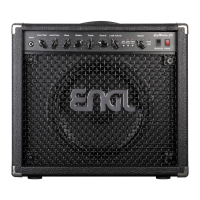
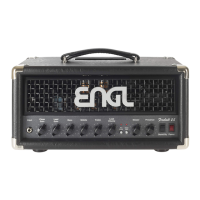
The ENGL Gig Master 15 is a tube guitar amplifier designed for both performance and recording, offering premium tone in a compact housing. It's suitable for small gigs, home and studio recording, and practicing at lower volumes without sacrificing sound quality. The amplifier features a balanced Line Out with speaker simulation and a built-in Power Soak with four variable power stages, making it versatile for diverse applications.
The amplifier's tone is shaped by two EL84 pentode power tubes and an ECC83 double triode preamp tube, providing ample front-end overdrive. It offers two channels, Clean and Lead, for a variety of tones. A specially voiced Mid Boost switch globally affects both channels by boosting specific midrange frequencies, enhancing the guitar's sound. This feature can be activated via a front panel button or a footswitch.
The front panel includes an Input jack for connecting a guitar, an Input Gain knob to control preamp input sensitivity for both Clean and Lead channels, and a Lead Drive knob to adjust the Lead channel's sensitivity and preamp distortion. Passive EQ controls for Bass, Middle, and Treble allow for detailed tone shaping. The Lead Volume knob controls the volume of the Lead channel, influencing the Send level of the FX loop. A Master volume control adjusts the overall power amp output, located post-FX loop.
Channel selection between Clean and Lead modes is done via a pushbutton, with a red LED indicating Lead mode. This function can also be controlled by a footswitch. A Stand By switch silences the amp during breaks, keeping the tubes warm for immediate full power activation. The Power switch turns the AC power on and off.
The rear panel features a Mains Connector for the power cord and a Mains Fuse Box containing the main and spare fuses. A Footswitch jack allows for remote control of channel switching (Clean/Lead) and Mid Boost via a conventional two-way footswitch or a MIDI switcher. The FX Loop includes Send and Return jacks, positioned between the preamp and power amp, allowing external effects processors to be integrated into the signal chain.
A Balanced Line Out, frequency compensated, provides a balanced signal for direct connection to a mixing console or recording unit. This output is located post-power amp, so the power amp must be activated. The built-in Power Soak provides a load for the power amp, allowing the amp to run without a speaker connected if desired, by setting its selector to "Speaker Off."
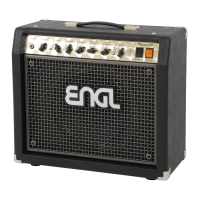
Speaker outputs include an 8 Ohms jack for an 8-ohm cabinet or the internal speaker of the E310 Combo. Two 16 Ohms serial outputs (A and B) are available for 16-ohm cabinets or combinations of 8-ohm speakers. The Power Soak circuit exclusively works with the 8-Ohm Output.
To achieve a pristine clean preamp signal, the designer suggests setting the Input Gain between 7 and 11 o'clock for active/humbucking pickups, and between 9 and 1 o'clock for single-coil pickups. For very soft lead, blues, or jazzy clean sounds, the Treble knob can be set between 11 and 1 o'clock. For more aggressive riffs or funk-approved tones, a Treble knob position between 1 and 4 o'clock is recommended.
The combination of Input Gain and Lead Drive controls the amount of preamp overdrive, allowing users to balance gain between Clean and Lead modes. Setting the Lead Drive knob around 10 o'clock can provide a tougher rhythm tone with an added edge.
The Mid Boost feature, remotely controllable via footswitch, allows for on-the-fly tone shaping to support various playing styles, such as rhythm guitar work, singing leads, and power chords.
The Power Soak offers four settings: "Full Power" deactivates the Power Soak, sending full output to 8-ohm or 16-ohm speaker outputs. "5 Watts" and "1 Watt" activate the Power Soak, reducing power to 30% and 5% respectively for the 8-ohm cabinet. "Speaker Off" activates the Power Soak, converting the power amp's full output to heat, and switches off the connected 8-ohm cabinet. This setting is ideal for direct-to-desk recording without a speaker.
When using the Line Out, the output level is influenced by Input Gain, Lead channel Volume, voicing controls, and Master volume. It's recommended to dial in the desired sound on the front panel first, then adjust levels at FX devices or signal processors.
To prolong tube life, it is recommended to set the Stand By switch to "Stand By" (0 position) before powering on the amp. After 30 seconds, the power amp can be activated. Using standby during short breaks prevents tubes from overheating and reduces wear. For breaks longer than 30 minutes, switching the amp off is advised to conserve energy.
The amp should be protected from hard knocks and shocks, and allowed to cool down before transport. Storing the amp in damp or dusty rooms should be avoided. If not in constant use, covering the amp or using a transport cover/flight case is recommended to prevent dust intrusion.
For cleaning, a soft, damp cloth or sponge with diluted soapsuds or mild dishwashing liquid should be used. Caustic or scouring detergents and solvents should be avoided as they can damage the amp's vinyl skin and labels. Liquids should be kept away from the amp, especially its interior.
Adequate air circulation at the rear and top of the amp is crucial for cooling and component life. The amp should never be operated without a sufficient load (speaker, cabinet, or internal Power Soak circuit). High ambient temperatures should be avoided for prolonged operation, as they place additional strain on components.
Tube replacement should be done with selected tubes that meet ENGL's criteria to prevent microphonic properties, noise, and unbalanced power amp signals. Since power tube idle current (bias) must be checked and adjusted when replacing tubes, this task should be performed by experienced and authorized specialists.
 General
| Power Output | 15W |
|---|---|
| Effects | Reverb |
| Master Volume | Yes |
| Effects Loop | Yes |
| Channels | 2 |
| EQ | 3-band EQ |
| Inputs | 1 x Instrument |
| Speaker | 1 x 12" |
| Type | Tube |
| Tubes | 2 x EL84 |
| Footswitchable | Yes |

 To Next Page