Need help?
Do you have a question about the Epson L15160 and is the answer not in the manual?
Remove all protective materials from inside the product before operation.
Guide for filling the ink tanks with the provided ink bottles.
Instructions for loading paper into the printer's cassette.
Steps to connect the product to a telephone wall jack for fax functionality.
Install product software via CD or download, and select connection type.
Connect wirelessly from devices using Epson iPrint or Epson Connect.
Resolving network connection problems and screen darkness.
Addressing printouts with lines or incorrect colors.
Guidance on finding the user guide and contacting technical support.
This document serves as a comprehensive "Start Here" guide for the Epson L15150/L15160 series of multifunction printers, providing essential instructions for initial setup, operation, and troubleshooting. The guide emphasizes user safety, proper handling of the device, and maintenance procedures to ensure optimal performance and longevity.
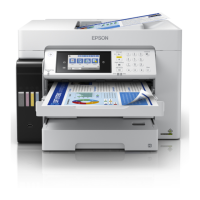
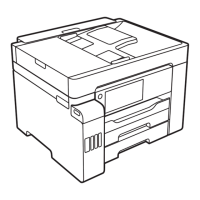
The Epson L15150/L15160 is a versatile multifunction printer designed for both home and office use, capable of printing, scanning, and copying. It features an integrated ink tank system, which allows for high-volume printing with refillable ink bottles, reducing the need for frequent cartridge replacements. The printer supports various connectivity options, including wireless, direct USB, and wired network connections, making it adaptable to different user environments. It also offers mobile printing capabilities, enabling users to print documents and photos directly from smartphones, tablets, or computers via Epson iPrint™ and Epson Connect™ services. The device is equipped with a control panel and an LCD screen for easy navigation and configuration of settings. Its design prioritizes user convenience, from the straightforward unpacking process to the intuitive software installation and paper loading procedures. The printer is designed to deliver high-quality prints, especially when used with Genuine Epson 542 pigment inks, which are recommended for their reliability and resistance to damage.
The setup process begins with unpacking the printer and removing all protective materials. Users are instructed to lift the scanner unit to access and remove internal packing materials, ensuring the transportation lock remains in the printing position. The guide then details the ink filling process, a key feature of this ink tank system. Users are advised to keep ink bottles out of reach of children and to avoid drinking the ink. The ink bottles are vacuum-packed to maintain reliability and should only be opened when ready to fill the tanks. The process involves opening the ink tank cover and the cap for each ink tank, then inserting the corresponding color-coded ink bottle into the filling port. The bottles are keyed to prevent incorrect color insertion. Users should allow the bottles to empty naturally without squeezing them. Once empty, the bottles are removed, capped, and the ink tank caps are closed. It is crucial not to leave ink bottles inserted after they are empty to prevent damage or leaks. After all ink tanks are filled, the power cord is connected to the product and an electrical outlet, but not yet to a computer.
The next step involves raising the control panel and pressing the power button to turn on the product. The LCD screen guides users through selecting language, country, date, and time settings. An important phase is ink charging, which takes approximately 9 minutes. During this time, users are cautioned not to unplug or turn off the product, raise the scanner unit, or load paper to avoid wasting ink. Part of the ink from the included bottles is used for this initial setup, which will cause ink levels to decrease, a normal occurrence that does not affect stated in-box yields.
Paper loading instructions are also provided. Users must ensure the product is not charging ink before pulling out a paper cassette. The side edge guides in the cassette should be slid all the way out. Paper is then inserted with the glossy or printable side facedown, ensuring it is loaded against the front edge guide and does not stick out from the end of the cassette. The side edge guides are then slid against the paper, but not too tightly, and paper should not be loaded above the arrow mark on the side edge guide. The cassette is then inserted all the way, and paper settings are selected on the control panel.
For fax functionality, users connect a phone cord from a telephone wall jack to the LINE port on the product. The LCD screen prompts users to set up the fax immediately or later. Software installation is covered, with instructions for both Windows and Mac users. Windows users are advised to cancel any "Found New Hardware" screens and disconnect the USB cable if it was prematurely connected. Mac users or those without a CD/DVD drive will need an internet connection to download the software. The guide directs users to the Epson support website for the latest software. After running the setup program, users select their preferred connection type: wireless, direct USB, or wired network. For wireless connections, the software installer typically attempts automatic setup, but users may need to enter their network name (SSID) and password.
Mobile printing is a significant feature, allowing users to print wirelessly from various devices. This includes direct printing from iOS or Android™ devices using Epson iPrint™ by connecting the printer and device to the same network. Android™ (v4.4 or later) devices can also print directly by connecting to the same network and selecting the print option from the menu icon. Additionally, Epson Connect™ enables printing from anywhere, whether next to the printer or remotely.
The guide includes sections for troubleshooting common issues, which can be considered part of ongoing maintenance. If network setup is unsuccessful, users are advised to verify the network name (SSID), restart their router, check firewall alerts, ensure the printer is connected to a 2.4 GHz network (if the router offers both 2.4 GHz and 5 GHz), and correctly enter the network password.
For print quality issues, such as lines or incorrect colors, users are instructed to run a nozzle check to identify any gaps in the printout. If gaps are present, cleaning the print head is recommended. These steps are crucial for maintaining print quality and preventing further issues. If the product's screen is dark, users should ensure the product is turned on and touch the LCD screen to wake it from sleep mode. If the product is not found after connecting with a USB cable, users should verify that the product is on and securely connected.
The guide also provides information on replacement inks, specifically the Epson 542 series, emphasizing the use of Genuine Epson pigment inks to prevent damage not covered by the warranty. This recommendation is a key maintenance aspect, ensuring the printer's longevity and consistent performance. The document also suggests using Epson specialty and plain papers for brilliant results, which can be purchased from authorized resellers. This advice contributes to overall print quality and helps maintain the printer's internal mechanisms by using compatible media.
Technical support information, including phone numbers for various countries, is provided for users who encounter problems that cannot be resolved through the guide. Access to the online User's Guide is also highlighted as a resource for more detailed information on settings, troubleshooting, and advanced features, reinforcing the importance of continuous user education for proper device maintenance. The guide implicitly promotes preventive maintenance by detailing correct setup procedures, ink handling, and paper loading, all of which contribute to the printer's long-term health and operational efficiency.
 General
| Print Technology | Inkjet |
|---|---|
| Print Resolution | 4800 x 2400 dpi |
| Max Paper Size | A3+ |
| Ink Tank Capacity (Black) | 127 ml |
| Automatic Duplex Printing | Yes |
| Scan Resolution | 1200 x 2400 dpi |
| Dimensions | 515 x 500 x 350 mm |
| Print Method | PrecisionCore Print Head |
| Maximum Print Resolution | 4800 x 2400 dpi |
| Paper Sizes Supported | A3+, A3, A4, A5, A6, B4, B5, DL, Legal, Letter |
| Ink Tank Capacity (Color) | 70 ml (Cyan, Magenta, Yellow) |
| Connectivity | USB, Ethernet, Wi-Fi, Wi-Fi Direct |
| Mobile Printing | Epson iPrint, Email Print |
| Scanner Type | Flatbed |
| Copy Speed | 23 ipm |
| Fax | Yes |
| Print Speed (Black) | 25 ppm |
| Display | 4.3-inch color touchscreen |

 To Next Page