Need help?
Do you have a question about the ermaf GP 95 ACU and is the answer not in the manual?
Instructions to read and keep the manual safe for future reference and safe operation.
Explanation of symbols used in the manual, including instructions and actions.
Disclaimer stating the manufacturer is not liable for damage due to non-observance of instructions.
Information relevant to safety, including DANGER, WARNING, and CAUTION indicators.
Details on the type code of the heater, including its description and capacity.
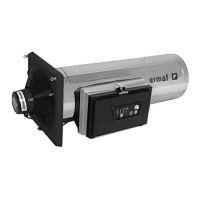
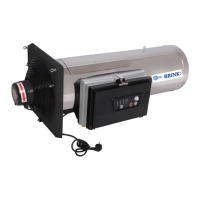
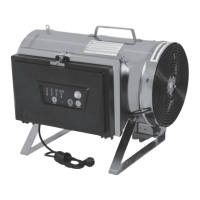
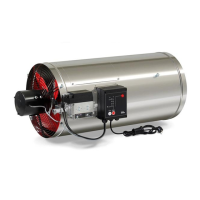
Identification of key components of the heater with corresponding numbers.
Information to be found on the type label for device identification.
Critical safety warning regarding dangerous gases released from slurry agitation.
Guidelines for the correct placement and orientation of the heater unit.
Step-by-step instructions for connecting the heater to the gas supply line.
Procedure to ensure gas connections are leak-free after installation.
Instructions for electrical wiring of the heater, including safety precautions.
Visual representation of electrical connections for the burner control unit.
Steps for wiring a single heater to a room thermostat via 230 V AC or 24 V sources.
Wiring configurations for connecting multiple heaters to a thermostat or control computer.
Information on connecting an external remote reset function.
Details on connecting and parameterizing an external fan for improved air circulation.
Explanation of MFA 2 for status signaling, including fault reporting options.
Information about the Burner Chip Card, its function, and compatibility requirements.
Procedure for setting a delay for multiple heaters to prevent power shortages.
Steps and precautions for commissioning the heater after installation, ensuring correct setup.
Overview of the burner control unit's display, buttons, and status indicators.
Explanation of the operating modes and their functions displayed on the control unit.
Procedure for switching the heater on and selecting an operating mode.
Procedure for safely switching the heater off, including post-cooling.
How to access and use the setting mode for eBus addresses and parameterizing outputs.
Instructions for measuring and adjusting the burner gas pressure using the combination control.
How to display and interpret the flame signal for burner operation and adjustment.
Important safety precautions and step-by-step instructions for cleaning the heater.
Steps for re-assembling parts after cleaning or maintenance, and checking functionality.
Steps to open the burner control unit for checking internal wiring.
Diagram showing the internal electrical connections of the burner control unit.
Details error codes P, R, and 2, their causes, and remedies.
Details error codes R, F, and 3, their causes, and remedies.
Details error codes F, C, and 1, their causes, and remedies.
Details error codes C, E, and U, their causes, and remedies.
Details error codes U and the circulating dash display, their causes and remedies.
Safety precautions and steps for performing regular maintenance on the heater.
Procedure for checking critical safety functions and the burner's operational status.
Steps for re-assembling components after cleaning or repair work.
Procedure to check the functionality of the vane switch.
Detailed instructions for reassembling various components of the heater.
Final check of safety functions before the initial startup of the heater.
Steps to verify safety functions like gas valve closure and shutdown mechanisms.
Procedure to check the burner's flame pattern and emissions during operation.
Details on a compatible room thermostat for temperature control.
Information about the pressure reducer for LPG, including specifications.
Details of manual valves for gas supply control.
Components and order number for the natural gas connection kit.
Components and order number for the propane connection kit.
Instructions for ordering spare parts and a list of available parts with item numbers.
Comprehensive technical specifications of the heater, including gas types, performance, and dimensions.
Manufacturer's declaration that the product complies with EU directives and standards.
Guidelines for transport, storage, packaging, and disposal of the unit.
A form to be filled out for returning the product, including fault descriptions.
Contact information for the manufacturer, including address, phone, fax, and email.


 To Next Page
 General