37Seare Instruction Manual
1) It is critical that your airplane be balanced
correctly. Improper balance will cause your
plane to lose control and crash. The center of
gravity is located 90mm back from the leading
edge of the wing, measured at the wing root.
2) If the nose of the plane falls, the plane is
nose heavy. To correct this rst move the
battery pack further back in the fuselage. If this
is not possible or does not correct it, stick small
amounts of lead weight on the fuselage sides
under the horizontal stabilizer. If the tail of the
plane falls, the plane is tail heavy.
To correct this, move the battery and receiver
forward or if this is not possible, stick weight
onto the rewall or use a brass heavy hub
spinner hub. When balanced correctly, the
airplane should sit level or slightly nose down
when you lift it up with your ngers.
1) We highly recommend setting up the
SEAFIRE using the control throws listed
BELOW. We have listed control throws for both
Low Rate (initial test ying/sport ying) and
High Rate (aerobatic ying).
2) Turn on the radio system, and with the trim
tabs on the transmitter in neutral, center the
control surfaces by making adjustments to the
clevises or adjustable servo connectors. The
servo arms should be centered also.
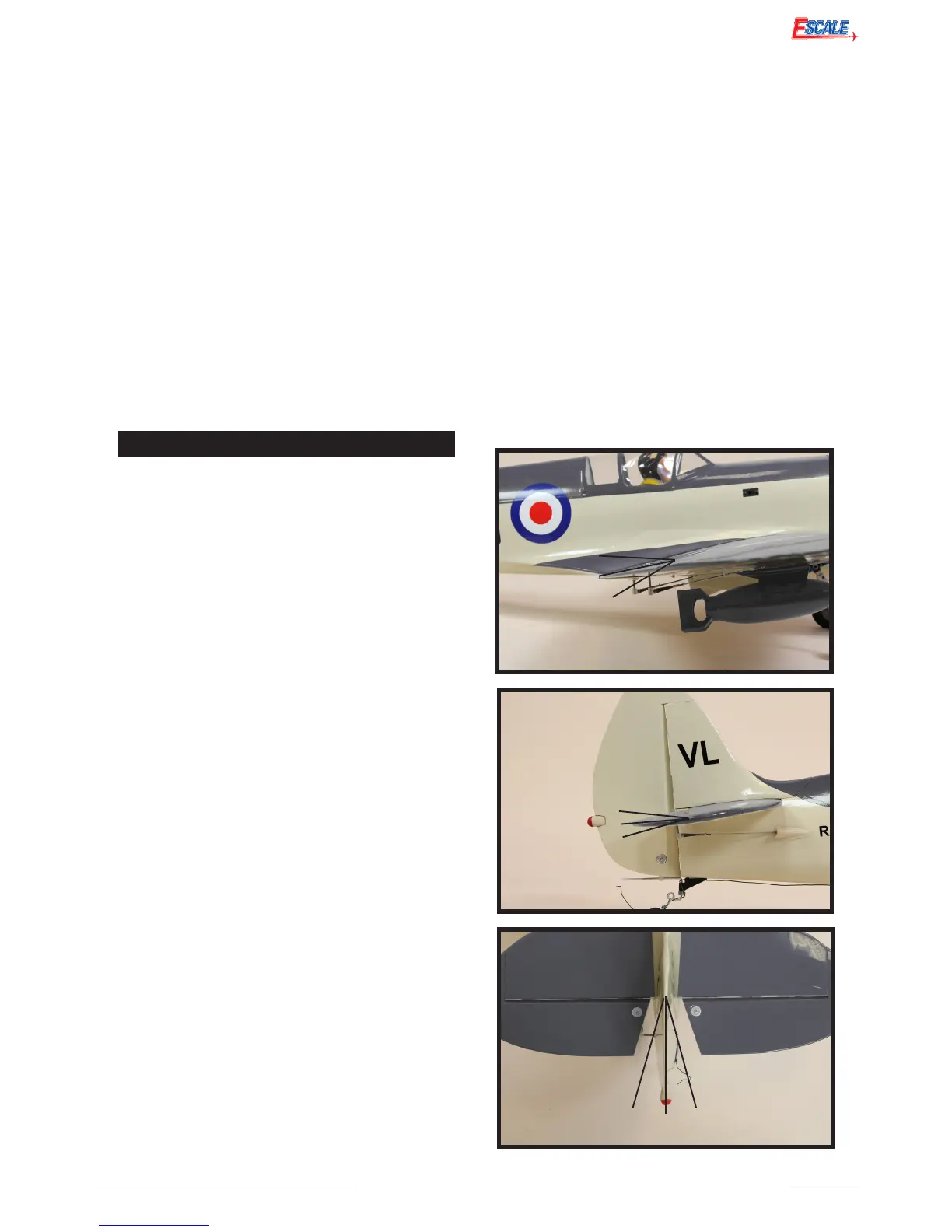
3) When the elevator, rudder and aileron
control surfaces are centered, use a ruler
and check the amount of the control throw in
each surface. The control throws should be
measured at the widest point of each surface!
4) By moving the position of the adjustable
control horn out from the control surface,
you will decrease the amount of throw of that
control surface. Moving the adjustable control
horn toward the control surface will increase
the amount of throw.
Ailerons: 10mm up 10mm down
Elevator: 15mm up 15mm down
Rudder: 10mm right 10mm left
Ailerons: 15mm up 15mm down
Elevator: 20mm up 20mm down
Rudder: 15mm right 15mm left
Do not use the aerobatic settings for initial test
ying or sport ying.
10-15mm
10-15mm
15-20mm
15-20mm
10-15mm
10-15mm


 To Next Page