General Information, Safety and Installation Instructions
Read this first
Check the pack and make sure you have all of the
parts listed on the front of this booklet. If not, contact
the outlet where you bought this product.
This fitting must be installed in accordance with the
Building Regulations. These may be obtained from
HMSO or viewed and downloaded from www.odpm.
gov.uk following the link for Building Regulations.
If in any doubt, consult a qualified electrician.
Switch off the mains before commencing installation
and remove the appropriate circuit fuse.
Suitable for indoor use only.
This product is only suitable for use in living areas (not
for areas constantly subject to moisture).
The smoke alarm must not be exposed to dripping or
splashing.
Before making fixing hole(s), check that there are no
obstructions hidden beneath the mounting surface
such as pipes or cables.
The chosen location of your new alarm should allow
for it to be securely mounted (e.g. to a ceiling joist)
and safely connected to a mains supply.
Do not attach to surfaces which are damp, freshly
painted or otherwise electrically conductive
(e.g. metallic surfaces).
If the location of your new alarm requires the provision
of a new electrical supply, the supply must conform to
the requirements of the Building Regulations.
This product is designed for permanent connection
to fixed wiring: this should be either a suitable circuit
(protected with a 5 or 6 Amp MCB or fuse) or a fused
spur (with a 3 Amp fuse) via a fused connection unit.
Make connections to the electrical supply in
accordance with the following code:
Live - Brown or Red
Neutral - Blue or Black
Yellow - Connect between multiple alarms
This fitting is double insulated, DO NOT CONNECT ANY
PART TO EARTH.
Cable of at least 0.75mm
2
cross-sectional area must be
used to connect to the supply and between alarms.
You are advised at every stage of your installation to
double-check any electrical connections you have
made. After you have completed your installation there
are electrical tests that should be carried out: these
tests are specified in the Wiring Regulations (BS7671)
referred to in the Building Regulations.
If in doubt, consult a qualified electrician.
Locating the smoke alarm
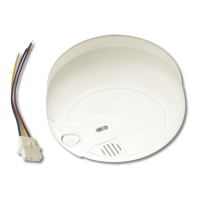
This smoke alarm is a multi station ionisation alarm
and can be connected to other smoke alarms of the
same make and type. This interconnect feature allows
up to 40 smoke detectors to be connected together
over a distance of 150 metres maximum, using the
single white wire thus allowing all smoke detectors
to sound when one is activated. This smoke detector
cannot be connected to any other device such as a fire
alarm panel.
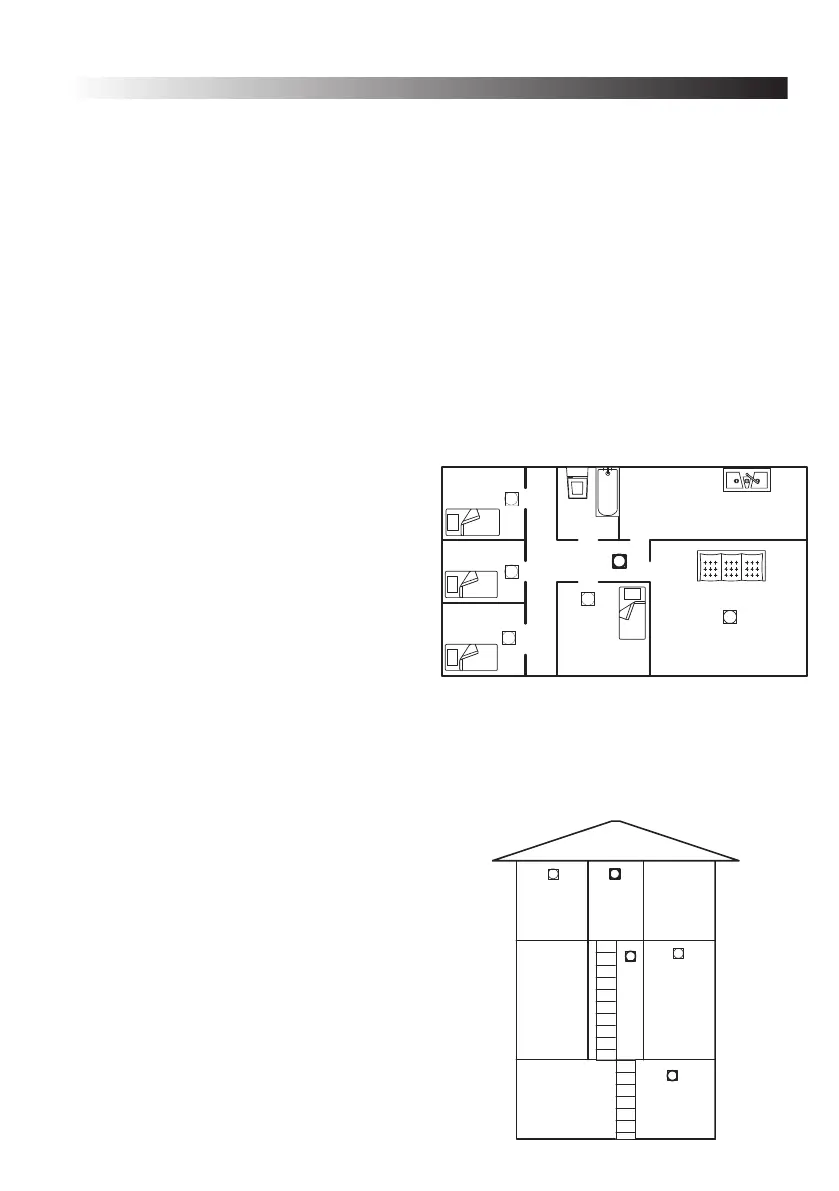
If your dwelling is on a single storey, for minimum
protection you should fit an alarm in the hallway
between the living areas (including kitchens) and the
sleeping areas. Place it as near to the living areas as
possible and ensure that alarm is audible when the
bedrooms are occupied. See Fig.1.
If your dwelling is multi-storey, for minimum
protection, one alarm should be fitted at the bottom of
the staircase with further alarms fitted on each upstairs
landing. This includes basements but excludes crawl
spaces and unfinished attics. See Fig. 2.
091029-1PA
S
S
S
S
S
S
S
S
S
S
S
Fig 1.
S
S
S
S
S
S
S
S
S
S
S
Fig 2.


 To Next Page
 Loading...