Installation Instructions & Care
10. Assemble the detector onto the base plate by
aligning the two projections on the base plate
with the two keyhole slots in the detector. Lock in
position by turning clockwise.
11. Insert the two tamper-proof tabs in the slots
provided in the side of the unit. Once fitted the
detector can only be removed from the base plate
by first removing these tabs, gently prising them
out with a screw driver.
12. Replace the circuit fuse and restore the power.
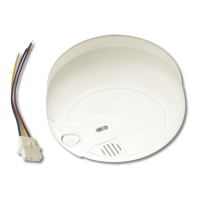
13. Test the correct operation of the smoke detector by
pressing the test button on the front of the detector,
the alarm should emit a loud pulsating alarm.
Operation
Once your smoke alarm has been installed a small
GREEN indicator light (LED) should be visible through
the detector grill indicating that the AC supply is
healthy. A RED indicator light (LED) should also flash
approximately once a minute to indicate that the battery
is healthy.
When smoke is detected, the unit will emit a loud
pulsating alarm and a RED indicator light (LED) will flash
quickly until the air is clear.
The “HUSH” feature can mute the detector if it has been
inadvertently triggered by holding down the test button
for a few seconds. The smoke alarm will be muted for
10 minutes and then reset into normal mode after this
period. Note: if the smoke density increases during this
time the smoke alarm will be triggered again.
Testing your smoke alarm
After installation and after reoccupation of the dwelling
following a vacation etc; check all alarms for correct
operation.
It is recommended that you test your smoke alarm once
a week to ensure the detector is working correctly.
Push and hold the test button for approximately 3
seconds. A loud pulsating alarm should sound and
a RED flashing indicator light (LED) can be seen to
indicate that the unit is functioning correctly.
Note: For multiple interconnected smoke alarms, test
each alarm in turn checking also that the alarm is
triggered on all other smoke alarms.
Maintaining your smoke alarm
If the smoke detector emits a short “beep” once a
minute the battery is at the end of its life and should be
replaced immediately. This low voltage warning will be
given for at least 7 days.
Warning: The use of batteries other than those
recommended on the back of the smoke alarm may be
detrimental to its operation.
Clean your smoke alarm regularly to prevent dust build
up. This can be done using a vacuum cleaner with the
brush attachment. Clean gently around the front grille
section and the sides.
Important
If there is any question as to the cause of an alarm it
should be assumed that the alarm is due to an actual
fire and the dwelling should be evacuated immediately.
In the event of fire
1. Leave the building as quickly as possible. Check
room doors for heat or smoke. Do not open a hot
door. Use an alternative escape route. Crawl along
the floor, if possible, breathe through a wet cloth or
hold your breath. Do not stop to collect anything.
2. Meet at a pre-arranged meeting place outside the
dwelling and check everybody is there.
3. Call the Fire Brigade immediately from outside
the building. The brigade should be summoned
regardless of the size of the fire and regardless of
whether there is a facility for transmission of alarms
to a remote manned centre.
4. Do not go back inside a burning building, wait for
the Fire Brigade to arrive.
Important safeguards
Installation of your smoke alarm is only one step in your
safety plan. Other important steps should be taken to
further improve your safety:-
• Install this smoke alarm properly, following this
instruction leaflet.
• Test your smoke alarm weekly.
• Replace the battery immediately once depleted.
• Do not smoke in bed.
• Keep matches and lighters away from children.
• Store flammable materials in a proper manner and
never use them near naked flames or sparks.
• Maintain emergency equipment such as fire
extinguishers, escape ladders etc. and ensure all
occupants know how to use them correctly.
• Plan an escape route(s) from your building in
advance and ensure all occupants are aware of
them. Re-enforce this awareness periodically
throughout the year.
• Make sure that escape routes remain free of any
obstructions.


 To Next Page
 Loading...