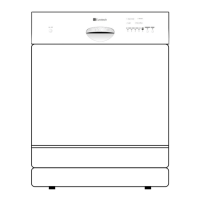
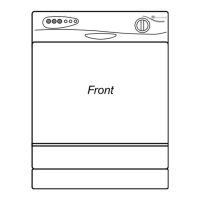
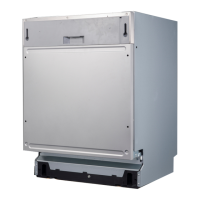
This document is an instruction manual for the Eurotech ED-ID14P Dishwasher, designed for domestic use.
Function Description
The Eurotech ED-ID14P is an automatic dishwasher with a capacity for 14 standard place settings. Its primary function is to clean and dry dishes, cutlery, and other kitchenware using various wash cycles. The dishwasher is designed to be connected to the water mains and uses specialized dishwasher detergents and rinse aids. It features both upper and lower baskets for loading, with adjustable height for the upper basket and folding racks in the lower basket to accommodate larger items. The appliance includes a filtering system to remove food particles from the wash water, ensuring efficient cleaning and preventing clogs. It also has a rinse aid dispenser to ensure thorough rinsing, spot-free, and streak-free drying.
Important Technical Specifications
- Model: ED-ID14P
- Capacity: 14 place settings
- Dimensions (W x D x H): 596mm × 558mm × 815mm
- Voltage Connected Load: See rating label (Power supply: 220-240V AC 50 Hz, socket specification: 12 A 250 VAC)
- Water Pressure: 0.04–1.0 MPa
- Hot Water Connection: Max 60 °C
- Wash Cycles:
- Intensive: For heavily soiled loads (pots, pans, casserole dishes with dried food). Pre-wash (40°C), Main wash (55°C), Rinse1, Rinse2, Hot rinse (65°C), Drying. Detergent: 5/27.5g. Time: 150 min. Energy: 1.35 kWh. Water: 20.0 L.
- Heavy: For heavy soiled loads (pots, plates, glasses, lightly soiled pans). Main wash (60°C), Rinse 1, Rinse 2, Hot rinse (65°C), Drying. Detergent: 5/27.5g. Time: 135 min. Energy: 1.25 kWh. Water: 16.0 L.
- Normal (AS/NZS 2007.1): For normally soiled loads (pots, plates, glasses, lightly soiled pans). Main wash (45°C), Rinse, Hot rinse (50°C), Drying. Detergent: 5/27.5g. Time: 113 min. Energy: 0.83 kWh. Water: 13.7 L. This is the test cycle for comparability.
- Rinse: For dishes that need to be rinsed and dried only. Pre-wash, Hot rinse (70°C), Drying. Detergent: /. Time: 67 min. Energy: 0.85 kWh. Water: 8.0 L.
- Rapid: A shorter wash for lightly soiled loads that do not need drying. Main wash (40°C), Hot rinse (50°C). Detergent: 20g. Time: 50 min. Energy: 0.60 kWh. Water: 8.0 L.
- Soak: To rinse dishes that are planned to be washed later. Pre-wash. Detergent: /. Time: 8 min. Energy: 0.07 kWh. Water: 4.0 L.
- Control Panel Indicators: Water supply indicator, Rinse Aid indicator light, Drying light, Program key-press, On/Off button.
- Safety Features: Hydrogen gas warning, proper use guidelines (e.g., loading sharp items, preventing plastic contact with heating element), electrical shock hazard warnings, overflow detection.
Usage Features
- Loading: Dishes should be loaded upside down or at a slant to allow water to run off. Items should be stacked securely without impeding spray arm rotation. Very small items should not be washed in the dishwasher. The lower basket should be emptied first, then the upper basket, to prevent dripping.
- Basket Adjustment: The upper basket's height can be adjusted without removing it from the machine, allowing for larger items in either the upper or lower section. The lower basket includes folding racks for accommodating pots and pans.
- Detergent Dispenser: The dispenser has markings for main wash (approx. 20g) and pre-wash (approx. 5g) detergent. Detergent should be added just before starting a wash cycle.
- Rinse Aid Dispenser: The rinse aid dispenser has adjustable settings (four or six, factory set to 5) to control the amount of rinse aid dispensed, ensuring optimal drying and preventing spots/streaks. The optical level indicator "D" shows the rinse aid level.
- Starting a Wash Cycle: Turn on the water supply, press the ON/OFF button, select the desired program, and close the door firmly.
- Changing a Program: A program can only be modified if it has been running for a short time. To change, open the door, press the program button for more than three seconds to cancel, then select a new program and close the door.
- Adding a Forgotten Dish: A dish can be added before the detergent cup opens by opening the door slightly to pause, waiting for spray arms to stop, adding the dish, and closing the door.
- End of Wash: The buzzer rings 6 times. Turn off the appliance and water supply, then open the door slightly and wait 15 minutes before unloading to allow dishes to cool and dry better.
- Not Suitable for Dishwasher: Items like wooden, horn, mother-of-pearl handles, heat-sensitive plastics, glued cutlery, pewter, copper, lead crystal glass, rusting steel, wooden platters, and synthetic fiber items are not suitable. Some glasses may dull, and silver/aluminum may discolour.
Maintenance Features
- Filter System: The filter system (coarse, flat/main, micro filters) should be inspected and cleaned after every use to remove food particles. The entire assembly should be cleaned once a week using a cleaning brush.
- Spray Arms: The spray arms should be cleaned regularly to prevent clogging from hard water chemicals. They can be removed by unscrewing the nut clockwise, washed with soapy water, and cleaned with a soft brush.
- Dishwasher Exterior: The control panel should be cleaned with a lightly dampened cloth. The exterior can be cleaned with appliance polish wax. Abrasive cleaners or sharp objects should not be used.
- Door Cleaning: The door edges should be cleaned with a soft, warm, damp rag. Spray cleaners, abrasive agents, or paper towels should not be used on the door panel to avoid damage or scratches.
- Seals: Periodic cleaning of the seals with a damp sponge helps prevent odors caused by trapped food.
- Holiday Care: If going on holiday, it's recommended to run an empty wash cycle, remove the plug, turn off the water supply, and leave the door slightly ajar to prevent odors and keep seals moist.
- Winterization (Protect Against Freezing): If the dishwasher is in an unheated place, the electrical power and water supply should be cut off, water drained from the inlet pipe and valve, and the filter removed with any remaining water in the sump.
- Troubleshooting Tips: The manual provides a comprehensive list of error codes (LED flashes) and common problems with possible causes and remedies, such as door open, water inlet/drainage malfunction, temperature sensor issues, overflow/leakage, heating element issues, cloudiness on glassware, yellow/brown film, noise, suds, stained interior, and not clean dishes/flatware.


 To Next Page
 General