Evco S.p.A. • Code 104K004E05 • page 3/6
CODE MEANING
Loc the key and/or operational setpoint are blocked (param-
eter r3), refer to paragraph 2.13
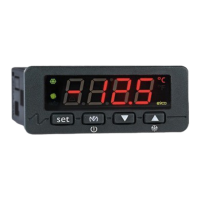
- - - - the quantity for display is not available (e.g. the probe is
absent)
7 ALARMS
7.1 Alarms
CODE MEANING
AL Minimum temperature alarm (HACCP alarm)
Remedies:
•check the alarm temperature
• check parameters A0, A1 and A2
Main consequences:
• if parameter A0 is set to 0 or if parameter P4 is set to 1 and
parameter A0 is set to 2, the device records the alarms
• if parameter u1 is set to 4, the alarm output will be acti-
vated
AH Maximum temperature alarm (HACCP alarm)
Remedies:
• check the alarm temperature
• check parameters A3, A4 and A5
Main consequences:
• if parameter A3 is set to 0 or if parameter P4 is set to 1 and
parameter A3 is set to 1, the device records the alarms
• if parameter u1 is set to 4, the alarm output will be acti-
vated
id Microport input alarm (HACCP alarm)
Remedies:
• check the causes which activated the input
• check parameters i0, i1 andi4
Main consequences:
• the outcome set by parameter i0
• if parameter i4 is set to 1, the device records the alarms,
providing parameter i2 is not set to -1
• if parameter u1 is set to 4, the alarm output will be acti-
vated
PF Power failure alarm (HACCP alarm)
Remedies:
• check the causes of the power failure
• press any key
Main consequences:
• the device records the alarm; see also parameter AA
• if parameter u1 is set to 4, the alarm output will be acti-
vated; pressing any key will also deactivate the alarm
output
iA Input malfunction alarm (only if parameter P4 is set to 3)
Remedies:
• check the causes which activated the input
• check parameters i5 and i6
Main consequences:
• if parameter i5 is set to 4, the device will continue to
operate as normal
• if parameter i5 is set to 5, the compressor will be switched
off
• if parameter u1 is set to 4, the alarm output will be acti-
vated
iSd Device blocked alarm (only if parameter P4 is set to 3)
Remedies:
• check the causes which activated the input malfunction
• switch the device off then on, or disconnect the power
supply
• check parameters i5, i6, i7, i8 and i9
Main consequences:
• the regulators will be switched off
• if parameter u1 is set to 4, the alarm output will be acti-
vated
COH Condenser overheating alarm (only if parameter P4 is set
to 3)
Remedies:
• check the condenser temperature
• check parameter C6
Main consequences:
• if parameter u1 is set to 4, the alarm output will be acti-
vated
CSd Compressor blocked alarm (only if parameter P4 is set to 3)
Remedies:
• check the condenser temperature
• switch the device off and then on again: if on switching
back on again the condenser temperature is still above
the value established by parameter C7, it will be neces-
sary to disconnect the power supply and clean the con-
denser
• check parameter C7
Main consequences:
• the compressor and evaporator fan will be switched off
• if parameter u1 is set to 4, the alarm output will be acti-
vated
When the cause that triggered the alarm has been resolved, the device
will restore normal operation, except for the following alarm states:
• the power failure alarm (code "PF") requiring that a key be pressed;
if parameter u1 is set to 4 (i.e. the service controlled by the fourth
output is the alarm output), pressing any key will also deactivate the
alarm output
• the device blocked alarm (code "iSd") which requires the device be
switched off or the power supply disconnected
• the compressor blocked alarm (code "CSd") which requires the
device be switched off or the power supply disconnected.
8 INTERNAL DIAGNOSTICS
8.1 Internal Diagnostics
CODE MEANING
Pr1 Cabinet probe error
Remedies:
• see parameter P0
• check probe integrity
• check probe-device connection
• check the cabinet temperature
Main consequences:
• the activity of the compressor will depend on param-
eters C4 and C5
• defrosting will never be activated
• if parameter u1 is set to 4, the alarm output will be acti-
vated
• if parameter u1 is set to 5 or 6, the fourth output will be
deactivated
Pr2 Evaporator probe error
Remedies:
• the same as for the previous case, but in relation to the
evaporator probe
Main consequences if parameter P4 is set to 0, 1, 2 or 3:
• if parameter P3 is set to 1, defrosting will last for the du-
ration established by parameter d3
• if parameter P3 is set to 1 and parameter d8 is set to 2, the
device will operate as though parameter d8 was set to 0
• if parameter F0 is set to 3 or 4, the device will operate as
though the parameter was set to 2
• if parameter u1 is set to 4, the alarm output will be acti-
vated
Main consequences if parameter P4 is set to 4 and if param-
eter d10 is set to 0:
• the same as for the previous case
Main consequences if parameter P4 is set to 4 and if param-
eter d10 is set to 1:
• the auxiliary probe (air off probe) will function as the
evaporator probe
• the defrost end temperature will depend on parameter
d11
• if parameter F0 is set to 3 or 4, the device will operate as
though the parameter was set to 2
• if parameter u1 is set to 4, the alarm output will be acti-
vated
Pr3 Auxiliary probe error (only if parameter P4 is set to 1, 2 or
4)
Remedies:
• the same as for the previous case, but in relation to the
auxiliary probe
Main consequences if parameter P4 is set to 1 or 2:
• if parameter u1 is set to 4, the alarm output will be acti-
vated
Main consequences if parameter P4 is set to 4:
• the activity of the compressor will depend on param-
eters C4 and C5
• defrosting will never be activated
• if parameter u1 is set to 4, the alarm output will be acti-
vated
rtc Clock error
Remedies:
• reset the date and time
Main consequences:
• if parameter d8 is set to 3, the device will operate as though
the parameter was set to 0
• functions relating to date and time will not be available
(Energy Saving, HACCP, etc ...)
• if parameter u1 is set to 4, the alarm output will be acti-
vated
When the cause of the alarm is resolved, the device restores normal
operation, except for clock errors (code "rtc") which require the date
and time to be reset.
9 TECHNICAL DATA
9.1 Technical data
Case: grey self-extinguishing.
Front panel protection classification: IP 65.
Connections (usare solo conduttori in rame): screw terminal
blocks (power supply, inputs and outputs), 6 pin connector (serial
port; by request), 4 pin connector (to remote indicator; by request);
spring extractable terminal blocks (power supply, inputs and outputs)
by request.
Operating temperature: from 0 to 55ºC (from 32 to 131ºF, 10 ...
90% relative humidity, without condensation).
Power supply: 12 VAC/DC (or 12-24 VAC/DC), 50/60 Hz, 3.5 VA
(approximate) or 115 ... 230 VAC, 50/60 Hz, 5 VA (approximate).
If the instrument is supplied at 115 ... 230 VAC, protect the power
supply with a fuse rated 250 V, 1.25 A, 6.7 I2t.
Insulation class: 2.
Maintenance of clock data in absence of power supply: 24
hours will battery fully charged.
Battery charge time: 2 minutes without interruptions (the battery
is charged by the device power supply).
Alarm buzzer: available by request.
Sensor inputs: 2 (cabinet probe and evaporator probe) for PTC/
NTC/Pt 1000 probes.
Digital inputs: 1 (microport) for NA/NC contact (clean contact, 5 V,
1 mA); fourth input can be configured as sensor input (display probe,
condenser probe or air off probe, for PTC/NTC/Pt 1000 probes) or
digital input (multifunction, clean contact, 5 V, 1 mA).
Sensor range: from -50.0 to 150.0ºC (from -50 to 300ºF) for PTC
probes, from -40.0 to 105.0ºC (from -40 to 220ºF) for NTC probes,
from -100 to 150.0ºC (from -145 to 300ºF) for Pt 1000 probes.
Sensitivity: 0.1ºC/1ºC/1ºF.
Digital outputs: 4 relays:
• compressor relay: 16 A res. @ 250 VAC,
5 FLA, 30 LRA (exchange contacts)
• defrost relay: 8 A res. @ 250 VAC, 2 FLA,
12 LRA (exchange contacts)
• evaporator fan relay: 8 A res. @ 250 VAC,
2 FLA, 12 LRA (NA contacts)
• fourth output: 8 A res. @ 250 VAC, 2 FLA,
12 LRA (exchange contacts).
The maximum permitted current on loads is 10 A.
Serial port: port for communicating with the monitoring system (by
means of a serial interface, via TTL, using the MODBUS communica-
tion protocol) or with the programming key; by request.
Other communication ports: port for communicating with the
remote indicator; by request.
PT • 46/10



 To Next Page
 Loading...