
 Need help?
Do you have a question about the Evenflo LiteMax DLX and is the answer not in the manual?
Provides essential safety warnings and product specifications for rear-facing use.
Explains the meaning of various safety symbols used in the manual.
Details weight, height, and head position requirements for rear-facing use.
Provides specific guidelines and recommendations for transporting premature infants.
Outlines limitations and warnings for using the child restraint, such as for travel only.
Warns against placing the restraint in the front seat due to air bag risks.
Advises on the safest seating positions within the vehicle.
Explains different types of seat belt retractors and their locking mechanisms.
Details seat belt security, limitations, and potential hazards.
Covers belt placement, armrest considerations, and occupant safety.
Explains the LATCH (Lower Anchors and Tethers for Children) system.
Provides rules and warnings for using LATCH connectors and storage.
Covers harness tightening, carrier safety, and prohibited uses.
Instructions for US customers on how to register for recalls.
Guidelines for using the restraint in vehicles and aircraft.
Identifies and illustrates the various components of the convenience base.
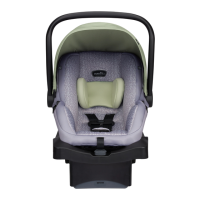
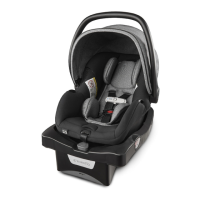
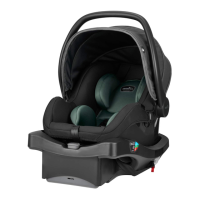
Identifies and illustrates the various components of the infant carrier.
Explains the different handle positions and their usage.
Describes the load leg's function in crash energy absorption and related warnings.
Provides illustrated steps for installing the load leg.
Details how to extend the load leg and check its secure position.
Illustrates the correct procedure for storing the load leg when not in use.
Specifies child weight and height requirements for base installation.
Checklist for securely installing the convenience base using lower anchor connectors.
Checks for child securement in carrier and base stability.
Provides critical warnings and rules for using the LATCH system.
Ensures proper connector engagement and checks for base movement.
Explains how to use the recline indicator for proper base leveling.
Initial steps for placing the base and checking its level using vehicle belts.
Instructions for using the Lock-Off feature to secure the seat belt.
Steps for securing the base using a lap/shoulder belt.
Steps for securing with lap belt and performing a final tightness check.
Instructions for placing the carrier into the base and checking its level.
Specifies correct handle positions for traveling with the carrier in the base.
Specifies child weight and height requirements for carrier-only installation.
Checks for proper child securement and carrier stability.
Instructions for placing the carrier on the vehicle seat and checking its level.
Steps for securing the carrier using only the vehicle's lap belt.
Steps for securing the carrier with a lap/shoulder belt and associated warnings.
Specifies correct handle positions for traveling with the carrier without the base.
Instructions for ensuring correct carrier level and recline without the base.
Specifies handle position for installing the carrier without base in aircraft.
How to adjust the headrest to the correct position for the child's shoulders.
Instructions for fastening harness straps and positioning the chest clip.
Guidance on how to properly tighten the harness straps for a snug fit.
Steps for releasing the chest clip and harness buckle.
Illustrates the different crotch strap positions available.
Detailed steps for moving the crotch strap anchor to a different slot.
Guide to selecting the correct waist strap slot based on child's size.
Instructions for repositioning the waist strap anchors.
Illustrates waist strap anchor placement for small and medium-sized babies.
Illustrates waist strap anchor placement for large-sized babies.
Steps for detaching the lower anchor connector clip.
Instructions for securely storing the lower anchor connector assembly when not in use.
Guidance on attaching the connector to the base posts for storage.
Explains carrier positions for stand and carry modes, emphasizing harness security.
FAA recommendations and importance of using a child restraint on aircraft.
Provides steps for rear-facing installation of the carrier in an aircraft seat.
Instructions on how to properly tighten and secure the aircraft seat belt.
Specifies correct handle position for installing the carrier without base in aircraft.
Detailed steps for attaching the canopy to the carrier.
Instructions for installing the harness covers.
Instructions for installing the buckle cover.
Step-by-step guide for removing the seat pad from the carrier.
Instructions for removing harness straps and crotch buckle.
Lists various replacement parts available for the product.
Provides instructions for cleaning plastic, metal, harness, and seat pad components.
Guidelines for properly disposing of the child restraint, including recycling.
Details the terms, conditions, and duration of the product warranty.
Guidance on where to store the owner's manual for future reference.
 General
| Dimensions | 27"D x 17"W x 24.5"H |
|---|---|
| Installation Type | Rear-facing and forward-facing |
| Harness Type | 5-point |
| LATCH System | Yes |
| Safety Features | Energy-Absorbing Foam |
| Harness System | 5-Point Harness |






 To Next Page