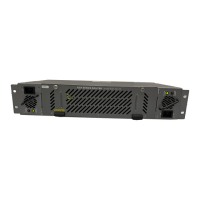
The EQT-1616-3G-C is a compact 1RU frame router designed for high-level integrated functionalities and routing of up to 16 input and 16 output 12Gbps signals. It features serviceable rear modules and sub-modules, making it a robust solution for mission-critical 24/7 applications.
Function Description:
The EQT-1616-3G-C utilizes format-independent data paths to support digital signals ranging from 1.5Gbps to 12Gbps. It is equipped with advanced hardware to facilitate integrated functionalities such as multiplexing single-link 4K to quad-link UHD and de-multiplexing quad-link UHD to single-link 4K. A key feature is its "Clean and Quiet Switching" capability, which provides seamless video and "popless" audio switching for all 16 outputs. This makes it suitable for master control UHD applications, functioning as a bypass router or a standalone master control router, supporting four quad-link 3G-SDI deterministically routed paths or 16 single-link 12G-SDI clean and quiet switching paths.
Another software-enabled feature is MADI (Multichannel Audio Digital Interface), which activates two auxiliary I/O ports dedicated to 64 channels of MADI audio. These channels can be shuffled into the 16 output video bus as embedded audio.
The router offers multiple control options:
- Local Control Panel: Physical buttons on the front panel (CP2402E) provide direct access to all crosspoints.
- Remote Control Panel: Allows remote access to all crosspoints via Ethernet or Serial connection.
- External Third-Party Control: The device can be controlled remotely by external systems, such as automation systems, via Ethernet, Serial, or GPIO control.
- Web Interface: A locally hosted web page provides monitoring, control, and configuration capabilities.
- VistaLINK® PRO: Offers comprehensive remote monitoring, control, and configuration via Simple Network Management Protocol (SNMP).
Important Technical Specifications:
- Configuration: Fixed at 16 inputs and 16 outputs.
- Redundant Protection: Features redundant power supplies.
- Video Inputs:
- Standards: SMPTE 292M, SMPTE424M, SMPTE 2082.
- Signal Level: 800mVp-p.
- Impedance: 75Ω terminating.
- Performance: Submodule and cable length dependent.
- Video Outputs:
- Signals Supported: SMPTE 292M, SMPTE424M, SMPTE 2082.
- Signal Level: 800mVp-p.
- Impedance: 75Ω terminating.
- Performance: Submodule dependent.
- Reference Timing:
- Switching Reference: Analog 525/625 bi-level looping.
- Connector: DIN 1.0/2.3.
- Signal Level: 1Vp-p ± 3dB.
- Impedance: 75Ω.
- Switching Line: Line 7 (HD/3G/12G).
- Control:
- Serial: 1x DB-9 Female (RS422/232).
- Ethernet: 2x RJ-45 (10/100Base-T).
- Protocols: Quartz, SNMP, Probel SW-P-02&08, GVG SMS7000.
- GPIO: Two 8-pin Phoenix connectors, dry contact only, opto-isolated GPI.
- Physical:
- Height: 1.75” (44.5mm) 1RU.
- Width: 19” (483mm) 19” Rack Mount.
- Depth (FP): 14.25” (362mm) over hinges and connectors.
- Weight: 3.4kg (7.5Lbs).
- Operating Temperature: 0°C to 40°C.
- Cooling: Fan-cooled, left to right.
- Electrical:
- Input Voltage: Auto-ranging 100-240V AC, 50/60Hz.
- Input Power: 130W 1R.
- Fuse Rating: T2AH250V fuses.
Usage Features:
- 12G Video Modules (EQT-MTR-12G-2): These multi-transceiver modules enable the passage of 12G video signals through the EQT, requiring the EQT-FK-12G feature key. Each module has two HDBNC input and two HDBNC output connectors.
- 3G Video Bypass Modules (+3GBP2): These modules ensure continuous 3G video signal flow even during power loss, automatically switching to a one-to-one route. Upon power restoration, previous routes are reinstated. Each module has two HDBNC input and two HDBNC output connectors. Both +3GBP2 and EQT-MTR-12G-2 modules can be used simultaneously.
- Clean & Quiet Switching (EQT-FK-CS): This feature, enabled by the EQT-FK-12G feature key, allows for seamless video and "popless" audio switching on all 16 outputs. It requires bi-level reference (NTSC or PAL) and synchronized signal sources (same standard and frequency, timed within ±1/2 line of reference). The device must be rebooted for changes to take effect.
- Clean Switch Audio: When set to 'Break-Away' mode, this allows independent audio shuffling between 256 channels of embedded/de-embedded audio and 64 channels of MADI audio (total 320 channels). 'Follow Video' mode routes embedded audio channels along with their respective video.
- Gearbox Functionality: Utilizes a two-sample interleave division method for converting quad-link 3G-SDI signals to single-link 12G-SDI and vice-versa (SMPTE 2082-10). This requires the EQT-FK-12G feature key and Clean Switch to be enabled. There are four configurable gearboxes, each affecting specific input/output port ranges for 12G-SDI pass-through.
- MADI Feature (EQT-FK-MADI): Activates 64 channels of MADI audio via two auxiliary I/O ports (AUX A and AUX B) on the rear. The EQT must be rebooted after enabling or disabling this feature.
- GPI and GPO: Two 8-pin Phoenix connectors provide programmable General Purpose Inputs (GPI) and General Purpose Outputs (GPO). GPIs are opto-isolated and can be powered externally or from the frame. GPOs are relay contacts, normally closed when power is off, and can be configured as normally open when power is on. GPIs can be configured for individual or encoded functions to trigger routes. GPOs can be individually encoded to trigger alarms (e.g., PSU Fault, Temperature Fault, Video Src Missing, Video Route Selected) or collectively to display source information.
- Network Configuration: IP addresses for both the router and control panel components can be set via Telnet through Ethernet or Serial connections.
- Firmware Upgrade: Firmware upgrades are performed via a web browser on the same network as the EQT, by uploading a
.img file. The device automatically reboots after the upgrade.
- MAGNUM Configuration: The EQT can be monitored and controlled by an Evertz MAGNUM server, allowing configuration of video and audio channels. Virtual ports can be configured for both video and MADI audio inputs/outputs, with specific audio levels assigned.
Maintenance Features:
- Unpacking and Inspection: Users are advised to carefully unpack, inspect for transit damage, and retain all packing material for potential future returns.
- Cable Support: It is crucial to properly support cables to prevent stress on connectors and extend their working life.
- Ethernet Link Monitoring: Each Ethernet connector has two LEDs (amber for 10/100Base-TX link detection and green for valid link/activity) to monitor connection status.
- System Monitoring: The EQT supports full signal monitoring for inputs and outputs, as well as comprehensive system monitoring including data rates and interior temperatures. Monitored data is available through VistaLINK® SNMP.
- Built-In Self Test: A tool for testing the functionality of various components (memory, Ethernet adapters). Note: Running these tests may interrupt device functionality and require a power cycle.
- SYSLOG Configuration: Menu for setting logging options for debugging purposes.
- SNMP Trap Destinations: Allows configuration of IP addresses for SNMP trap destinations, enabling remote alarm notifications.
- Reboot Functionality: A dedicated button/option in the web interface and VistaLINK® allows for device reboot. Many configuration changes require a reboot to take effect.

 Need help?
 General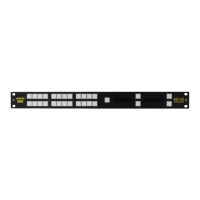

 To Next Page