Air Conditioner Service Manual
17
Operation Safety
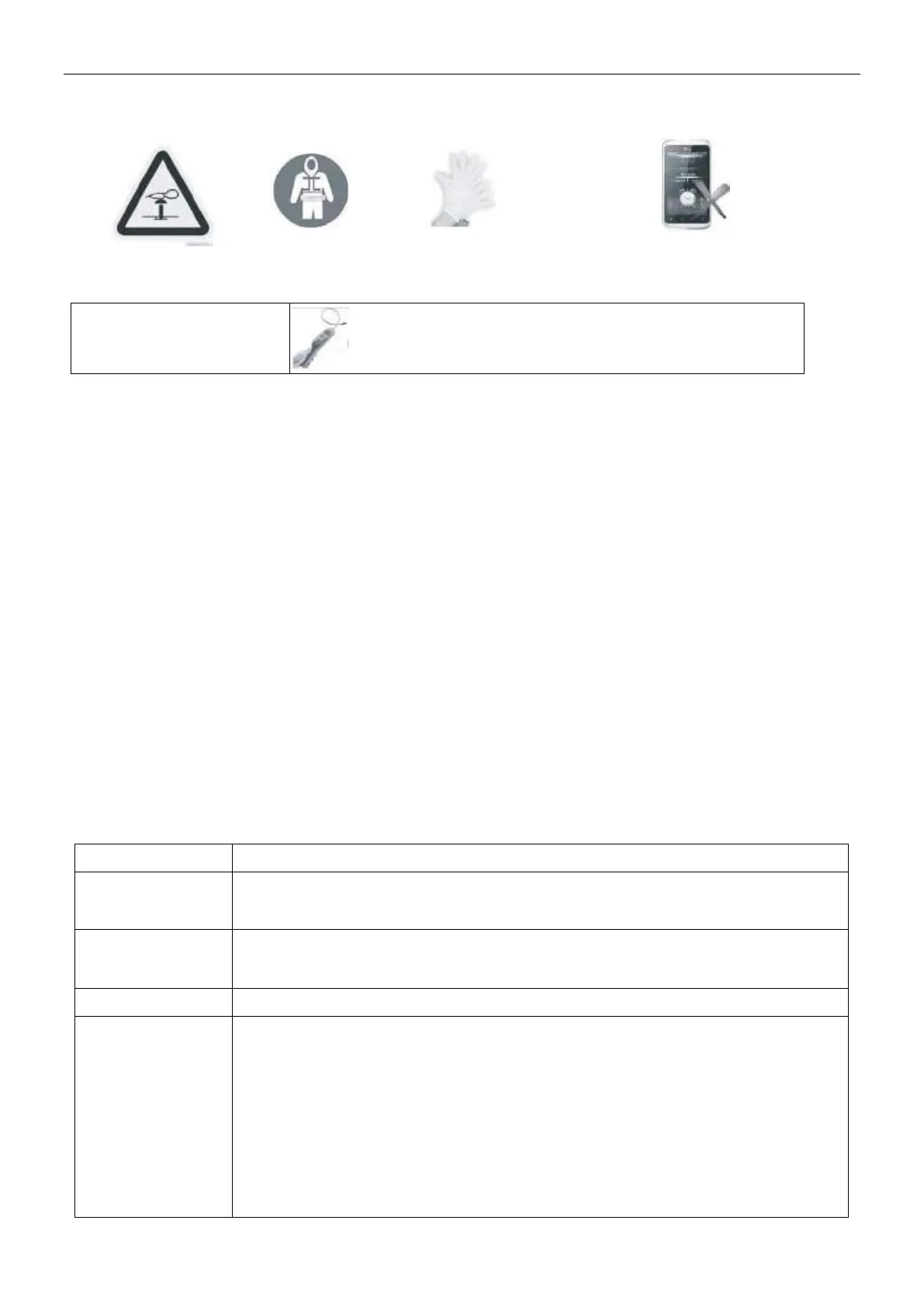
Open Flames Prohibited
Mind Static Electricity Must wear protective clothing and anti-static gloves Don`t use mobile phone
Installation Safety
Caution:
The installation should be in a well-ventilated condition location.
When you installing or maintaining an air conditioner using Refrigerant R32/R290, the location should be
free fire from open or any other goods temperature higher than 370℃ for R290/548℃for R32 which easily
produces open fire include welding, smoking, drying oven.
When installing an air conditioner of R32/R290, it is necessary to take appropriate anti-static measures
such as wear anti-static clothing and gloves.
It is necessary to choose the location for installation or maintenance where in the air inlets and outlets of
the indoor and outdoor units should be not surrounded by obstacles or close to any heat source or
combustible and/or explosive environment.
If the indoor unit suffers refrigerant leak during the installation, it is necessary to immediately turn off the
valve of the outdoor unit and all the personnel should go out till the refrigerant leaks completely for 15
minutes. If the product is damaged, it is a must to carry such damaged product back to the maintenance
station and it is prohibited to weld the refrigerant pipe or conduct other operations on the user’s site.
It is necessary to choose the place where the inlet and outlet air of the indoor unit is even.
It is necessary to avoid the places where there are other electrical products, power switch plugs and
sockets, kitchen cabinet, bed, sofa and other valuables right under the lines on two sides of the indoor unit.
Special tools:
A) The maintenance site should be equipped with a fixed-type combustible
refrigerant concentration detector and connected to a safeguard alarm system;
its error must be not more than 5%.
B) The installation site should be equipped with a portable combustible refrigerant
concentration detector which can realize two-level audible and visual alarm; its
error must be not more than 10%.
C) The concentration detectors should be calibrated regularly.
D) It is necessary to check and confirm the functions before using the concentration
detectors.



 To Next Page