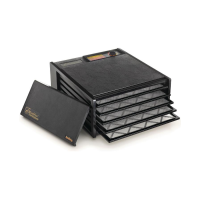
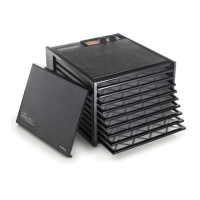
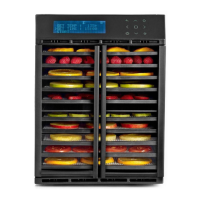
Wash produce before drying. Blot off excess water. Load trays with food that is sliced
evenly. As a tray is loaded, place it on the dehydrator to begin drying. During the drying
process, we suggest rotating the trays halfway thru the drying cycle.
PRETREATING
Pretreating food is not an essential procedure. However, pretreating will help maintain:
Color: reduces oxidation of foods such as apples and potatoes keeping them from turning
brown.
Nutrients: helps retain the minimal loss which tends to occur during the drying process.
Texture: lessens the chance for fiber deterioration in produce.
There are basically two types of pre-treatment, dipping and blanching.
DIPPING
Used primarily to prevent fruits or vegetables from oxidizing. The following are pre-treatment dips:
Sodium Bisulfite: When mixed with water, sodium bisulfite is a liquid form of sulfur. It is the
most effective and least expensive anti-oxidant. Use only a food-safe grade of sodium
bisulfite that is made especially for dehydration. If subject to sulfur allergic reactions, check
with your physician before using Sodium Bisulfite as a dip. For Fruits, mix 1 1/2 tablespoons
of Sodium Bisulfite in one gallon of water. Soak fruit slices for 5-10 minutes. Rinse. For
Vegetables, recommended for steam blanching only. Add 1 teaspoon Sodium Bisulfite
to 1 cup of steaming water and blanch. This is particularly recommended for vegetables
to be stored in excess of three months.
Ascorbic Acid-Citric Acid Dip: is simply a form of vitamin C. Citric acid. Soak the prepared
produce in a solution of 2 tablespoons of powder to 1 quart of water for 2 minutes.
Fruit Juice Dip: Citrus juices, such as pineapple, lemon or lime, may be used as a natural
anti-oxidant. Stir 1 cup of juice into 1 quart of lukewarm water and soak for 10 minutes.
BLANCHING
Done either in boiling water or by steaming the foods. This method is most effective on
tough-skinned fruits (sometimes having natural protective wax coating) such as grapes,
plums, cranberries, etc. By boiling fruits in water for 1 to 2 minutes, the skin “cracks” and
allows the moisture to more readily escape, thus the drying time is faster.
Water Blanch: Bring a pot of water to a boil and stir the food directly into the boiling water.
Cover and blanch for approximately 3 minutes. Remove food from the boiling water and
place it into ice water to cool. Blot with a towel to remove excess water before drying.
Steam Blanching: Using a pan-type steamer, fill the lower portion with 2 inches of water.
Fill upper section with food. Let the water rapidly boil approximately four minutes. Remove
food and place it into ice water to cool. Blot with a towel to remove excess water before
drying.
Electric Steamers: Electric steamers are perhaps the best means for blanching. Follow the
set guidelines provided in your electric steamer’s operating manual for blanching fruits
and vegetables.
DRYING BASICS
4


 To Next Page