Werner Schnorrenberg - DC4KU www.dc4ku.darc.de 06.11.2021
8
The level measurement accuracy in "dBm" of the 16-bit SunSDR2 DX is exceptionally good and is not
comparable with any other receiver I know. The maximum error is +/- 0.5 dB over a range of 110 dB.
With this extremely high accuracy, the SunSDR2 DX can also be used as a spectrum analyzer or as a
measuring receiver.
Sideband Noise and Reciprocal Mixing Dynamic Range
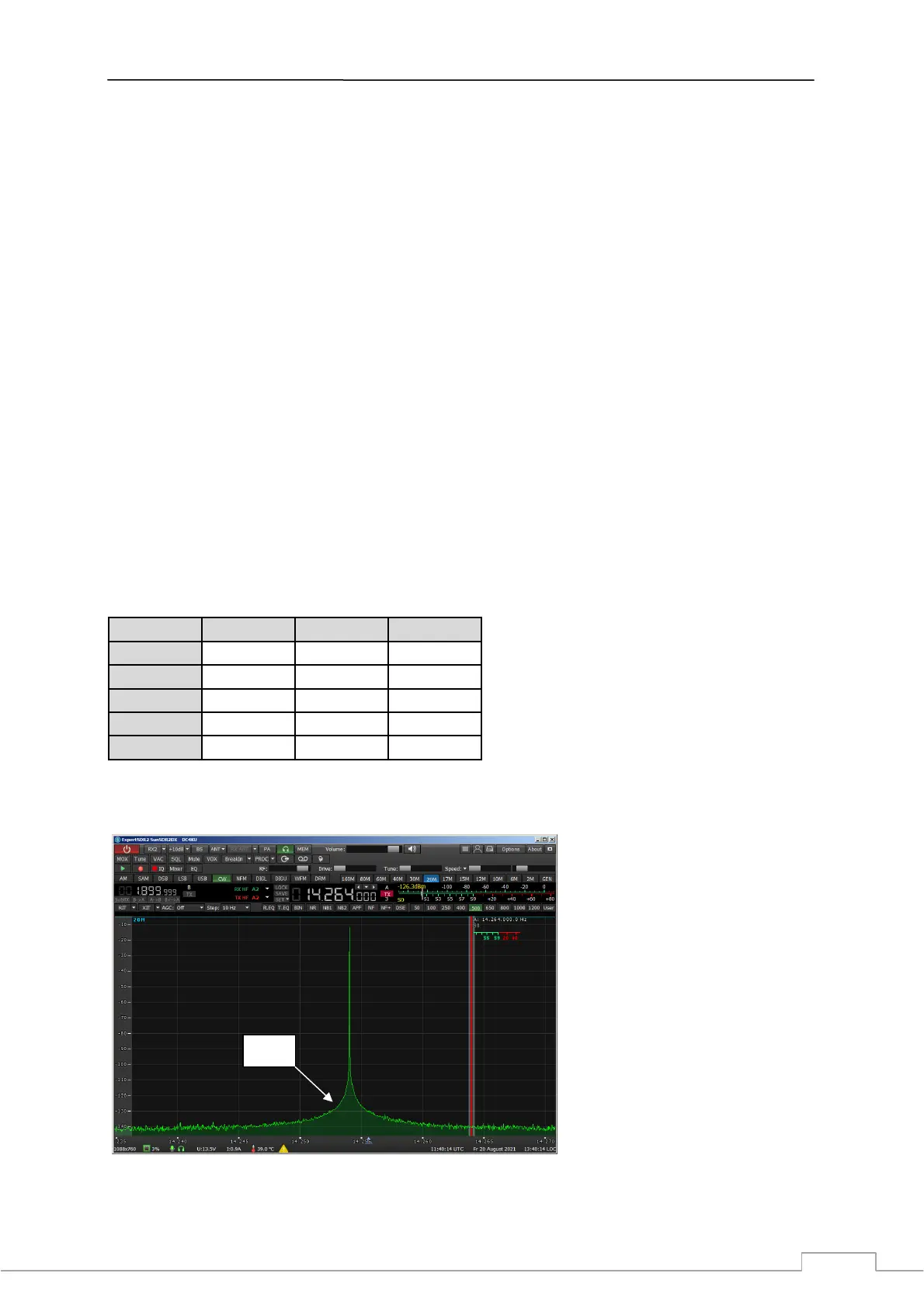
Sideband noise (SBN) and Reciprocal Mixing Dynamic Range (RMDR) are among the most important
characteristics of a receiver (Fig. 16, 17). In direct sampling SDRs, SBN is mainly caused by time
jittering of the ADC clock and in analogue receivers by frequency jittering of the heterodyne
oscillator. Small signals near larger signals can be masked by sideband noise, causing the receiver to
lose sensitivity and dynamic range. The loss of dynamic range is called "Reciprocal Mixing Dynamic
Range (RMDR)". Therefore: The higher the RMDR and the smaller the SBN, the better the receiver.
The SBN measurement is made with a low-noise OCXO at 14.2454MHz. The level of the OCXO is
increased at a distance of 1 to 10 kHz from the receiving frequency until the background noise (SBN)
increases by 3dB. From this, SBN and RMDR are calculated as follows
SBN = Pi - MDS + 10logB
with Pi= input level, B=500Hz and MDS = -133dBm/500Hz
and
RMDR = Pi -MDS
Delta f kHz Pi dBm SBN dBc/Hz RMDR dB
1 -38 -120 95
2 -16 -138 111
3 -15 -141 114
4 -14 -144 117
5 -13 -146 119
Table 4: SBN and RMDR at carrier spacing from of up to 5 kHz
Figure 16: Visible receiver sideband noise at Pi = -10dBm (S9 +63dBm)
SBN


 To Next Page