Werner Schnorrenberg - DC4KU www.dc4ku.darc.de 06.11.2021
9
120
130
140
150
12345
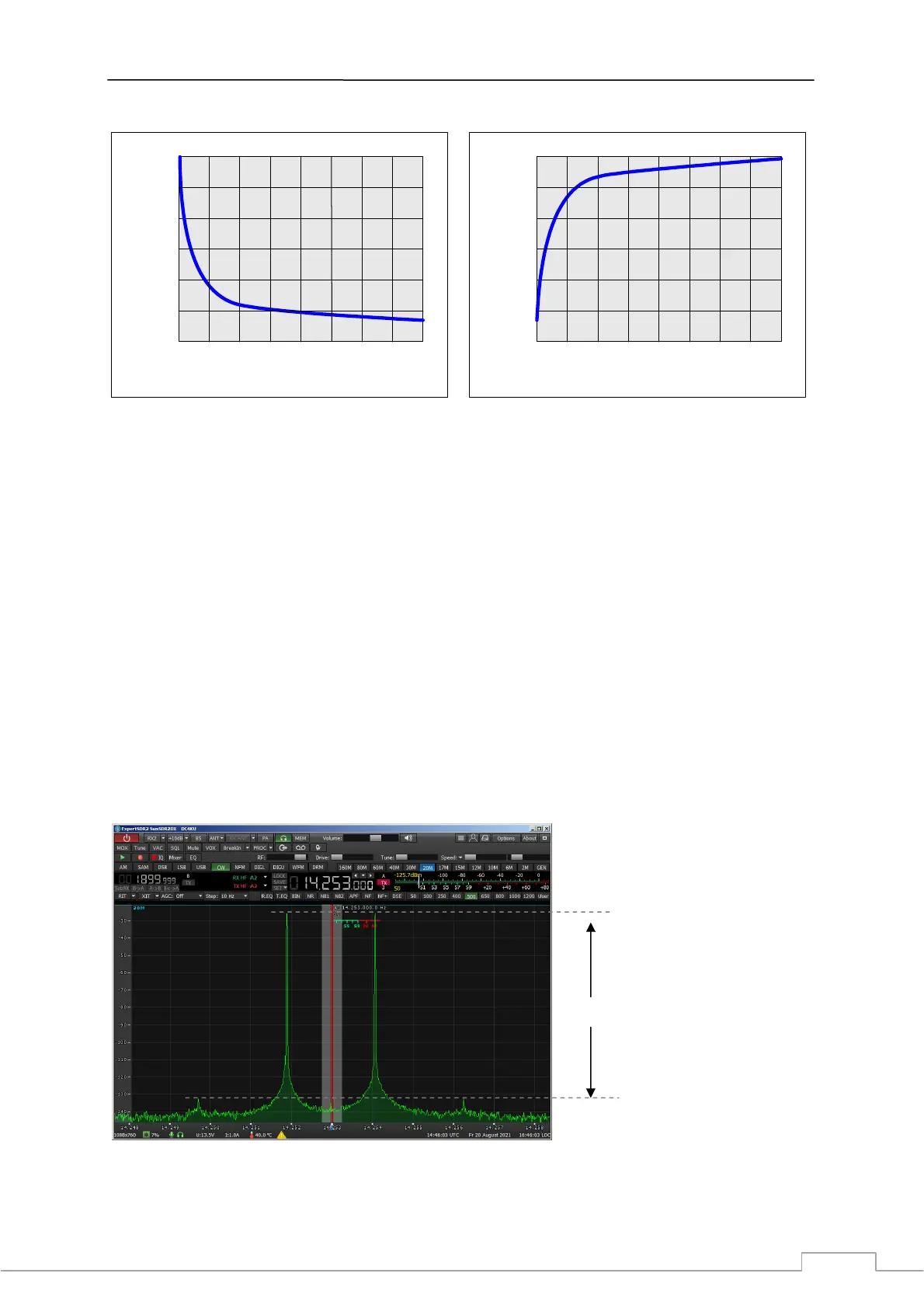
Frequenz-Offset (kHz)
Phase Noise (dBc/Hz)
SBN
120
110
100
90
12345
Frequenz-Offset (kHz)
RMDR (dB)
RMDR
Figure 17: Phase noise and RMDR curves
Intermodulation 3rd order, DR3
To test DR3 (Dynamic Range 3rd order), the receiver is driven with two RF signals of equal magnitude
and the 3rd order intermodulation products at 2xf1-f2 and 2xf2-f1 are measured simultaneously.
Therefore the level (Pi) of the 2-tone signal is gradually increased and the resulting 3rd order
intermodulation is noted, up to the limitation of the receiver (Fig. 19). The DR3 is calculated to
DR3 = Pi - MDS.
In difference to analog receivers, the IMD3 interference products of direct sampling SDRs do not
increase with signal magnification at triple speed, but remain near the noise floor and only increase
massively shortly before limiting the ADC. The highest distortion-free dynamic range therefore occurs
at maximum gain of the ADC, in the so-called sweet spot. With +10dB pre-amplification and switched
on BP-Filters the SunSDR2 DX develops its best dynamics. At a level of Pi=2x-25dBm (2xS9+48dB) the
largest DR3 of -25dBm - (- 131dBm) = 106dB (sweet spot) is produced (Fig. 18). With further signal
enlargement the ADC then comes into its limitation (clipping).
Settings: f1=14.100MHz, f2=14.102MHz, CW, B=500Hz, Preamp on, Dither/Random on
Bild 18: Maximaler IMD3-Abstand, kurz vor Clipping: 106dB
IMD3 = 106dB
-Pi= 2 x -25dBm
-131dBm


 To Next Page