Need help?
Do you have a question about the Express Water Whole House and is the answer not in the manual?
Covers turning off main water, electric, and gas water heaters before installation.
Connecting pipes and fittings, then slowly turning the main water valve back on.
Flushing the system with cold water, observing for leaks, and understanding initial cloudiness.
Steps to safely shut off the water supply before filter replacement.
Using the pressure release button to relieve pressure in the filter housing.
Guidance on correctly placing O-rings, aligning filters, and tightening housings.
Turning water supply back on, checking for leaks, and flushing new filters.
This document is an installation and maintenance manual for a 3-Stage Whole House Water Filtration System from Express Water. The system is designed to provide clean water for an entire home by protecting appliances and plumbing from major contaminants.
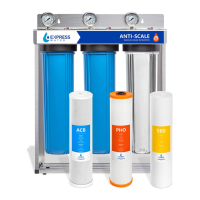
The Express Water 3-Stage Whole House System is a comprehensive water filtration solution that treats all incoming water to a home before it reaches any faucets or appliances. Its primary function is to remove various contaminants from the water supply, ensuring cleaner water for drinking, bathing, laundry, and other household uses. The system utilizes a multi-stage filtration process, typically involving a sediment filter, a granular activated carbon (GAC) filter, and an activated carbon block (ACB) filter, though other filter types are available for specific needs like heavy metal reduction or anti-scale treatment.
The system operates by directing the incoming water through these three distinct filter cartridges. Each stage is designed to target different types of impurities. The first stage, often a sediment filter, removes larger particles such as sand, silt, rust, and scale, which can clog plumbing and damage appliances. The subsequent stages, typically carbon-based filters, are responsible for reducing chlorine, chloramines, volatile organic compounds (VOCs), pesticides, herbicides, and other chemicals that can affect water taste, odor, and clarity. By filtering water at the point of entry to the home, the system ensures that all water used throughout the house is treated, offering protection for water heaters, dishwashers, washing machines, and other water-using appliances, thereby potentially extending their lifespan and improving their efficiency.
The system is designed for installation on the main water supply line after it enters the home but before it branches off or reaches the hot water heater. This strategic placement ensures that all water, both hot and cold, is filtered. The manual emphasizes the importance of professional installation, especially if the feed water pressure is prone to spikes or exceeds 80 PSI, in which case a pressure protection or reducer valve is recommended. The system does not remove biological contaminants, and for biologically unsound water, a UV light is suggested as an additional filtration option.
The Express Water 3-Stage Whole House System is designed for straightforward operation once installed. The system includes pressure gauges that allow users to monitor the water pressure, which is a key indicator for filter replacement. A noticeable drop in pressure (typically 10-12 PSI from the initial pressure) signals that the filters are becoming clogged and need to be changed.
An important feature highlighted in the manual is the ability to change the direction of water flow through the system. This flexibility allows the system to be adapted to different plumbing setups, ensuring compatibility with various home configurations. The process involves unscrewing filter housings, disconnecting and rotating the black housing caps 180 degrees, and then reattaching them, effectively reversing the inflow direction. This adaptability is crucial for ensuring proper installation regardless of the existing plumbing layout.
For maintenance and continuous water supply, the manual suggests an optional bypass setup. While not supplied by Express Water, this setup, involving additional piping and valves, allows water to bypass the filtration system during maintenance, ensuring that the home's water supply is not interrupted when filters are being changed or the system is being serviced.
The system is built for durability, with a robust mounting bracket and housings designed to withstand typical household water pressures. The recommended operating conditions are a feed water pressure of 20-80 PSI and a temperature range of 40-100 °F. The system must be installed in a sheltered, level, and dry environment, protected from extreme hot or cold weather, direct sunlight, and freezing temperatures, to ensure optimal performance and longevity.
Maintaining the Express Water 3-Stage Whole House System primarily involves regular filter changes and periodic housing cleaning. The manual provides clear instructions for these tasks, making them manageable for homeowners.
Filter Replacement: Each filter cartridge has an estimated lifespan of 6 months or up to 100,000 gallons of water, though this can vary based on water quality, temperature, and pressure. The manual advises replacing filters when a significant drop in water pressure is observed. The filter change process begins by turning off the main water supply to the system and depressurizing the plumbing by opening the nearest faucet until flow stops. A red pressure release button on the system helps in preparing for water discharge. The filter housings are then unscrewed using a filter housing wrench.
Once the old filters are removed and discarded, the manual recommends cleaning the filter housings annually. This involves scrubbing the inside of the housing and the top manifold with a mixture of warm water and a small amount of household bleach, followed by thorough rinsing. This cleaning helps prevent the buildup of dirt and grime and maintains the system's hygiene.
O-Ring Maintenance: During filter changes, the o-rings may come loose. The manual instructs users to carefully remove the o-ring, apply silicone grease to it, and then set it back in place before reattaching the housings. Gasket lubricant should also be applied to the threads of each filter housing to ensure a proper seal and ease of future removal.
Filter Alignment: When inserting new filters, it's crucial to ensure they are correctly aligned and facing the proper direction. Specifically, for carbon-based filters (ACB, GAC, KDF, or PHO), the silicone o-ring should face the top of the system. After inserting the filters, the housings are tightened by hand, followed by a slight additional turn with the filter housing wrench (a fourth to a half turn) to ensure a secure, leak-free connection without over-tightening.
System Start-up and Flushing: After replacing all filters and reattaching the housings, the water supply to the system is slowly turned back on. The system will fill with water, and users should check for any leaks at connection points and o-rings. The manual then details a crucial flushing procedure: running the closest cold water faucet to flush out loose carbon particles and air bubbles. The water may initially appear blackish or cloudy, which is normal. This flushing should continue until the water runs clear, followed by an additional 5 minutes, then a 30-minute wait, and another 10-minute cold water flush. This ensures the system is properly primed and the water is ready for use.
Ongoing Monitoring: The manual also advises occasional checks for leaks during the first week of use to ensure all connections remain stable. It also notes that slight cloudiness due to air bubbles may persist for up to a week of regular use, which is harmless. Finally, users are reminded to turn their water heater back on after completing the maintenance.
 General
| Filtration Capacity | 100, 000 gallons |
|---|---|
| Flow Rate | 15 GPM |
| Inlet/Outlet Size | 1 inch |
| Filter Life | 6-12 months |
| Micron Rating | 5 microns |
| Operating Temperature | 40-100°F |
| Connections | NPT |

 To Next Page