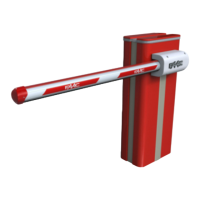
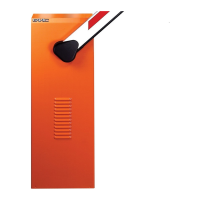
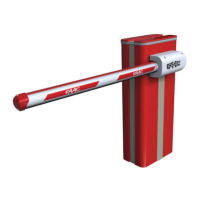
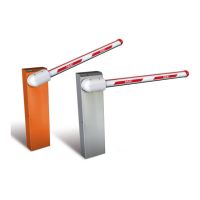
The device described in this manual is the Barrier MHTM™ MicroDrive, a series of automated barriers designed for various access control applications. These barriers are manufactured by MAGNETIC Autocontrol GmbH.
Function Description
The Barrier MHTM™ MicroDrive system is primarily used for regulating vehicle and pedestrian access in different environments, including toll booths, parking facilities, and general access points. The system operates by raising and lowering a boom arm to permit or deny passage. The "MicroDrive" designation likely refers to a compact and efficient drive mechanism, contributing to its performance and reliability.
The manual outlines several variants of the barrier, each tailored for specific applications:
- ACCESS PRO H: Designed for general access control, likely in high-traffic areas given the "PRO H" designation.
- ACCESS: A standard access control barrier.
- ACCESS PRO: An enhanced version of the ACCESS barrier.
- ACCESS SELECT: Another variant for access control, possibly offering more selective features.
- PARKING: Specifically designed for parking management systems.
- PARKING PRO: An advanced version of the PARKING barrier.
- PARKING SELECT: A selective parking barrier.
- TOLL: Optimized for toll collection points.
- TOLL PRO: A professional-grade toll barrier.
- TOLL HIGH SPEED: Designed for rapid operation in high-speed toll lanes.
The core function involves the automated movement of a boom arm, controlled by an internal drive system and external commands (e.g., card readers, loop detectors, or manual input). The system is designed to be robust and reliable for continuous operation.
Important Technical Specifications
While detailed electrical and performance specifications are not fully elaborated in the provided excerpts, several key dimensions and installation requirements are mentioned:
Dimensions (Installation Footprint):
- Minimum wall clearance: 500 mm on both sides of the barrier housing.
- Minimum rear clearance: 800 mm.
- Foundation width: 600 mm.
- Foundation depth: Not explicitly stated, but the diagram for foundation setup shows a depth for the mounting bolts.
- Housing height (ACCESS PRO H): 1115 mm from the base to the top of the housing.
- Boom pivot height (ACCESS PRO H): Approximately 875 mm from the base to the boom pivot point, with the top of the boom at 925 mm.
- Housing height (ACCESS / PARKING): 915 mm from the base to the top of the housing.
- Boom pivot height (ACCESS / PARKING): Approximately 675 mm from the base to the boom pivot point, with the top of the boom at 925 mm.
- Housing height (TOLL): 1115 mm from the base to the top of the housing.
- Boom pivot height (TOLL): Approximately 875 mm from the base to the boom pivot point, with the top of the boom at 910 mm.
Boom Lengths (A):
- ACCESS PRO H: Available in 3500 mm, 4500 mm, 5000 mm, and 6000 mm lengths.
- ACCESS / PARKING:
- Access: 3500 mm
- Access Pro: 3500 mm
- Access Select: 3500 mm
- Access L: 6000 mm
- Access Pro L: 6000 mm
- Access Select L: 6000 mm
- Parking: 3500 mm
- TOLL:
- Toll: 3000 mm
- Toll Pro: 3000 mm
- Toll HighSpeed: 2000 mm, 2500 mm, 3000 mm
- Toll HighSpeed 2: 1500 mm
Electrical Connection:
- Voltage: 230 V AC / 50 – 60 Hz.
- Cable requirements: Specific wiring diagrams are provided, indicating the need for appropriate gauge wires (e.g., 20 mm, 30 mm, 8 mm). A warning for "Electrical voltage!" is prominently displayed, emphasizing safety during connection.
Environmental Conditions:
- Foundation stability: The foundation must be able to withstand forces, indicated by a requirement for "< 2 mm/m²" (likely referring to maximum permissible movement or deflection under load, though the unit seems unusual for this context, it might refer to surface evenness or stability).
Usage Features
The Barrier MHTM™ MicroDrive is designed for user-friendly operation and integration into various access control systems.
- Versatility: The different models (ACCESS, PARKING, TOLL) cater to a wide range of applications, from standard entry/exit points to high-speed toll lanes.
- Left/Right Version: The barrier can be configured as a left or right version, allowing for flexible installation depending on the site layout. This is crucial for optimizing traffic flow and visibility.
- Boom Types: The manual illustrates different boom types, including MicroBoom, VarioBoom, and MicroBoom-T, which likely offer varying levels of robustness, visibility, or specialized features (e.g., break-away functionality, integrated lighting).
- Warning Signs: The inclusion of warning signs (pedestrian, cyclist, motorcyclist) indicates a focus on safety, ensuring that all users are aware of the barrier's operation and potential hazards. These signs are to be sticked on the boom arm.
- Service Mode: The system features a "Service Off" mode, which is essential for safe maintenance and installation procedures, preventing unintended operation.
- Boom Assembly: The boom assembly process is detailed, including specific instructions for attaching the boom arm to the barrier housing. For ACCESS PRO H and ACCESS/PARKING, this involves securing the boom with screws and applying water for lubrication during assembly. Specific torque values (12 Nm for M8 x 16 screws) are provided for secure fastening.
- Crushing Danger: Multiple warnings about "Danger of crushing!" are present, particularly during boom assembly and alignment, highlighting the importance of safety precautions during installation and maintenance.
Maintenance Features
The manual provides instructions for several maintenance-related tasks, emphasizing safety and proper procedure.
- Required Tools: A comprehensive list of required tools is provided, including impact drills, saws, silicone cartridges, various wrenches (open-face, torque, Torx, hexagon socket), Phillips screwdrivers, and diagonal pliers. This ensures that technicians have the correct equipment for installation and maintenance.
- Foundation and Housing Installation: Detailed steps are given for setting up the foundation and installing the barrier housing, which is a critical initial maintenance/installation step. This includes drilling holes for mounting bolts and securing the housing.
- Transport Protection Removal: Instructions for removing transport protection indicate that the device is shipped with protective elements that must be removed before operation, a standard pre-operational maintenance step.
- Electrical Connection: Clear diagrams and warnings are provided for electrical connection, which is a key aspect of both installation and troubleshooting.
- Boom Alignment: The manual includes instructions for aligning the barrier boom, which is crucial for smooth and safe operation. This involves checking the upper and lower tool bores for opening and closing the barrier, and using a level to ensure proper horizontal alignment.
- Adjusting Balancing Springs: A dedicated section (Chapter 10) is for adjusting the balancing springs. This is a critical maintenance task to ensure the boom operates smoothly and with minimal strain on the motor, contributing to the longevity of the system. The manual refers to "operating instructions, chapter 'Check and set the balancing springs in the lever system'" for detailed guidance.
- Start-up Procedure: A "Start up barrier" section (Chapter 12) indicates a defined process for bringing the barrier into operational status after installation or maintenance, likely involving checks and initial configuration.
Overall, the Barrier MHTM™ MicroDrive is presented as a versatile, robust, and safety-conscious access control solution, with clear instructions for installation, operation, and maintenance.

 Need help?
 General

 To Next Page