
 Need help?
Do you have a question about the FALMEC Downdraft Series and is the answer not in the manual?
Overview of the installation process for Falmec downdraft hoods.
Specific instructions and diagrams for installing the hood with a back motor.
Covers initial steps like recess hole dimensions and fixing to support.
Steps to configure the KACL.784 model with a front motor.
Steps to configure the KACL.784 model with a back motor.
Instructions for installing the optional carbon-zeolite filter.
Replacing the inlet and securing the motor for front exhaust.
Adjusting the direction of air exhaust for the KACL.798 model.
Steps for configuring the KACL.798 model with a back motor.
Guidance on using rectangular and round pipes for remote motor setup.
Instructions for connecting onboard and remote motors to power.
General safety instructions and warnings for users and installers.
Key warnings for installers, users, intended use, and cleaning.
Covers installation requirements, technical features, and positioning.
Explains safe electrical hookup procedures and compliance.
How to operate the hood, select speeds, and use timer functions.
Description of the control panel indicators and their meanings.
Instructions for external exhaust and internal recirculation systems.
How to use the radio control and important operational warnings.
Procedures for creating new codes and restoring default codes for the radio control.
Guidelines for cleaning external surfaces, internal parts, and filters.
Specific instructions for metal anti-grease and carbon-zeolite filters.
Guidance on proper disposal of the appliance at the end of its useful life.
Details of the 5-year parts and labour warranty and exclusions.
Covers warranties for outdoor use, remote motors, and installation requirements.
Contact information for warranty inquiries and customer support.
This document serves as an installation and user manual for Falmec downdraft rangehoods, emphasizing quiet and powerful performance. It covers various aspects from initial setup to maintenance and warranty information, ensuring users can effectively install, operate, and care for their appliance.
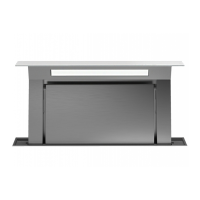
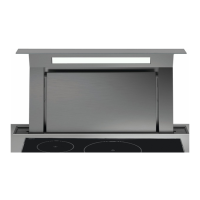
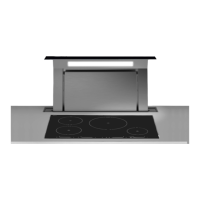
The Falmec downdraft rangehood is designed to extract fumes and vapors generated during cooking in non-professional domestic kitchens. It operates by drawing air downwards, effectively removing cooking by-products from the kitchen environment. The rangehood can be configured with either a front or back motor, and also supports remote motor installations for greater flexibility in kitchen design and noise reduction.
For air discharge, the rangehood offers two primary configurations: external exhaust (suction) and internal recirculation (filtering). In the external exhaust mode, fumes and vapors are discharged outside through a dedicated exhaust pipe. This setup requires the outlet fitting to be connected to an external output, with specific guidelines for pipe diameter, slope, and length to ensure optimal performance and prevent condensation. For internal recirculation, the air passes through carbon-zeolite filters to be purified before being recycled back into the environment. This configuration is ideal for kitchens where external venting is not feasible.
The rangehood features a touch pushbutton panel for control, offering multiple speed settings, a light on/off function, and a timer. The speed settings range from maintaining clean air with low electricity consumption to rapid disposal of strong odors and vapors. A 24-hour cycle function allows for intermittent operation (1 hour on, 3 hours off) to maintain air quality over extended periods. The timer function enables auto switch-off after 15 minutes, ensuring that the hood continues to operate for a short period after cooking to clear residual odors.
For maintenance, the rangehood includes a filter alarm that indicates when the anti-grease filters require cleaning. It also has a mechanism to open the hood for maintenance, which is activated by pressing a specific button for over 3 seconds when the hood is closed.
The downdraft rangehood is designed for intuitive and convenient use. The touch pushbutton panel provides clear controls for all functions. Users can easily switch the motor on/off, select one of four speeds, and control the lighting. The speed settings are tailored for different cooking intensities, from light cooking to heavy frying with strong odors.
The 24-hour cycle is a useful feature for continuous air purification, especially in open-plan living spaces or when lingering odors are a concern. The timer function adds convenience, allowing users to set the hood to automatically turn off after a specified period, ensuring all cooking vapors are cleared without needing manual intervention.
The rangehood is equipped with high-efficiency, low-consumption LED spotlights, providing ample illumination for the cooking area. These lights have a long lifespan under normal use conditions.
For safety, the manual emphasizes several precautions. Users are advised to always supervise cooking processes, especially when using deep-fryers, as overheated oil can catch fire. Open flames should not be left unattended under the hood, and flambéing under the rangehood is prohibited. The hood should never be used without the metal anti-grease filters, as this can lead to grease and dirt accumulation, compromising its operation. Accessible parts of the hood can become hot when used simultaneously with cooking appliances, so caution is advised.
The radio control feature offers an alternative method for operating the rangehood. It allows users to switch the motor on/off, adjust speed, and control the lights remotely. The radio control has a maximum operating distance of 5 meters, which may vary depending on electromagnetic interferences. It also includes functions for creating a new code and associating the radio control with the hood, which is particularly useful in environments with multiple radio controls or when replacing a lost one.
Regular maintenance is crucial for ensuring the proper operation and longevity of the Falmec downdraft rangehood. The manual provides detailed instructions for cleaning both external and internal surfaces, as well as maintaining the filters.
External surfaces, especially brushed stainless steel, should be cleaned at least every 15 days to prevent the buildup of oily substances and grease. The manufacturer recommends using "Magic Steel" wipes or a damp cloth with mild liquid detergent or denatured alcohol, followed by rinsing and drying with soft cloths. Special care must be taken around the push button control panel and lighting devices to prevent moisture from reaching electronic parts. Glass panels should be cleaned with specific non-corrosive or non-abrasive detergents and a soft cloth.
For internal metal parts, the cleaning procedure is similar to external surfaces, but electrical parts and motor-related components should never be cleaned with liquids or solvents.
The metal anti-grease filters require frequent washing, ideally at least once a month. They should be soaked in boiling water with cleaning solution for an hour, taking care not to bend them. After soaking, they should be rinsed well and allowed to dry completely before reassembling. Washing them in a dishwasher is permitted, but low-temperature washes (55°C max.) are recommended to minimize darkening of the filter material. The filter alarm on the control panel will indicate when these filters need attention.
The carbon-zeolite filters, used in recirculation mode, need to be regenerated every 18 months and replaced after 3 years under normal conditions. Regeneration involves removing the filters and placing them in a domestic oven at 200°C for approximately 2 hours. After cooling, they can be refitted.
In case of any equipment malfunction, users are advised not to attempt repairs themselves but to contact the dealer or an authorized Servicing Department. The manual also emphasizes the importance of using original spare parts for any replacements.
The document concludes with important information regarding the disposal of the appliance at the end of its useful life, in compliance with WEEE (Waste Electrical and Electronic Equipment) directives and national regulations, encouraging separate disposal to facilitate recycling and minimize environmental impact.
 General
| Type | Downdraft |
|---|---|
| Lighting | LED |
| Installation | Built-in |
| Airflow (Max) | 800 m³/h |
| Ducting Size | 150 mm |
| Voltage | 220-240 V |
| Material | Stainless Steel |
| Control Type | Touch Control |
| Filter Type | Grease Filter |
| Grease Filter | Yes |
| Recirculation Possible | Yes |
| Frequency | 50-60 Hz |
| Extraction Rate | 600-800 m³/h (depending on model) |


 To Next Page