I - 1
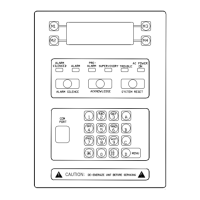
The 15220A, Two Zone, and 15240A, Four Zone, Fire Alarm System Control Unit provides manual, automatic,
and waterflow alarm and supervisory service. Zone #1 may be used as a manual, automatic, or waterflow initiating
circuit or it can be programmed to be used with normally open sprinkler supervisory switches. Zone #2 may be used
as a manual, automatic, or waterflow initiating circuit and can also be programmed to be non-silencable for use with
waterflow switches, if required. The control unit has one signal circuit capable of operating up to a total of 2.5A. of
U.L. listed compatible signals. The control unit also provides up to 0.3A. of resetable 19-28VDC power for U.L. listed
compatible 4-wire smoke detectors. The integral battery charger is capable of charging up to a 15 A.H., 24VDC battery
set and is supervised for a disconnected, shorted, or low (below 23VDC) battery set. Other standard features include
ground detection, signal silencing, subsequent alarm signaling, automatic short circuit disconnect on the signal circuit
and trouble buzzer ring back.
The 15216 Semi-flush Trim is an optional feature for the 15220A or 15240A Fire Alarm System Control Unit or 14050
Battery Cabinet. The trim allows the cabinet to be mounted up to 3.5" deep into the wall.
ONE OF THE FOLLOWING BATTERY SETS SHOULD BE USED TO SATISFY THE N.F.P.A. REQUIREMENT
OF A SECONDARY AND TROUBLE SIGNAL POWER SUPPLY. SEE SECTION III FOR CALCULATING
BATTERY REQUIREMENTS:
The 14047 Battery Set provides 6 Amp.- Hours of capacity @ 24 volts and mounts in the 15220A or 15240A Fire
Alarm System Control Unit cabinet.
The 14048 Battery Set provides 10 Amp.- Hours of capacity @ 24 volts and mounts in the 15220A or 15240A Fire
Alarm System Control Unit cabinet.
The 14049 Battery Set provides 15 Amp. - Hours of capacity @ 24 volts and mounts in the 14050 Battery Cabinet.
The 14050 Battery Cabinet is used for mounting the 14049 Battery Set. The battery cabinet matches the 15220A
or 15240A Fire Alarm System Control Unit in size, finish, and construction.
The 15212 Remote Annunciator Module is an optional module for the 15220A or 15240A Fire Alarm System Control
Unit. This module provides a supervised annunciator output per zone capable of driving 21-28VDC L.E.D. indicators,
a form "C" system trouble contact, and a form "C" general alarm contact. This module also contains a trouble L.E.D.
that will indicate an open condition or activated annunciator output. The form "C" trouble contact is 21-28VDC
powered for driving a 21-28VDC remote trouble unit or it may be programmed dry for other applications.
The 15213A March Time / Temporal Signaling Module is an optional module for the 15220A or 15240A Fire Alarm
System Control Unit. This module provides programming capabilities for the control unit's signal circuit (Note: This
module doesn't provide two additional signal circuits). Circuit #1 can be programmed for steady, march time or
temporal (code 3) signaling. Circuit #2 is non-silencable, intended for steady operation of strobes or other signals
required to be non-silencable.
The 15219 Zone Relay Module is an optional module for the 15220A or 15240A Fire Alarm System Control Unit.
This module provides a form "A" zone alarm contact per zone, a form "A" general alarm contact, and a form "B" general
alarm contact.
The 15209 City Tie Module is an optional module for the 15220A or 15240A Fire Alarm System Control Unit. This
module provides an alarm / trouble transmitter and a form "C" system trouble contact. The module also contains
a city tie disconnect switch and a trouble / off-normal switch L.E.D. The disconnect switch may be activated during
testing or servicing of the system to prevent an alarm transmission from this module (a trouble output will be generated
upon activation of the disconnect switch).
The 15215 City Tie / Auxiliary Relay Module is an optional module for the 15220A or 15240A Fire Alarm System
Control Unit. This module provides a supervisory / trouble transmitter, an alarm / trouble transmitter or a local energy
city box trip circuit, a form "C" system trouble contact, and a form "C" general alarm contact. The module also contains
a city tie / relay disconnect switch and a trouble / off-normal switch L.E.D. The disconnect switch may be activated
during testing or servicing of the system to prevent a supervisory or an alarm output from this module (a trouble output
will be generated upon activation of the disconnect switch).



 To Next Page