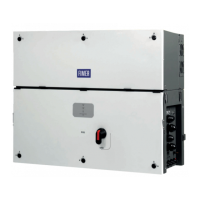
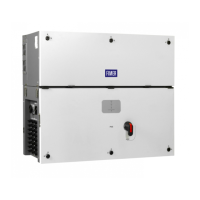
The FIMER PVI-10.0/12.5-TL-OUTD is a string inverter designed for photovoltaic (PV) systems, converting direct current (DC) from PV generators into alternating current (AC) suitable for feeding into the public distribution grid. This manual covers models with maximum output powers of 10.0 kW and 12.5 kW, including variants with or without a DC disconnect switch and input fuses board. The inverter operates automatically, requiring no operator intervention during normal operation, and is designed for safe thermal and electrical conditions, automatically reducing power fed into the grid if necessary.
Function Description
The inverter's core function is to transform DC electrical energy from a PV generator into AC electrical current for grid injection. This DC to AC conversion is performed efficiently using static electronic devices, without rotating parts. The system compensates for energy drawn from the grid and feeds excess power back into it, allowing for potential sale or credit for future consumption in accordance with local regulations.
The inverter features a dual Maximum Power Point Tracking (MPPT) structure, with two independent input channels (boosters) and an output inverter. Each input converter is dedicated to a separate array, allowing for different positions or orientations of PV arrays. The two trackers can also be configured in parallel to handle higher power levels or current. This inverter is transformerless, meaning it lacks galvanic insulation between input and output, which increases conversion efficiency. It is equipped with all necessary protections for safe operation and compliance with norms, even without an insulating transformer. The inverter is controlled by two independent Digital Signal Processors (DSPs) and a central microprocessor, ensuring grid connection is controlled in compliance with electrical field norms for both power supply and security.
Key functionalities include:
- Configurable relay: A switching relay that can be set for various operating configurations, such as activating an alarm in case of an error.
- Remote switch-on/switch-off: Allows external control to turn the inverter on or off. When active, inverter switching depends on the external control in addition to normal grid parameters.
- Reactive power feed into the grid: The inverter can produce and feed reactive power into the grid by adjusting the phase factor. This can be controlled via a dedicated RS485 serial interface, the display, or Aurora Manager Lite software.
- Limiting active power fed into the grid: The inverter can limit the active power fed into the grid to a desired percentage, configurable via the display or Aurora Manager Lite.
- Input Fuses (FS version only): Each input is supplied with protection fuses (not factory fitted) to protect the device from currents exceeding string limits. Proper sizing of these fuses is crucial during installation.
- Data transmission and control: The inverter can be monitored remotely via an RS-485 serial interface, allowing connection to FIMER monitoring devices for local or internet-based remote monitoring.
Important Technical Specifications
Input:
- Absolute Maximum Input Voltage (Vmax,abs): 900 V
- Rated Input Voltage (Vdcr): 580 V
- Input start-up voltage (Vstart): 360 V (adjustable 250-500 V)
- Input operating interval (Vdcmin...Vdcmax): 0.7 x Vstart...850 V (min 200 V)
- Input Nominal Power (Pdcr): 10300 W (PVI-10.0-TL-OUTD), 12800 W (PVI-12.5-TL-OUTD)
- Number of Independent MPPT: 2
- Maximum input power for Each MPPT (PMPPTmax): 6500 W (PVI-10.0-TL-OUTD), 8000 W (PVI-12.5-TL-OUTD)
- Input voltage interval (VMPPTmin ... VMPPTmax) to Pacr (parallel MPPT configuration): 300-750 V (PVI-10.0-TL-OUTD), 360-750 V (PVI-12.5-TL-OUTD)
- Maximum DC Input Current (Idcmax) / for each MPPT (IMPPTmax): 34.0 A / 17.0 A (PVI-10.0-TL-OUTD), 36.0 A / 18.0 A (PVI-12.5-TL-OUTD)
- Number of DC Connection Pairs in Input for each MPPT: 2
- DC Input Connector type: Quick Fit PV Connector (5)
- Type of photovoltaic panels: Class A (according to IEC 61730)
- Input protection: Reverse Polarity Protection (inverter protection only, from limited current source), Input Overvoltage protection for each MPPT (Varistors), Insulation Check (complying with local standard).
- DC Disconnect Switch rating (-S Version): Max. 32.0 A / 1000 V
- Fuse Rating (-FS Version): gPV / 1000 V / Max. 20.0 A
Output:
- AC Connection to the grid: Three phase 3W or 4W+PE
- Nominal AC output voltage (Vacr): 400 V
- Output voltage range (Vacmin...Vacmin): 320-480 V (1)
- Nominal AC Output Power (Pacr @cosφ=1): 10000 W (PVI-10.0-TL-OUTD), 12500 W (PVI-12.5-TL-OUTD)
- Maximum AC Output Power (Pacmax @cosφ=1): 11000 W (3) (PVI-10.0-TL-OUTD), 13800 W (4) (PVI-12.5-TL-OUTD)
- Maximum apparent Output power (Smax): 11500 VA (PVI-10.0-TL-OUTD), 13800 VA (PVI-12.5-TL-OUTD)
- Maximum output current (Iacmax): 16.6 A (PVI-10.0-TL-OUTD), 20.0 A (PVI-12.5-TL-OUTD)
- Rated Output Frequency (fr): 50 Hz / 60 Hz
- Output Frequency Range (fmin...fmax): 47-53 Hz / 57-63 Hz (2)
- Nominal Power Factor: > 0.995 (adj. ± 0.9)
- Total Current Harmonic Distortion: < 2%
- AC Connections Type: Screw Terminal block (max cross-section 16 mm²); cable gland M40
Operating Performance:
- Maximum Efficiency (ηmax): 97.8%
- Weighted Efficiency (EURO/CEC): 97.1% / - (PVI-10.0-TL-OUTD), 97.2% / - (PVI-12.5-TL-OUTD)
- Power Supply Threshold: 30.0 W
- Night-Time Consumption: < 1.0 W
Environmental:
- Ambient temperature: -25...+60°C (-13...+140°F) with derating above 55°C / 131°F (PVI-10.0-TL-OUTD) or 50°C / 122°F (PVI-12.5-TL-OUTD)
- Storage temperature: -40...+80°C (-40...+176°F)
- Relative Humidity: 0...100% condensing
- Typical noise emission pressure: 50 dbA @ 1 m
- Maximum operating altitude: 2000 m / 6560 ft
- Environmental pollution classification for external environment: 3
- Environmental Category: External
- Environmental Protection Rating: IP 65
- Cooling System: Natural
- Overvoltage rating as per IEC 62109-1: II (DC input) III (AC output)
- Dimensions (H x W x D): 716mm x 645mm x 224mm / 28.2” x 25.4” x 8.8”
- Weight: < 41 kg / 90.4 lb
- Assembly System: Wall bracket
Safety:
- Safety class: I
- Insulation level: Without transformer (TL)
- Marking: CE, RCM
Usage Features
Installation:
- Wall mounting: The inverter is designed for wall mounting using a provided bracket. Minimum distances (15 cm top, 10 cm sides, 20 cm bottom) must be maintained for proper heat dissipation and maintenance access.
- Environmental conditions: Installation should avoid direct sunlight, small enclosed spaces, flammable materials, and areas where prolonged human or animal presence is expected due to noise. Installations above 2000 meters require special consideration due to reduced cooling efficiency and dielectric resistance.
- PV generator connection (DC side): Requires checking correct string polarity and absence of ground leakage. Quick-fit connectors (Weidmüller PV-Stick/WM4, MultiContact MC4, Amphenol H4) are used. For -FS versions, individual strings must be connected directly to the inverter, as input fuses are not sized for parallel strings.
- Grid output connection (AC side): Supports star (3 phases + neutral) or delta (3 phases) connections. Ground connection is mandatory. Cable sizing is crucial to prevent unwanted disconnections due to high line impedance.
- Communication and control board: Features connections for multi-function relay (ALARM), Tachometer signal (WIND), remote ON/OFF (REM), RS485 serial communication (RS485, RS485(A), RS485(B)), and an RS485 line termination switch (120 Ω TERM.).
Operation:
- User interface: An LCD display with 16 characters x 2 lines and an LED panel provide operational data, service messages, and alarm/fault messages.
- Display modes: The display cycles through information automatically or can be manually scrolled using UP/DOWN buttons when locked.
- Settings menu: Accessible via password (default "0000"), allowing configuration of parameters like RS485 address, Vstart voltage, MPPT scan sensitivity and interval, reactive power feed-in, and active power limitation.
- Autotest procedure: For CEI 0-21 standard, autotests can be initiated from the display menu or via RS485/USB converter with Aurora Communicator software to check over-voltage, under-voltage, over-frequency, and under-frequency parameters.
Maintenance Features
Routine Maintenance:
- Annual visual inspection: Check for correct operation, visible labels, cable/connector integrity, and stable environmental conditions.
- Annual operations: Ensure cable glands and connection block screws are tight, wiring box cover is properly closed. If no monitoring system is present, check the alarm and error history log.
- Annual cleaning: Clean the equipment, especially the bottom grille of the wiring box and the heat sink.
Troubleshooting:
- Alarm messages: The inverter displays error/warning codes (Exxx/Wxxx) on the display, along with LED indicators, to help identify and resolve malfunctions. Examples include:
- Ground fault (Ground F): Indicates leakage current in the DC section. Requires measuring insulation resistance and checking the PV generator.
- Vac absent: No output voltage (AC side) detected. Requires checking grid voltage and line protection.
- Memory broken: Communication problem with the memory board. Requires checking connector terminals and reinserting the board.
- Awaiting sun / Sun Low / Input UV: Insufficient input voltage/irradiation. Requires checking PV generator composition and irradiation.
- Grid Fail: Grid parameters exceed limits. Requires checking grid voltage and impedance.
- Fan broken: Malfunction in internal fans.
- Bulk UV: Voltage at bulk capacitors below threshold.
- String Err. (-FS models): Damaged string protection fuse(s). Requires checking and replacing fuses.
- SPD DC Err / SPD AC Err (-FS models): Overvoltage surge arresters triggered. Requires inspecting and replacing damaged cartridges.
- Over Temp. (from external box): High internal temperature. Requires checking for direct sunlight exposure and allowing cooling.
- Power limitation messages (LIMxxx% CODE): Indicate output power limitations due to user settings, grid standards, or internal protective devices (e.g., over-frequency, over-voltage, excess temperature, input over-voltage, anti-islanding).
Specific Maintenance Procedures:
- Resetting grid standard time: A 24-hour window is available after initial setup to modify the grid standard. If this window expires, a second-level password (obtained via FIMER's registration website) is required to reset the timer.
- Replacing input fuses (-FS version): Requires disconnecting AC and DC lines, opening the front cover, and using a multimeter to ensure no voltage is present before replacing fuses with specified 10x38mm, 1000Vdc, 20A max, IEC60269-6 compliant fuses.
- Replacing buffer battery: Necessary if error signals appear or date/time settings reset. Requires disconnecting AC and DC lines, opening the front cover, and replacing the CR2032 battery on the motherboard, observing polarity.
- Verification of ground leakage: Involves measuring voltage between positive/negative poles and ground using a voltmeter. A stable non-zero reading indicates leakage.
- Measuring insulation resistance of PV generator: Requires short-circuiting the two poles of the PV generator and measuring resistance between the shorted poles and ground using a megohmmeter. Resistance values below 1Mohm (-TL models) or 0.2Mohm (-I models) prevent grid connection.
Storage and Dismantling:
- Storage: For long periods of non-use, the equipment should be correctly packed and stored in well-ventilated indoor areas to prevent damage.
- Dismantling and disposal: Disposal of components (displays, cables, batteries, etc.) must comply with local environmental regulations. FIMER is not responsible for disposal.

 Need help?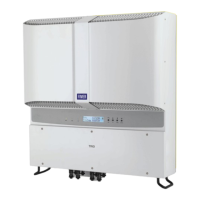

 To Next Page
 General