Need help?
Do you have a question about the Fimer PVS-100-TL and is the answer not in the manual?
Crucial instructions to prevent injury, death, or equipment damage during operation.
Explains symbols and icons used in the manual and on the equipment for hazard identification.
Safety guidelines for installation and maintenance operations on the inverter.
Identifies and provides suggestions to prevent residual risks that cannot be eliminated.
Details warranty conditions and clarifies what is not included in the supply.
Defines the intended use, limitations, and general conditions for the inverter's application.
Provides a description of equipment characteristics and technical terminology used in the manual.
Explains how to identify the equipment and its manufacturer using labels and markings.
Lists the available inverter models and their corresponding specifications and variants.
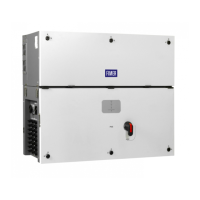
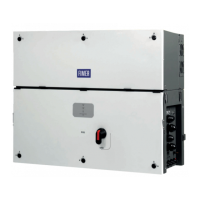
Provides a list of all external components of the inverter with their reference numbers for identification.
Presents detailed technical specifications for various inverter models and their components.
Displays graphs illustrating the efficiency curves for all inverter models described in the manual.
Explains how the inverter automatically reduces power under specific thermal or electrical conditions.
Describes the components and structure of a photovoltaic generator relevant to inverter connection.
Provides an overview of the inverter's function, operation, and system diagrams.
Provides guidelines for transporting and handling the equipment to protect it from damage.
Lists the weight of the power module and wiring box, including lifting points and handle options.
Specifies conditions for storing the equipment to maintain its integrity and performance.
Details the correct procedures and precautions for lifting the inverter components safely.
Lists all components supplied with the inverter package for installation and setup.
Lists available kits of recommended spare parts for maintenance and repair purposes.
Emphasizes safety precautions that must be followed during the entire installation process.
Provides recommendations and requirements for selecting a suitable installation site and positioning the inverter.
Specifies minimum clearance distances required around the inverter for ventilation and maintenance.
Provides guidance on spacing requirements when installing multiple inverters in the same location.
Advises on checking wireless signal strength for optimal installation and communication.
Details the steps involved in securely mounting the inverter, including bracket assembly.
Describes the process of physically mounting the inverter unit onto the prepared bracket.
Explains how to connect the internal interface cables between the power module and the wiring box.
Details the procedures and requirements for connecting the inverter's AC output to the grid.
Explains how to select and size the protective grounding cable for safe installation.
Explains how to properly connect the AC output cables to the inverter's terminals.
Outlines the procedures for connecting the DC input cables from the PV generator to the inverter.
Specific instructions for connecting DC inputs on standard and S2 inverter models.
Specific instructions for connecting DC inputs on -S(X or Y) and S(X or Y)2 inverter models.
Provides detailed steps for installing various types of quick-fit DC connectors.
Describes how to connect communication interfaces for monitoring and control.
Details how to establish an Ethernet connection for data transfer and remote monitoring.
Explains how to set up RS485 communication for monitoring and control systems.
Explains the indicators and status lights on the inverter's LED panel for operational feedback.
Introduces the different user interfaces available for interacting with and configuring the inverter.
Describes the mobile application for commissioning, setting parameters, and troubleshooting inverters.
Details the web-based interface for accessing configuration and monitoring functions via a browser.
Explains the cloud-based platform for remote monitoring and asset management of solar plants.
Outlines the general tolerances for measurements provided by the inverter compared to certified instruments.
Details the procedures for initial setup and configuration of the inverter after installation.
Step-by-step guide for commissioning using the Fimer mobile application.
Step-by-step guide for commissioning using the Web User Interface via wireless connection.
Explains the meaning of different LED status indicators on the inverter for operational feedback.
Describes how to access the inverter's Web User Interface via wireless or wired connections.
Details the process of logging into the Web User Interface after establishing a connection.
Provides an overview of the navigation structure and sections within the inverter's Web User Interface.
Covers the main dashboard and status summary sections for viewing system information.
Details the configuration options for AC and DC parameters, grid settings, and other inverter functions.
Details how to configure network settings for LAN, WLAN, and RS485 communication.
Provides critical safety procedures for de-energizing the inverter before any maintenance.
Step-by-step guide for safely isolating the inverter from all voltage sources.
Outlines recommended periodic maintenance operations for long-term proper inverter function.
Advises on the recommended replacement schedule for key inverter components.
Details the procedure for replacing the internal and side fan sections of the inverter.
Offers solutions for common problems related to web user interface and wireless communication.
Lists and explains various alarm and error messages, including their causes and solutions.
Describes how to check for ground leakage from the PV generator and its system behavior.
Explains the procedure for measuring the PV generator's isolation resistance to ground.
Lists the network ports and services required for inverter communication and operation.
 General
| Model | PVS-100-TL |
|---|---|
| Rated Power | 100 kW |
| Max. DC Voltage | 1100 V |
| Cooling | Forced air |
| Cooling Method | Forced air |
| Protection Degree | IP65 |
| Nominal AC Voltage | 400 V |
| Max. AC Current | 160 A |
| Output Voltage | 400 V |
| Frequency | 50/60 Hz |
| Protection Level | IP65 |
| Type | String Inverter |
| Protection Class | Class I |
| Operating Temperature Range | -25°C to +60°C |

 To Next Page