REGULATORY INFORMATION FOR SMOKE ALARMS
RECOMMENDED LOCATIONS FOR SMOKE ALARMS
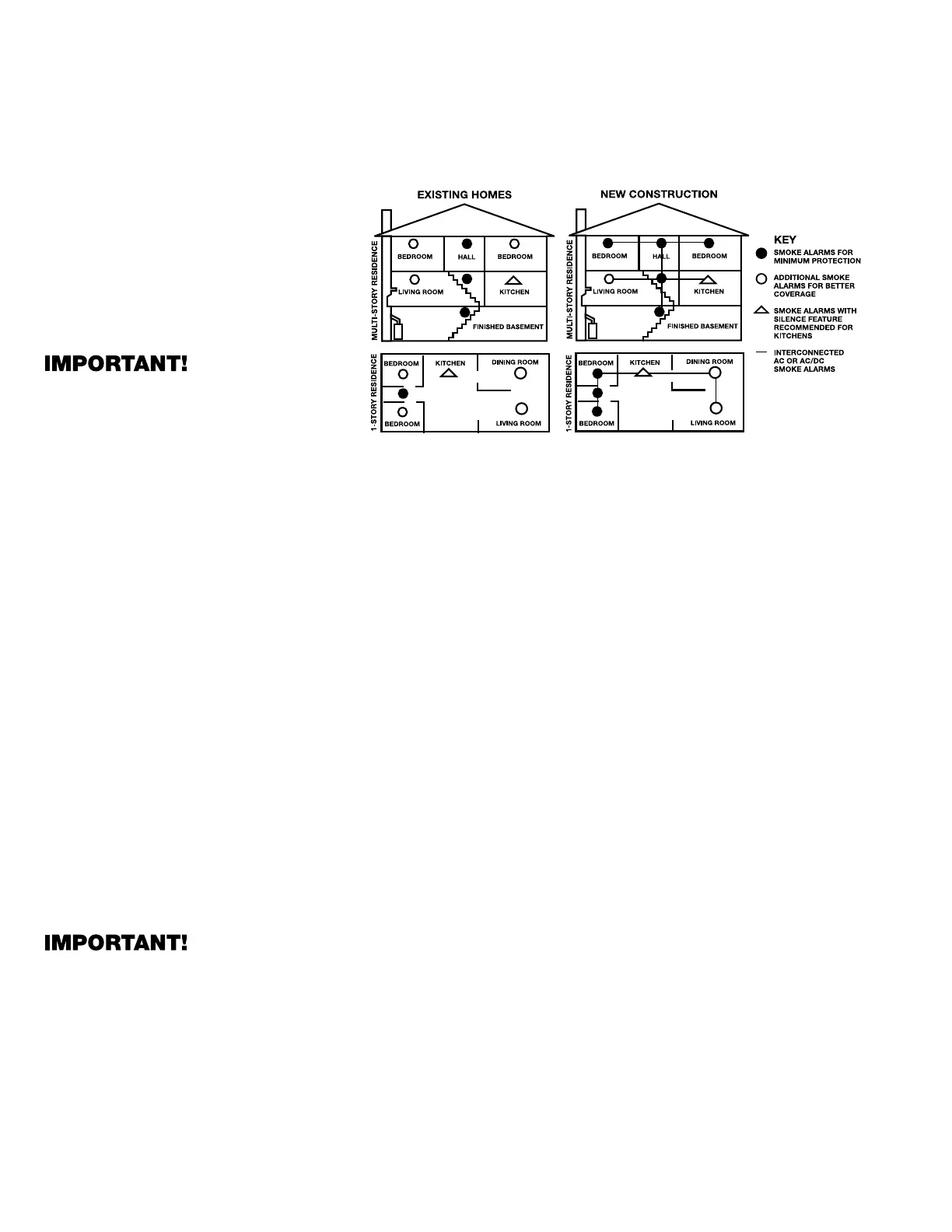
Installing Smoke Alarms in Single-Family Residences The National Fire Protection Association (NFPA), recommends one Smoke Alarm on every floor, in every
sleeping area, and in every bedroom. In new construction, the Smoke Alarms must be AC powered and interconnected. See “Agency Placement Recommendations” for
details. For additional coverage, it is recommended that you install a Smoke Alarm in all rooms, halls, storage areas, finished attics, and basements, where temperatures
normally remain between 40˚ F (4.4˚ C) and 100˚ F (37.8˚ C). Make sure no door or other obstruction could keep smoke from reaching the Smoke Alarms.
More specifically, install Smoke Alarms:
•
On every level of your home, including
finished attics and basements.
•
Inside every bedroom, especially if
people sleep with doors closed.
•
In the hall near every sleeping area. If your home has
multiple sleeping areas, install a unit in each. If a hall is
over 40 feet (12 meters) long, install an Alarm at each end.
•
At the top of the first-to-second floor stairway,
and at bottom of basement stairway.
Specific requirements for Smoke Alarm installation vary
from state to state and from region to region. Check
with your local Fire Department for current requirements
in your area. It is recommended AC or AC/DC units
be interconnected for added protection.
AGENCY PLACEMENT RECOMMENDATIONS
Standards: Underwriters Laboratories Inc. Single and Multiple Station Smoke Alarms 217.
NFPA 72 Chapter 29 “For your information, the National Fire Alarm and Signaling Code, NFPA 72, reads as follows:”
29.5.1* Required Detection.
29.5.1.1* Where required by other governing laws, codes, or standards for a specific type of occupancy, approved single and multiple-station smoke alarms shall be installed as follows:
(1) *In all sleeping rooms and guest rooms
(2) * Outside of each separate dwelling unit sleeping area, within 21 ft (6.4 m) of any door to a sleeping room, with the distance measured along a path of travel
(3) On every level of a dwelling unit, including basements
(4) On every level of a residential board and care occupancy (small facility), including basements and excluding crawl spaces and unfinished attics
(5) *In the living area(s) of a guest suite
(6) In the living area(s) of a residential board and care occupancy (small facility)
(Reprinted with permission from NFPA 72
®
, National Fire Alarm and Signaling Code Copyright © 2010 National Fire Protection Association, Quincy, MA 02269. This reprinted
material is not the complete and official position of the National Fire Protection Association, on the referenced subject which is represented only by the standard in its
entirety), (National Fire Alarm and Signaling Code
®
and NFPA 72
®
are registered trademarks of the National Fire Protection Association, Inc., Quincy, MA 02269).
California State Fire Marshal (CSFM) Early warning detection is best achieved by the installation of fire detection equipment in all rooms and areas of the
household as follows: A Smoke Alarm installed in each separate sleeping area (in the vicinity, but outside bedrooms), and Heat or Smoke Alarms in the living rooms,
dining rooms, bedrooms, kitchens, hallways, finished attics, furnace rooms, closets, utility and storage rooms, basements, and attached garages.
SYMPTOMS OF CO POISONING
These symptoms are related to CO POISONING and should be discussed with ALL household members.
Mild Exposure: Slight headache, nausea, vomiting, fatigue (“flu-like” symptoms).
Medium Exposure: Throbbing headache, drowsiness, confusion, fast heart rate.
Extreme Exposure: Convulsions, unconsciousness, heart and lung failure. Exposure to Carbon Monoxide can cause brain damage, death.
This CO Alarm measures exposure to CO over time. It alarms if CO levels are extremely high in a short period of time, or if CO levels reach a certain minimum over a
long period of time. The CO Alarm generally sounds an alarm before the onset of symptoms in average, healthy adults. Why is this important? Because you need to
be warned of a potential CO problem while you can still react in time. In many reported cases of CO exposure, victims may be aware that they are not feeling well, but
become disoriented and can no longer react well enough to exit the building or get help. Also, young children and pets may be the first affected. The average healthy
adult might not feel any symptoms when the CO Alarm sounds. However, people with cardiac or respiratory problems, infants, unborn babies, pregnant mothers, or
elderly people can be more quickly and severely affected by CO. If you experience even mild symptoms of CO poisoning, consult your doctor immediately!




 To Next Page