EasyManua.ls Logo

FISCHER MD-1a - User Manual

FISCHER MD-1a
10 pages
Print Icon
To Next Page IconTo Next Page
Loading...
Question and Answer IconNeed help?

Do you have a question about the FISCHER MD-1a and is the answer not in the manual?

Summary

Galvanic Unit Description

Typical Installation

Guidance on locating and connecting the Galvanic Unit to a treatment area and power source.

Safety Precautions

Important warnings regarding high voltage, servicing, and environmental conditions for safe operation.

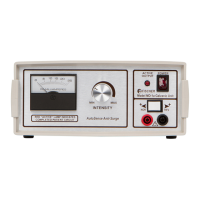
Model MD-1 a Panel Controls

DC Milliampere Meter

Analog meter displaying actual current flow in DC Milliamperes through the patient circuit.

Meter Scale Switch

Selects the meter scale (0-10 or 0-50) for indicating current flow, affecting reading accuracy.

Active Lamp

Red LED that illuminates when a completed patient circuit and active current flow are detected.

Power Switch

Rocker-type switch to turn the Galvanic Unit ON or OFF.

Intensity Knob

Adjusts the desired current level, with actual output indicated on the DC Milliamperes meter.

Polarity Reversal Switch

Allows reversing polarity (NOR/REV) without swapping patient cord plugs (units made after 1/1/2005).

Output Jacks

Two banana jacks (RED positive, BLACK negative) for connecting patient cords.

Device Specifications

Key Device Parameters

Details including device name, manufacturer, power source, fuse rating, output modes, and voltage/current ranges.

Accuracy and Safety Standards

Information on meter accuracy, leakage current limits, and electrical safety certifications.

Device Maintenance Procedures

General Maintenance Recommendation

Device requires minimal maintenance, focusing on regular inspection of the unit and accessories.

Device Inspection Procedures

Visual Device Inspection (Annually)

Annual inspection covering line cord, plugs, panel controls, and cabinet integrity.

Visual Electrode Inspection (6 Months)

Semi-annual inspection of patient cords, plugs, and electrodes for wear or damage.

Electrical Device Inspection

Line Voltage and Ground Integrity

Verification of input voltage (105-120 VAC) and reliable ground connection integrity.

Chassis and Patient Leakage Tests

Measurement of ground leakage current (chassis/patient) to ensure safety limits are met.

Optional Dielectric Strength Test

Optional test applying high voltage to check insulation integrity (1250 VAC).

Device Output and Performance Testing

Output Measurement Procedures

Tests for minimum/maximum output, and verification of meter readings at specified scales (0-10 and 0-50).

AC Ripple Measurement (Optional)

Optional measurement of AC ripple in the output current using an oscilloscope (0-0.5 Vpp).

Parts List

Component Identification

Detailed list of part numbers, item descriptions, and quantities for the MD-1a unit.

Schematic Diagram

Circuit Overview

Detailed electronic schematic illustrating the internal components and connections of the MD-1a unit.

Overview

The FISCHER Model MD-1a Galvanic Unit is a medical device designed for professional use in a clinic setting, offering a versatile approach to galvanic (DC) current applications such as anaphoresis, cataphoresis, or iontophoresis. It generates an adjustable, filtered DC current from standard AC line voltage.

Function Description

The core function of the MD-1a Galvanic Unit is to provide a controlled direct current for various medical treatments. It features an analog DC Milliammeter that indicates the actual current flow through the connected patient circuit. The unit includes a METER SCALE SWITCH, allowing selection between a 0-10 mA range for more accurate readings of currents less than 10 mA, and a 0-50 mA range. This switch only changes the meter scale, not the output level. An ACTIVE LAMP (red LED) illuminates only when a complete patient circuit is detected and active current is flowing, serving as an indicator of current activation rather than just power-on. The POWER SWITCH turns the unit on and off, with its red top edge exposed when power is on. The INTENSITY KNOB is used to adjust the desired current level, with the actual current indicated on the meter, as its position may vary depending on patient circuit resistance. For units manufactured after January 1, 2005, a POLARITY REVERSAL SWITCH is included, allowing users to switch between normal (red jack positive) and reverse (black jack positive) polarity without swapping patient cord plugs. It is crucial to return the INTENSITY to "0" before changing polarity. Two "banana" OUTPUT JACKS facilitate the connection of patient cords, with the red jack always positive relative to the black (negative) jack. The unit is designed to slowly ramp the output current to its set value once a load resistance is detected, requiring several seconds for stabilization before measurements.

Usage Features

The MD-1a Galvanic Unit is designed for ease of installation and operation. It should be located near a treatment area where controls are easily accessible and plugged into a 110-115 volt A.C. grounded wall receptacle (220-volt operation is available by special order). The use of "cheater" or adapter plugs is strictly prohibited, as proper grounding is essential for safe and proper operation. The unit is equipped with a "hospital grade" plug for reliable grounding. Its light weight and small size make it portable, but proper grounding must always be ensured when relocating. The dual-prong plug of the patient cordset connects to the front panel jacks, with the red jack being positive and the black negative. The accessory electrodes are then firmly plugged into the opposite ends of each cord.

Standard accessories include a Dual Patient Cordset (red and black cords), 3" x 6" Wet pad electrodes, and optionally, Iontophoresis Trays.

Precautions for Use:

  • The device produces high voltage, requiring careful operation and adherence to safety procedures.
  • The power cord must be disconnected when servicing to reduce shock hazard.
  • Contact with in-circuit capacitors, which may retain a high voltage charge, should be avoided.
  • A minimum of 3 minutes should be allowed after disconnecting from the power source for circuit components to fully discharge before performing any service.
  • The unit should not be moved or carried by its attached cords.
  • It should not be subjected to excessive shock or vibration, nor used or stored in temperatures exceeding 105 degrees Fahrenheit or in high humidity.

Maintenance Features

The MD-1a Galvanic Unit requires specific periodic maintenance to ensure its continued safe and effective operation. The factory recommends an annual inspection, though maintenance personnel at the installation site may perform inspections at other intervals, not exceeding 24 months.

Visual Device Inspection (Annually):

  • Line Cord and Plug: Inspect for insulation wear, broken or exposed wires, loose Heyco grip, bent or broken plug spades, and bent or broken ground connection. Replace the line cord if any wear or breakage is evident.
  • Panel Controls: Inspect for damaged or worn controls. Rotate the Intensity control knob to check for positive stops at minimum and maximum, and tighten if loose. Check the integrity of Output Jacks and replace if corrosion or cracks are evident. Verify the operation of the "Active" LED by applying a 1K to 10K ohm load across Output Jacks and rotating the Intensity knob; the LED should be off at minimum intensity and turn on at a setting of 1-2. Verify the operation of the Polarity Reversal switch (for units made after 1/1/2005) by switching to "REV" position and observing polarity reversal at red & black panel jacks. Verify meter operation on both 0-10 and 0-50 scales with a 1K to 10K ohm load and a nominal output setting of 10 DCmA.
  • Cabinet: Inspect for cracks or breakage. Ensure that the four bottom panel screws are tight and that the front and panels are properly seated in the housing (only if the unit has been opened for circuit access).

Visual Electrode Inspection (Every 6 Months):

  • Electrodes and Cords: Inspect patient cords (red and black) for wear, broken or exposed wires, or corroded banana jacks. Patient cords should be replaced regularly (every 12-24 months) or if wear is evident. Inspect the dual plug at one end of the cords and tighten the allen screw if necessary to clamp the internal wire. Inspect electrodes (wet pads or iontophoresis trays) for breakage or corrosion and replace if necessary.

Electrical Device Inspection (Annually):

  • Line Voltage, Ground Integrity: Measure the line voltage supplied to the device (Accept: 105-120 VAC). Confirm a reliable ground connection with a 3-prong grounded receptacle. Measure device ground wire resistance between the line plug ground contact and the screw near the Heyco cord grip on the rear panel (Accept: 0 to 1.0 ohm; nominal reading .1-.2 ohms). This measurement should not be made between the line plug ground contact and front or rear panel surfaces, as these panels are anodized and non-conductive.
  • Chassis and Patient Leakage: Measure ground leakage between line and chassis using an approved Electrical Safety Analyzer (Accept: Less than 50uA). This measurement should not be made between line and front or rear panel surfaces. Measure patient lead leakage between line and red and black Output Jacks using an approved Electrical Safety Analyzer (Accept: Less than 50uA).
  • Dielectric Strength Test (OPTIONAL): Apply 1250 VAC, 60 Hz between line and chassis ground for 60 seconds, and between line and patient leads (red and black jacks) for 60 seconds, using an approved Dielectric Withstand Tester with a cutoff current set to 1.0-2.0 mA (Accept: No Breakdown). Safety precautions must be observed during this test. Devices failing this test should not be returned to service as they may be internally damaged. This test is optional and not required annually.

Device Output Measurements (Annually):

  • Preliminary Setup: Plug the line cord into a grounded receptacle and turn on the MD-1a. Attach the dual patient cordset to the Output Jacks and make all measurements between the red and black banana plugs using a series load resistance of 1K ohm (rated at 3 watts or more).
  • Output Measurements: Measure minimum output with the Intensity knob at its minimum position (Accept: 0 DCmA). Measure maximum output with the Intensity knob at its maximum position (Accept: 40-58 DCmA). Verify meter readings on both 0-10 and 0-50 scales by adjusting intensity to achieve 10 mA and 20 mA respectively, and measure the actual current (Accept: 8.0-12 DCmA for 10 mA setting, and 16-24 DCmA for 20 mA setting). Allow several seconds for output current to stabilize due to the slow ramp-up circuitry.
  • AC Ripple (OPTIONAL): Measure AC ripple present in the output current by connecting an isolated ground oscilloscope in parallel with the 1K load resistance. Adjust Intensity for a metered output of 20 DCmA (using the 0-50 scale) and observe the AC component (ripple) superimposed on the DC waveform (Accept: 0-.5 Vpp (2.5%)).

FISCHER MD-1a Specifications

General IconGeneral
TypeCoating Thickness Gauge
Measurement Range0 - 2000 µm
DisplayLCD
Operating Temperature0°C to 50°C
Measuring principleMagnetic induction and eddy current
ApplicationNon-destructive coating thickness measurement
Resolution0.1 μm
Probe TypeIntegrated probe
Power SupplyBatteries

Related product manuals