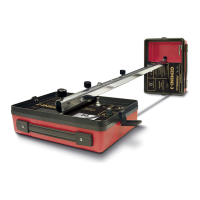
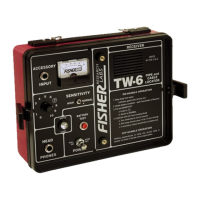
The Fisher Labs TW-6 is a pipe and cable locator designed for utility and construction craftsmen, building on the Fisher M-Scope tradition of providing speed and precision in locating underground pipes and cables. The device is intended for effective use by practicing on known "conductors" such as valve box covers, manhole covers, or visible valves to gain familiarity with its operation before field use.
Function Description:
The TW-6 operates in two primary modes: INDUCTIVE and CONDUCTIVE. In the INDUCTIVE mode, the Transmitter induces an electromagnetic field into the object, which is then detected by the Receiver. This mode is suitable for general locating and tracing. In the CONDUCTIVE mode, the Transmitter directly energizes the pipe or cable through a direct connection, which is ideal for tracing individual pipes or cables, especially when other lines are nearby. The device is capable of locating manhole covers, valves, tees, and risers, as well as determining conductor depth by triangulation. It can also be used to locate non-metallic pipes by employing a "fish-tape" or "snake" to create a conductive path.
Important Technical Specifications:
The TW-6 system consists of a Transmitter and a Receiver.
Transmitter:
- Operating Frequency: 81.92 kHz ±.005%
- Batteries: 8 each, AA (NEDA 15)
- Weight: 2 1/2 lbs. (1.1 kg)
- Sensitivity: N/A
- Signal-to-noise ratio: N/A
- Headset Impedance: N/A
- Dimensions: 11 1/2" x 9" x 3" (29 x 23 x 7.6 cm)
- Operating Temperature: -10°F to +120°F (-23°C to +48°C) depending on batteries used.
- Total Weight (without handle or accessories, ground plate assembly or operating manual): 5 1/2 lbs. (2.5 kg)
- Total Shipping Weight (including only ground plateassembly and operating manual): 6 3/4 lbs. (3 kg)
- Total Shipping Volume: .69 cu. ft. (19.5 liters)
- Field Strength: 17.5dBuV @ 300 meters, 81.92kHz.
Receiver:
- Operating Frequency: 81.92 kHz ±.005%
- Batteries: 8 each, AA (NEDA 15)
- Weight: 3 lbs. (1.36 kg)
- Sensitivity: N/A/Normal: 400 uV typical High: 8 uV typical
- Signal-to-noise ratio: 110dB
- Headset Impedance: 600 ohms (mono), 8 ohms (stereo)
- Dimensions: 11 1/2" x 9" x 3" (29 x 23 x 7.6 cm)
- Operating Temperature: -10°F to +120°F (-23°C to +48°C) depending on batteries used.
- Total Weight (without handle or accessories, ground plate assembly or operating manual): 5 1/2 lbs. (2.5 kg)
- Total Shipping Weight (including only ground plateassembly and operating manual): 6 3/4 lbs. (3 kg)
- Total Shipping Volume: .69 cu. ft. (19.5 liters)
The device is a Category II radiocommunication device and complies with Industry Canada Standard RSS-310.
Usage Features:
- Receiver Controls:
- Carrying Strap: Allows for one-hand free operation during Tracer Probe use.
- Meter: Provides visual indication of signal strength, aiding in locating and tracing.
- Accessory Input: A jack for connecting headphones.
- Sensitivity: A toggle switch for selecting NORMAL or HIGH range, and a knob for controlling sensitivity within the selected range.
- Depth Level: A bubble indicator for determining the 45-degree angle necessary for depth measurement.
- Headphones: A jack for headphones, which automatically mutes the speaker when plugged in.
- Battery Test: A button to check battery strength; if the meter reads below 80, batteries should be replaced.
- Power: A pull-out switch for ON/OFF.
- Speaker: Produces an audible signal, with volume and pitch increasing with signal strength.
- Transmitter Controls:
- Battery Test Meter: Visual indication of battery strength, automatically activated when the unit is turned ON.
- Constant Signal/Warble Tone Switch: Selects between a constant signal or a warble tone. The warble tone generates a pulsating sound and an oscillation of the needle between 20 and 100.
- Accessory Output: A jack for connecting Ground Plate Assemblies, Coupling Clamp, or Ground Rod Assembly for conductive tracing.
- Component Descriptions:
- Ground Rod/Harness Assembly: Provides a "ground" for efficient conductive tracing, especially on hard ground.
- 3-Piece Handle: Used for inductive locating and can be lowered for greater depth penetration.
- Handle Carrying Strap: Used for carrying the receiver and for lowering the handle during deep searches.
- Handle Carrying Case: Protects the handle and keeps it organized.
- Carrying Case: Provides sturdy protection for the TW-6 and storage for accessories.
- Headphones: Stereotype headphones are available, switch-selectable between monaural and stereo. Stereo phones are preferred due to adjustable volume for each ear and the shrill nature of the VCO sound without volume control on mono headphones.
- Modes of Operation:
- How to Assemble: Involves aligning the receiver and transmitter panels with the handle knobs and tightening them.
- How to Tune: Includes checking batteries, setting receiver sensitivity, turning on power, balancing the unit, and adjusting the front knob to reach the lowest meter and speaker indications (null). Caution is advised against tuning in the presence of metal objects.
- Inductive Locating (with handle): Involves walking over the suspected area to find maximum signal indications, which pinpoint the conductor's location. A "null" indicates the center of the pipe.
- High Power (with handle): Similar to inductive locating but with increased sensitivity for deeper searches.
- Inductive Tracing (without handle): The transmitter is placed at least 30 feet from the conductor, and the receiver is moved over the conductor to trace its path.
- Inductive Locating When Only Approximate Position of a Linear Conductor is Known: Best performed by two operators walking parallel, or by one operator moving the transmitter and then tracing with the receiver.
- Pinpointing Center of the Pipeline: After locating the pipe, the transmitter is placed on its bottom edge, and the receiver is moved side-to-side to find a null directly over the conductor.
- Determining Conductor Depth by Triangulation: Requires placing the receiver at a 45-degree angle to the ground and backing away at a right angle to the conductor until a minimum signal is reached. The horizontal distance from the conductor centerline to the receiver's fastener, minus 5 inches, is the depth. A tracer probe can improve accuracy.
- Locating Manhole Covers, Valves, Tees and Risers: Performed in Inductive Mode by tracing the main pipe and noting increased signals over metal masses. Grid patterns are recommended for paved-over manhole covers.
- Locating Pipe When Other Lines Are Close By: Involves setting the transmitter three to five feet from the desired pipe, either parallel or with its plane pointing towards the pipe, to maximize signal in the desired pipe and minimize it in secondary pipes.
- Conductive Tracing (without handle): The most satisfactory method for tracing individual pipes when others are nearby. Involves direct connection of the transmitter to the conductor via a clamp and ground rod, with the transmitter placed 90 degrees away from the pipe.
- Tracing Procedure: General guidelines for tracing, including keeping the transmitter at a distance and moving the receiver to find nulls.
- Coupling Clamp: Used to inductively energize and trace without a metal-to-metal contact, or for direct connection to a closed loop or circuit.
- Locating Non-Metallic Pipes: Involves running a "fish-tape" or "snake" down the pipe and connecting the transmitter to it, or using aluminum foil tracer tape laid above the pipe.
Maintenance Features:
- Changing Batteries: Batteries should be checked regularly using the battery test function. If the meter reads below 80, all eight AA batteries in both the transmitter and receiver should be replaced simultaneously. The battery pack is accessed by removing the access plate with a coin or large blade screwdriver.
- Battery Life: The transmitter and receiver will operate for 30 to 40 hours on a set of 8 standard quality AA batteries. Alkaline batteries provide greater life (30 to 40% more).
- Battery Disposal: Batteries contain hazardous materials and must be disposed of according to local laws.
- Rechargeable Batteries: Do not attempt to recharge the batteries that come with the TW-6, or any other batteries, except Ni-Cad rechargeables.
- Warranty: Fisher Research Laboratory provides a 2-year limited warranty. Proof of purchase is required for claims. Customers outside the U.S.A. should check with their distributor for details. Warranty does not cover shipping costs.
- FCC and Industry Canada Compliance: The device complies with relevant regulations, and any unauthorized changes or modifications could void the user's authority to operate the equipment.

 Need help?
 General





 To Next Page