19
www.flexit.com
Product Description
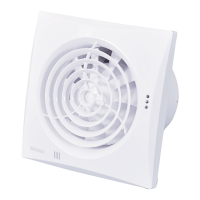
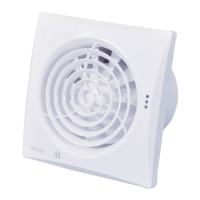
The Flexit Silent Eco fan series is designed for the ventilation of wet
rooms, but can also be used in other types of rooms.
The fan is driven by a high-efficiency motor which only consumes
7.5W.
Maintenance free bearings with a lifetime of up to 40,000 hours in
continuous operation.
The motor is fitted with overheating protection.
Special motor vibration damping ensures very low noise levels.
Fitted with a non-return damper which prevents cold air seeping in
when the fan is not in operation. The damper can be easily removed if
required.
The fan series consists of a number of different models with different
functions;
Silent Eco
Standard fan which is started/stopped via a switch.
Connected as shown in Fig. 3a.
Silent Eco TH
The fan is controlled by a humidity sensor and timer. The humidity
sensor starts the fan at a pre-set humidity level. The timer controls
how long the fan continues after moisture has been removed from the
room. The timer also starts the fan when switched on via the switch
and controls how long the fan continues to run after the power is
switched off, irrespective of the humidity level. The length of time the
fan continues can be adjusted between 2-30 min. The humidity sensor
can be adjusted between 60-90% RH. Adjusting the humidity sensor
and timer; remove the front cover. Open the cover as shown in Fig. 5.
Rotate the adjustment screws as shown in the instructions on the fan.
Use the plastic screwdriver attached to the fan, Fig. 4b. Connected as
shown in Fig. 3b.
Silent Eco TM
With motion sensor and timer. The fan is started when motion at 1 to
4 metres is detected within the sensor’s 100° detection angle. The
timer controls how long the fan continues after movements cease
and can be adjusted between 2-30 min. Connected as shown in Fig.
3a.
Silent Eco P
These fans are started and stopped using an integrated switch with
pull cord. Electrical connection as per Fig. 3a.
NB: When connecting fans with a timer and humidity sensor (TH), the
fan must be connected to a separate switch as shown in fig. 3b. If the
fan is not connected via such a switch, the timer function will not work.


 To Next Page
 Loading...