10
Loading your FLOE trailer
Securing The Load
Do not ever strap the load to or over the side of the trailer
bed. Doing so may lead to a dangerously unsecured load
and may cause damage not covered under your warranty.
WARNING
TIE DOWN INSTRUCTIONS
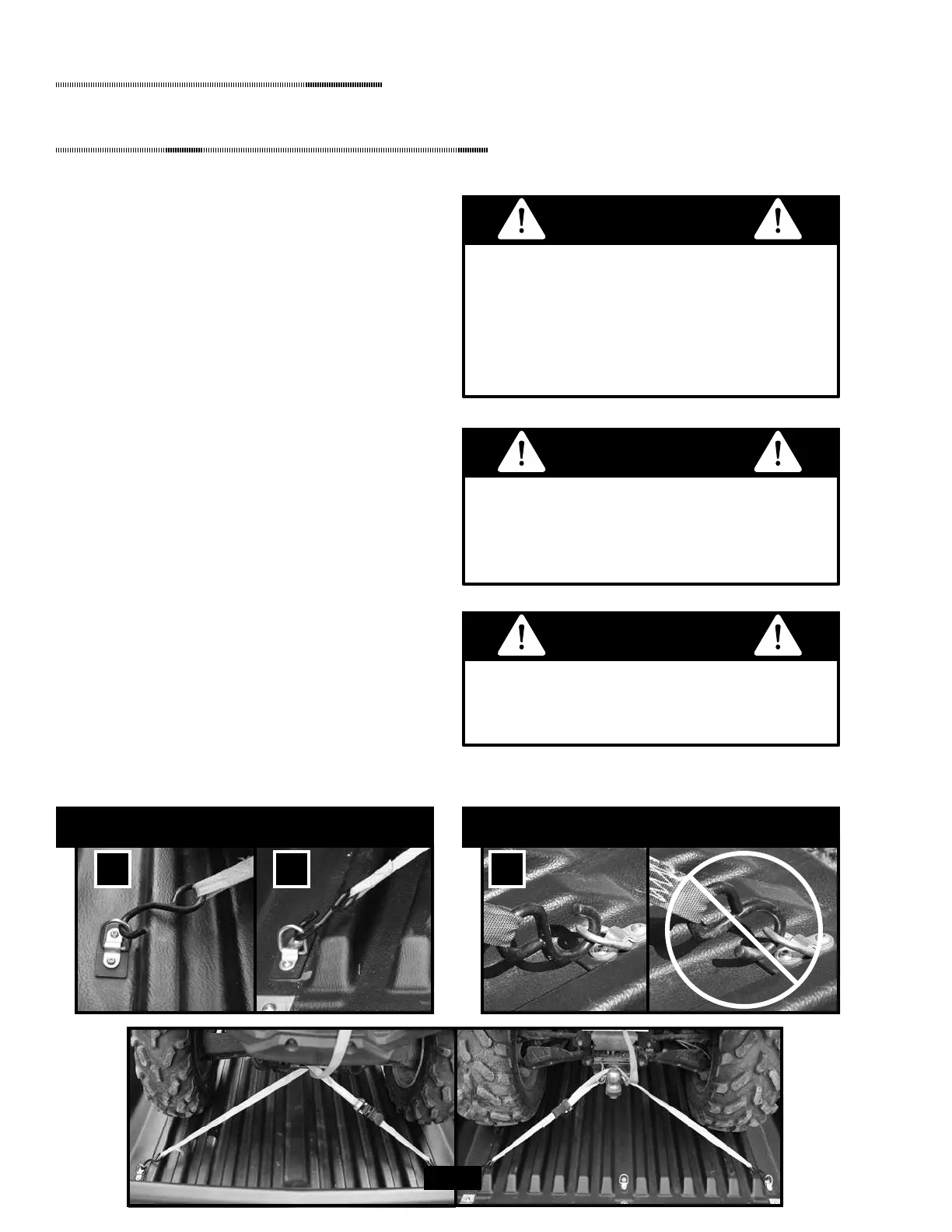
1. Use any of the tie down D-rings in the trailer bed as needed
to safely secure your load.
• e maximum capacity of each 8-57 D-ring is 500 lbs of
cargo weight. For instance: an ATV weighing 800 lbs should
be secured to four tie down loops as shown in (FIG. 4).
Maximum capacity of each D-ring on all other CargoMax
trailers is approximately 1600 lbs.
2. Cargo must be secured so that tie down restraints can not
become loose while traveling.
• If the load were to shi forward or backward it could
cause excessive tongue weight or negative tongue weight.
Either situation could be dangerous.
3. When securing hooks through the SIDE of the tie down
D-rings, either direction is appropriate -- see (FIG. 1).
4. When securing hooks through the TOP of the D-rings,
make sure the hook faces up -- see (FIG. 2). NEVER use
hooks in the position shown in (FIG. 3) as this provides a
greater chance of failure.
5. Do not place straps from the outside of the trailer over the
bed as you may cause damage to the trailer bed.
Ensure that the load is adequately secured. Load may
become loose during travel. Check your load while traveling.
Unsecured loads can cause product damage, road hazards
and/or cause severe injuries and death.
WARNING
When securing cargo, consider how it will behave if
extreme acceleration, deceleration (fast braking),
swerving, or poor road conditions occur. A load that
shifts forward or backward may cause an unsafe
situation which could result in product damage, severe
injuries or even death.
WARNING
SECURING THROUGH SIDE OF D-RING
FIG. 1FIG. 1
✔
✔
✔
FIG. 2FIG. 2
SECURING THROUGH TOP OF D-RING
FIG. 3FIG. 3
PROPER USE OF TIE-DOWN D-RINGSPROPER USE OF TIE-DOWN D-RINGS
FRONTFRONT REARREAR
FIG 4FIG 4


 To Next Page