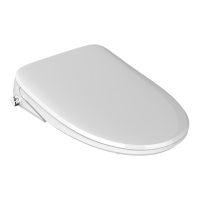
The Fluid Bidet Seat (model BID1000W) is an electric bidet seat designed to enhance personal hygiene and comfort. It offers a range of features including various cleaning modes, a drying function, a heated seat, and deodorization. The product is intended for use with a standard toilet and requires a grounded electrical outlet and a water supply connection.
Function Description:
The bidet seat provides both rear and front cleaning functions. Users can initiate these functions by turning a knob on the main unit. The rear cleaning knob, when turned forward, starts the rear cleaning function, followed by automatic drying. Turning the knob further adjusts the washing position. Similarly, the front cleaning knob, when turned backward, initiates front cleaning and subsequent automatic drying, with knob adjustments controlling the washing position. A vertical press of the knob acts as a stop button, halting any active function (rear cleaning, front cleaning, drying, or nozzle cleaning).
The device includes a drying function with adjustable warm wind temperature and speed. For comfort, the seat is heated, offering 6-level temperature adjustment. A "soft close" mechanism prevents the lid and seat from slamming. To prevent low-temperature burns, the seat temperature automatically drops to a low level after 10 minutes of continuous use.
Deodorization is achieved without photocatalyst and offers 6-level adjustment. The product also features a night light assembly with "Smart," "Always on," and "Always off" settings. A noise-free setting ensures quiet operation at night by turning off the buzzer. A user ID setting helps avoid interference from remote controls in multi-user environments.
Safety features are integrated throughout the design. These include a water temperature sensor, anti-burning apparatus, thermostat, temperature fuse, ground fault protection, leakage protection, and an anti-freeze cracking device. For water pressure, it has a pressure stabilizer and an automatic pressure discharging device. Anti-fouling measures include an anti-syphon device, anti-backflow device, and a filter device.
Important Technical Specifications:
- Rated Voltage: 110-120V, 50/60Hz
- Rated Power: 960W
- Main Unit Heating Power: 1400W (120V)
- Drying Device Heating Power: 200W
- Heated Seat Heating Power: 50W
- Water Pressure Range: Minimum 0.08MPa (hydrostatic pressure), Maximum 0.8MPa (hydrostatic pressure)
- Power Cord Length: Approximately 1.2m
- Water Temperature Adjustment: 6-level
- Water Volume Adjustment: 5-level
- Nozzle Position Adjustment: 5-level
- Warm Wind Temperature Adjustment: 6-level
- Warm Wind Speed: Over 0.2m³/min
- Deodorization Method: None Photocatalyst
- Deodorization Surface Temperature Adjustment: 6-level
- Sterilization Device (If Applicable): Plasma sterilization device
- Antibacterial Position: Seat, Nozzle
Usage Features:
- Knob Control: Intuitive knob for activating and adjusting cleaning and drying functions.
- Seat Sensor: Detects user presence for activating functions and safety.
- Remote Control: Provides convenient access to all functions.
- Self-Test: Performs a safety self-test upon power connection, indicated by buzzer beeps and knob light flashes.
- Grounding: Requires connection to a properly grounded outlet to reduce the risk of electric shock.
- Water Supply: Connects to the toilet's water supply pipe via a tee-joint.
- Installation: Designed for easy installation onto most standard toilets, with specific size requirements (130-190mm mounting hole distance, 434-493mm from mounting holes to front edge, >490mm from tank to front edge, <90>25mm from mounting holes to tank).
Maintenance Features:
- Main Unit Cleaning: Requires turning off power, wiping with a soft, wrung-out cloth, and then turning power back on. Avoid direct rinsing with water.
- Nozzle Maintenance: The nozzle rod extends for manual cleaning with a rag or soft brush. The nozzle can also be removed for separate cleaning.
- Filter Washer Maintenance: Recommended when flush performance is poor despite normal water pressure. Involves turning off the angle valve, unscrewing water inlet pipes, removing and cleaning the filter washer with a toothbrush, and then reassembling.
- Filter Cleaning for Pressure-Maintaining Valve: Involves closing the angle valve, unplugging power, disassembling the cover, unscrewing the filter connector, removing and cleaning the filter assembly, and then reassembling. Care must be taken not to lose or damage the sealing ring.
- Self-Cleaning Waterway Maintenance: If the self-cleaning waterway is blocked, the current-limiting shaft and nut can be accessed and cleaned using a flat-blade screwdriver and a small brush.
- Deodorizing Device Maintenance: The deodorant box can be unscrewed to replace the none-photocatalyst. Replacement is recommended every 3 years.
- Clamp Removal and Installation: The clamp cover can be opened, rotated counterclockwise, and pried out with a flat-blade screwdriver for removal. Installation involves clipping the clamp into the slot and rotating it until the opening faces down, then closing the cover.
- Troubleshooting Guide: Provides solutions for common issues such as no water from the nozzle, weak water cleaning, low water/seat/wind temperature, no wind, nozzle rod malfunction, remote control display issues, and deodorization malfunction. It also advises on contacting service providers for persistent problems or leakage protection switch trips.


 To Next Page

 General