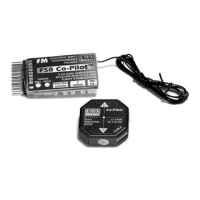
FMA Direct 5 FS8 Co-Pilot™ user guide
Safety precautions
General safety precautions
Radio controlled models are not toys! Please observe these gen-
eral safety precautions:
n Follow all instructions in this manual to assure safe operation.
n If you have not assembled and operated a radio controlled
model before, obtain help from an experienced modeler. You
will need guidance to successfully assemble, test and operate
radio controlled models. One of the best ways to obtain help
is to join your local radio control club.
n Never fly radio controlled aircraft near people, buildings, tele-
phone or power lines, cars, trees or other objects on the
ground or in the air.
n Never allow a helicopter to fly within 20 feet of you or an-
other person. If a helicopter flies toward you or another per-
son, stop the engine immediately to prevent personal injury.
n Keep your radio controlled models and equipment away from
children. Do not allow unauthorized people of any age to op-
erate radio controlled models without proper supervision from
an experienced modeler.
n In some areas of the country, you cannot legally operate radio
controlled models except at approved fields. Check with lo-
cal authorities first.
n Observe frequency control. If someone else is operating a ra-
dio controlled model on the same channel as your transmitter,
do not turn on your transmitter—even for a short time.
Your transmitter has a channel number marked somewhere on
its case. When a model receives signals from two transmitters
on the same channel at the same time, it cannot be controlled
and will crash—possibly causing personal injury or property
damage. For safety, most RC flying fields have formal fre-
quency control rules. Follow them carefully.
n Do not operate your radio control transmitter within 3 miles
of a flying field. Even at a distance, your transmitter can
cause interference.
n Do not operate radio controlled models and equipment in the
rain, or at night.
n Protect all electronic equipment from exposure to rain, water,
high humidity and high temperatures.
n FMA Direct recommends that you join the AMA. They can
help you find a club in your area.
Academy of Model Aeronautics
5161 East Memorial Drive
Muncie, Indiana 47302
Phone: (800) 435-9262
Web: www.modelaircraft.org
Safety precautions for flight stabilization:
n FS8 Co-Pilot™ is designed for flight stabilization only. It
cannot navigate the aircraft or prevent a stall. You must con-
trol the aircraft’s flight path.
n FS8 Co-Pilot™ is for recreational use only. Do not install
Co-Pilot™ in aerial photographic aircraft where there is a
possibility of flying over people.
n You must mount the FS8 Co-Pilot™ Sensor securely. Care-
fully follow the instructions in “Installing,” which tells you to
roughen the surface with sandpaper, then clean the surface
with rubbing alcohol.
n Keep fuel off the Sensors. Fuel on the Sensors can affect FS8
Co-Pilot™ operation for as long as 10 minutes.
n Perform an infrared calibration at the beginning of each flying
session, and repeat the calibration if there are major weather
changes. Details are in “At the field.”
n Besides your regular preflight check, also check FS8 Co-Pi-
lot™ operation before each flight. Details are in “At the
field.”
n FS8 Co-Pilot™ derives precision and flexibility from the cali-
bration procedure (“Infrared calibration” in “At the field”).
Background information and technical reasoning are provided
in “Understanding infrared field calibration” (page 15) and
“About infrared field calibration” (page 16). Please read and
observe the following guidelines for the best, safest operation
with the greatest margin:
l As nearly as possible, calibrate FS8 Co-Pilot™ over the
type of terrain the aircraft will be flying over. For example,
do not calibrate over bare dirt if the aircraft will be flying
over light vegetation.
l Grass provides the best, most consistent reference terrain,
but snow is the coolest reference terrain.
l If the flying area has variable terrain, calibrate over the
coolest part. This provides a conservative, lower calibra-
tion number, and assures a greater margin over warmer ref-
erence terrain. Typical infrared temperatures, in order from
coolest to warmest are: snow, water, grass, light vegetation,
sand, and asphalt or concrete.
l If you calibrate over an artificially warm medium such as
asphalt or concrete, the infrared temperature over anything
else will be lower, which reduces the temperature differ-
ence (between earth and sky) available for FS8 Co-Pilot™
to work with. If at all possible, don’t calibrate over asphalt
or concrete.
l If the aircraft will be flying over patchy snow, calibrate
over the snow.
l A calibration reading of 1 is rare. It is recommended that
you not fly using FS8 Co-Pilot™ when a reading of 1 is ob-
tained over the coolest terrain present. To completely turn
off FS8 Co-Pilot™, you must rotate the Throw controls
fully counterclockwise or unplug the Roll/Pitch Sensor.
l Helicopters require extra precision to hover. For that rea-
son, you should only use FS8 Co-Pilot™ on a helicopter
when the calibration reading is 3 or greater.


 To Next Page
 Loading...