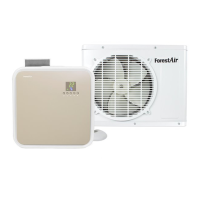
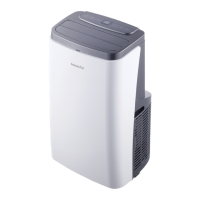
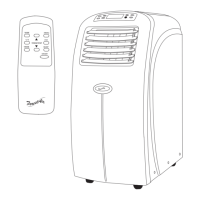
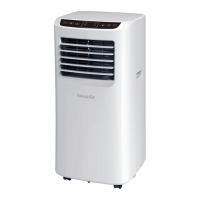
The ForestAir Mini Portable Split Air Conditioner (models F001-MP8K-B and F003-10KR-BG) is a versatile appliance designed for residential indoor use, offering cooling, dehumidification, and ventilation functions. This owner's manual provides comprehensive guidelines for installation, operation, and maintenance to ensure satisfactory performance and longevity of the unit.
Function Description:
The device operates as a mini portable split air conditioner, meaning it consists of two main units: an indoor unit and an outdoor unit, connected by coolant lines. This split design allows for more efficient cooling and quieter indoor operation compared to traditional portable air conditioners, as the noisy compressor is located in the outdoor unit. The unit can function in several modes:
- Automatic Mode: The unit automatically switches between Cooling and Ventilation modes to maintain a desired temperature. Fan speed is automatically set and cannot be adjusted. If the set temperature is higher than the ambient temperature, it will operate in Ventilation mode.
- Cooling Mode: This mode cools the room to a desired temperature, allowing the user to set the fan speed (Low, Medium, or High). The unit will not start if the set temperature is higher than the room temperature.
- Dehumidification Mode: The unit removes moisture from the air. The fan speed is automatically set to Low and cannot be adjusted.
- Ventilation Mode: The unit uses its fan to circulate air without cooling. Temperature cannot be adjusted in this mode, and the outdoor unit does not operate.
Important Technical Specifications:
While specific numerical specifications like BTU or power consumption are not detailed in the provided manual pages, the document highlights several key aspects:
- Temperature Range: The unit can be set to temperatures between 16 – 31°C (61 – 88°F) in Cooling mode.
- Timer Function: A timer can be set for 1 to 24 hours, adjustable in one-hour increments, for both switch-off and switch-on operations.
- Refrigerant: The manual mentions that the unit contains refrigerant and advises contacting a certified HVAC professional for non-routine maintenance involving coolant lines.
- Power Supply: It requires a grounded wall outlet and warns against using extension cords. The power plug should be intact and firmly inserted.
- Window Kit Compatibility: The window slider kit is designed to fit most standard vertical and horizontal windows and patio doors, with adjustable panels for openings ranging from 65 cm (25½ in) to 250 cm (98½ in). Panel A can be shortened if the window opening is less than 65 cm.
Usage Features:
The ForestAir Mini Portable Split Air Conditioner offers user-friendly controls and installation flexibility:
- Control Panel and Remote Control: The unit can be operated via a control panel on the indoor unit or a remote control. Both offer similar functions, including Power ON/OFF, Mode Selection, Fan Speed Selection, UP/DOWN buttons for temperature/time adjustment, and Temperature Unit Selection (°C/°F).
- Display Screen: An LCD screen displays the current temperature/time, temperature unit, operation mode, and fan speed.
- Elevated Installation (Indoor Unit): For maximum efficiency, it is recommended to install the indoor unit in an elevated area, as cool air is denser and moves downwards.
- Outdoor Unit Placement: The outdoor unit requires a level, stable surface with at least 30 cm (12 in) of clearance from walls and surrounding objects for adequate exhaust air release. It should also be drained with the provided condensation hose.
- Window Kit Assembly: The manual provides detailed instructions for assembling the four-panel window kit, including inserting T-bolts, sliding panels, and securing them with wing nuts and washers. The coolant lines are routed through a rubber connector fitted into panel A of the window kit.
- Auto Restart Delay: To increase the service life of the compressor, the unit has a 3-minute auto restart delay. If the unit is turned off and then on again immediately after, or switched to Cooling mode from another mode, the compressor will delay its startup by 3 minutes.
Maintenance Features:
Regular maintenance is crucial for the appliance's efficiency and longevity:
- Cleaning the Surface: The exterior should be cleaned with a damp non-abrasive cloth and dried with a soft towel. Harsh cleaning products, waxes, or chemical solvents should be avoided to prevent damage to the surface finish. Care must be taken to keep water out of the interior.
- Cleaning the Air Filter: The air filter should be cleaned every two weeks to prevent dust accumulation and maintain effectiveness. This involves pulling off the front panel, removing the filter, cleaning debris, and rinsing it with lukewarm water if desired. Mild detergents or a hand vacuum can also be used. The unit should never be operated without air filters.
- Water Drainage: While the indoor unit typically doesn't require draining, special instances may necessitate it. The process involves turning off and unplugging the unit, removing the back compartment cover, pinching the drainage hose's metal clasp with pliers to release the pipe, and draining the water. After draining, the unit should be run in Ventilation mode for at least two hours to dry the inside completely before reassembling the hose and cover.
- Troubleshooting Guide: The manual includes a comprehensive troubleshooting section for common issues (e.g., unit not working, poor cooling efficiency, excessive noise, compressor not working, remote control issues) and error codes (E0 for water collection, E1 for indoor temperature sensor failure, E2 for EVA sensor failure, E6 for overcooling, E7 for overheating), providing possible causes and solutions. For persistent issues or those not covered, contacting Customer Service or a professional is recommended.
Safety Precautions:
The manual emphasizes several safety precautions, including proper grounding, keeping the product upright, avoiding obstructions in air inlets/outlets, proper condensation hose connection, keeping away from flammable substances, and not disassembling or modifying the unit. It also advises against directing airflow on vulnerable individuals for extended periods and always unplugging the appliance before servicing.



 To Next Page
 General