QUANTUM
™
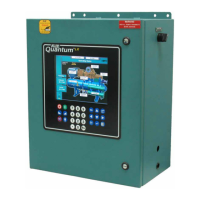
LX EVAPORATOR CONTROL PANEL
MAINTENANCE
090.610-M (MAY 2016)
Page 5
GENERAL INFORMATION
The components within the control panel can be
inadvertently damaged by static electricity or mis-
handling. Only qualied technicians should directly
handle these components.
1. DO NOT attempt to make corrections to the
power supply without shutting off the power
to the control panel. Accidental shorts can
irreparably damage the processor boards or
the display screen.
2. DO NOT HANDLE the panel boards when their
cables are disconnected without rst attach-
ing a properly grounded wrist ground strap to
prevent static electrical discharge from your
body.
Most problems encountered with the microprocessor
and control circuits will be the result of a wiring fault, a
blown fuse, faulty I/O module or failure of a peripheral
control such as a solenoid coil or a pressure transducer.
Faults in the computer, while possible, are unlikely. If a
fault develops in the computer, the probability is that
all functions will cease and the display screen will go
blank. The control system consists of an AC (high volt-
age) side, which can be either 120 volts, or 230 volts,
and a DC (low voltage) side. The AC side actuates so-
lenoids, relays, alarms, and other electromechanical
functions. The DC side operates the computer and its
various sensors.
When working within the panel, the AC high voltage
side, which can be either nominal 120 VAC or nomi-
nal 230 VAC, CAN CAUSE INJURY OR DEATH.
To troubleshoot the low-voltage side of the control cir-
cuits, it is necessary to have the following tools:
1. Accurate digital multimeter (capable of read-
ing to DC/AC, mA to the hundreds place)
2. Small wire stripper
3. Small screwdriver (with insulated shaft)
4. Small snip nose pliers
5. Wrist Grounding strap
6. Static free grounded work surface
Note: Proper panel voltage refers to the AC (high volt-
age) that has been supplied to the panel, which could
be either nominal 120 VAC or nominal 230 VAC.
WHAT TO DO BEFORE CALLING THE FACTORY
Many times when a suspected Quantum™ problem is
called in to the factory, not enough information is pro-
vided for the service personnel to assist in solving the
problem. This is because the caller most likely is not
aware of the type of information that would be use-
ful to factory personnel in helping to identify and cor-
rect the problem. An example of this is the statement
that the Quantum™ is not booting (the main processor
board is not starting). Unfortunately, this description is
usually vague and only means that there is nothing on
the display. A blank screen could be the result of many
different problems. The following is a list of possible
reasons for no display:
• No power
• Loose or Faulty Display Cable or Inverter Ca-
ble
• Bad Display
• Bad Backlight Inverter (on CCFT style displays)
• Bad Backlight Fluorescent Tube (on CCFT style
displays)
• Wrong Combination of Display, Cable, Invert-
er, or Software
• Faulty CPU Board
Before calling the factory for assistance, review the in-
formation on the following pages and try to discover
and resolve your Quantum™ LX problem. The actual
cause of most problems is usually not with the Quan-
tum™ board itself, but with something external. How-
ever, on the rare occasion that the problem has been
identied as being the Quantum™ board, use the fol-
lowing section as a guideline for replacing it.


 To Next Page
 Loading...