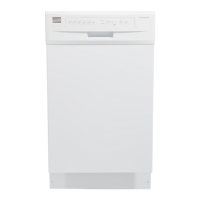
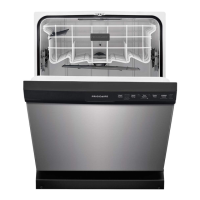
This document describes the Frigidaire dishwasher, a household appliance designed to clean dishes, glassware, and cookware using a combination of hot water and detergent. The dishwasher operates through a series of water fills and drains, circulating water through spray arms to remove food soils. It is designed for energy efficiency, utilizing motors for both wash and drain portions of the cycle.
Function Description
The Frigidaire dishwasher's primary function is to automate the dishwashing process. It achieves this by spraying a mixture of hot water and detergent onto soiled surfaces. The process involves filling the dishwasher with water to cover the filter area, pumping water through the spray arms, and then draining the water along with soil particles through the filter and out the drain. This sequence is repeated as needed, with the number of water fills varying depending on the selected wash cycle.
The dishwasher offers several wash cycles to accommodate different soil levels and needs:
- Heavy Wash: Recommended for heavily soiled pots, pans, casseroles, and dinnerware.
- Normal Wash: Suitable for lightly to heavily soiled loads.
- Light Wash: Designed for lightly soiled loads only.
- Energy Saver: A cycle aimed at reducing energy consumption.
- Rinse Only: Used for rinsing dishware that will be washed later, preventing food soils from drying onto dishes.
To enhance cleaning and drying performance, the dishwasher includes various options:
- Sanitize Option: Raises the final rinse water temperature to 155°F (68°C) and maintains it for 9 minutes to sanitize dishes and glassware. This option is available in Heavy and Normal Cycles and is designed to meet NSF requirements. The cycle time may extend to ensure the proper water temperature is reached.
- Hi-Temp Wash Option: Heats water in the main wash to approximately 140°F (60°C). This helps detergent remove food grease and soil more effectively and improves drying. It is automatically provided with the Heavy Wash cycle.
- Heat Dry Option: In combination with rinse aid, this option enhances drying performance. While it consumes a small amount of energy, it helps ensure items are thoroughly dry.
- Delay Start Option: Allows users to delay the start of a wash cycle for 2, 4, or 6 hours, providing flexibility in scheduling.
The dishwasher features status indicator lights to keep users informed about the cycle's progress. Lights illuminate for WASHING, DRYING, CLEAN, and SANITIZED (if selected and successfully completed).
Usage Features
Operating the Frigidaire dishwasher involves a straightforward process:
- Loading: Dishes should be scraped of large food pieces, bones, and pits. Burned-on foods should be loosened. Liquids should be emptied from glasses and cups. For best results, items should be loaded to allow water to reach all surfaces and to prevent blocking the spray arms or detergent dispenser. Sharp items and knives should be placed with handles up to reduce injury risk. Plastic items and delicate items should be placed in the top rack to prevent melting or damage.
- Detergent Addition: The dishwasher has two detergent cups: a smaller one for pre-wash and a larger one for the main wash. Only fresh, household-grade automatic dishwashing detergent should be used. The amount of detergent required varies based on water hardness, with a chart provided to guide users. For very hard water (over 12 grains), a water softener is recommended. If using automatic dishwashing tabs, one tab should be placed in the main wash cup.
- Rinse Aid Addition: A rinse aid dispenser, located next to the detergent cup, automatically releases a measured amount of rinse aid during the last rinse. Rinse aid significantly improves drying, reduces water spots, and lubricates the wash arm bearing for proper rotation. The dispense amount can be adjusted by rotating a dial under the cap. The indicator will be dark when full and clear when it needs refilling.
- Water Temperature: Hot water is crucial for optimal dishwashing and drying. The incoming water temperature should be at least 120°F (49°C). The dishwasher has an automatic sensor that will lengthen the cycle for water heating if the incoming temperature is too low. Running the hot water faucet nearest the dishwasher for several minutes before starting a cycle is recommended to ensure hot water enters the unit.
- Cycle Selection: Users select the desired wash cycle and any additional options (Sanitize, Hi-Temp Wash, Heat Dry, Delay Start) using the control panel. Indicator lights confirm selections.
- Starting the Cycle: After loading, adding detergent and rinse aid, and selecting the cycle/options, the START/CANCEL pad is pressed to begin.
- Child Lock: To prevent accidental changes or starts, the controls can be locked by pressing and holding the DRY OPTION pad for 3 seconds. An indicator light confirms the lock is active.
- Canceling a Cycle: A cycle can be canceled at any time by pressing and holding the START/CANCEL pad for 3 seconds. The dishwasher will perform a 90-second drain, after which a new cycle can be selected.
- Adding a Dish Mid-Cycle: If an item needs to be added after a cycle has started, the door should be unlatched, and a few seconds allowed for the wash action to stop and cold air to expand inside the dishwasher before opening fully. After adding the item, the door should be firmly latched, and the START/CANCEL pad pressed to resume.
The dishwasher is designed to remember the last cycle and options selected, allowing for quick restarts by simply pressing the START/CANCEL pad.
Maintenance Features
Regular maintenance ensures the dishwasher operates efficiently and prolongs its lifespan:
- Outer Door Cleaning: The outer door should be cleaned with warm, soapy water and a soft cloth, then rinsed and dried. Harsh cleaners should be avoided.
- Interior Cleaning: The inside of the dishwasher and its filter are largely self-cleaning with normal use. However, the tub gasket area should be wiped occasionally with a damp cloth.
- Glass Trap Maintenance: A glass trap, located in the center of the filter, collects broken glass, straws, bones, and pits. To empty it, the glass trap's handle is rotated 90° clockwise while pressing down on the wash arm. The spray arm and glass trap assembly are then lifted out, and the trap is emptied. It's crucial to ensure the spray arm and glass trap are fully snapped back into place to prevent damage.
- Overfill Protector: Located in the left front corner of the tub, this mechanism prevents overfilling. It should be cleaned occasionally with a household cleaner containing vinegar or bleach to dissolve any buildup. The overfill protector should move freely up and down by about one inch; if it doesn't, it should be lifted and cleaned underneath.
- Drain Air Gap (if installed): If a drain air gap is part of the installation, it should be checked periodically to ensure it is clean and allows proper drainage. This component is typically mounted on the countertop and can be accessed by removing its cover.
- Hard Water Spots and Film: Hard water can cause lime deposit buildup, spots, and film on dishes and the dishwasher interior. To remove this, clean dishes and glasses can be loaded (without metal utensils), a NORMAL WASH cycle started without detergent, and after the second water fill (about 10 minutes), 2 cups of white vinegar poured into the bottom of the dishwasher before allowing the cycle to finish.
- Winterizing: If the dishwasher is left in an unheated area, it must be protected from freezing. This involves disconnecting electrical power and water supply, draining water from the inlet valve and drain line, and then restoring service when appropriate. These steps should be performed by a qualified person.
The manual also provides a "Before You Call" section to help users troubleshoot common issues, such as food soils left on dishes, dishes not drying, spotted or cloudy glassware/flatware, chipped dishware, stained or discolored dishware, etching, detergent left in cups, and the dishwasher not filling, draining, or running. These troubleshooting tips often involve checking loading patterns, detergent and rinse aid levels, water temperature, and ensuring proper installation.

 Need help?
 General
 Weight and Dimensions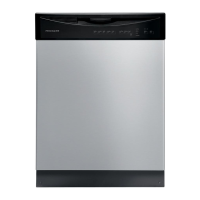



 To Next Page