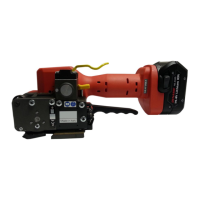
The FROMM P318 is a battery-powered plastic strapping tool designed for strapping packages with plastic strapping. It automates the process of tensioning, friction welding, and separating straps, making it suitable for various packaging applications.
Function Description
The P318 tool is designed for efficient and reliable strapping. Users manually feed the plastic strap around the package, either directly or in combination with a strap feeder. Once the straps are inserted into the tool, it automatically tensions them to a preselected force, seals them using friction welding, and then cuts the strap. The tool provides visual feedback through an LED indicator for different operational stages, including tensioning, welding, cooling, and battery status.
Important Technical Specifications
The P318 is compatible with both PET (Polyester) and PP (Polypropylene) plastic straps, available in plain or embossed qualities. It supports strap dimensions ranging from 8.0 to 13.0 mm in width and 0.35 to 0.8 mm in thickness. The tool's dimensions vary slightly depending on the battery model:
- With battery N5.4328: Length 330 mm (13"), Width 122 mm (4.8"), Height 130 mm (5.2").
- With battery N5.4330: Length 350 mm (13.8"), Width 122 mm (4.8"), Height 130 mm (5.2").
The weight of the tool also varies with the battery:
- With battery N5.4328: 3.4 kg (7.5 lbs).
- With battery N5.4330: 3.7 kg (8.2 lbs).
The tool's noise level is typically 79 dB (A), with a deviation K of 3 dB, measured according to DIN EN 60745-1 (12.2003). The weighted effective value of acceleration is less than 2.5 m/s², with a deviation K of 0.6 m/s², also measured per DIN EN 60745-1 (12.2003).
Strap tension is adjustable from 150 N (34 lbs) to a maximum of 800 N (180 lbs). The tensioning speed can be adjusted from approximately 150 mm/s (5.9 inch/sec) to 300 mm/s (11.8 inch/sec). The joint strength achieved by friction welding is approximately 75% of the plastic strap's tensile strength, though this value depends on the strap quality.
The tool operates within an ambient temperature range of -10°C to 45°C (14°F to 113°F), with optimal performance achieved between 15°C and 20°C (59°F and 68°F).
The P318 uses 18 VDC Li-ion batteries. Battery N5.4328 has a capacity of 1.5 Ah and charges in approximately 30 minutes. Battery N5.4330 has a capacity of 3.0 Ah and charges in approximately 60 minutes. Chargers are available for various voltage/frequency requirements (e.g., 220-240V/50-60Hz, 120V/50-60Hz).
Usage Features
Operation:
- Battery Insertion and Removal: Batteries are inserted from top to bottom until the unlatching push buttons engage. To remove, press the unlatching push buttons and push the battery out in the opposite direction. The LED lights briefly red upon removal.
- Battery Status Display: A button on the battery allows users to check its charge status in four steps, indicated by lamps. Four lit lamps mean a full charge, while one lit lamp indicates the need for recharging.
- Strap Insertion: The handle lever is pulled up, and two aligned straps are inserted into the strap guide. Releasing the lever secures the straps.
- Tensioning: Pressing and releasing the tension button initiates the tensioning process. The LED lights green during tensioning. The operation can be interrupted and restarted as needed.
- Sealing: After tensioning, the sealing lever is pressed down until it locks, then released. The tool performs friction welding and cuts the strap. The LED lights green during welding, then yellow during the cooling time, during which the tool should not be removed from the strap. A green LED indicates the sealing cycle is complete.
- Tool Removal: After the cooling time, the handle lever is pulled up, and the tool is pulled right/backwards and off the strapping.
Adjustments:
- Strap Tension and Speed: The upper adjusting knob controls both tensioning force and speed. Turning it clockwise increases these parameters, while counter-clockwise decreases them.
- Welding Time: The lower adjusting knob adjusts the welding time, which is crucial for optimal seal strength. Clockwise increases, counter-clockwise decreases. A coin can be used to turn these knobs.
Safety Features:
- General Safety: Users must read all instructions to prevent electric shock, fire, or injury. The work area must be clean and well-lit, and children/bystanders kept away.
- Electrical Safety: Power tool plugs must match outlets, and extension cords suitable for outdoor use should be used when operating outdoors.
- Personal Safety: Users must stay alert, wear eye protection, and avoid accidental starting. Loose clothing, jewelry, and long hair should be secured away from moving parts.
- Strap Warnings: Strap should never be used for pulling or lifting loads. Edge protectors are recommended for sharp load corners. Users must position themselves to one side of the strap during tensioning and sealing to avoid injury from flying strap or tool. Only recommended strap quality, width, gauge, and tensile strength should be used.
- Seal Control: Regular visual inspection of seals is necessary. The manual provides guidelines for identifying correct seals, seals with insufficient welding time (too short), and seals with excessive welding time (too long). Insufficient seals must be removed from packages.
Maintenance Features
Wearing Parts Exchange:
- Tensioning Wheel and Grippers: The manual provides detailed steps for disassembling and assembling these components, including removing the end cover, torsion spring, tensioning body, tensioning wheel, and grippers. Specific attention is required for the correct positioning of the tensioning wheel and grippers during assembly.
- Cutter, Welding Stop Gripper, and Welding Gripper: Instructions are provided for disassembling these parts, which involves removing the end cover, torsion spring, tensioning body, tensioning wheel, lever, coupler, centering sleeve, pressure spring, cutter, welding stop gripper, and welding gripper.
- Lubrication: Specific parts, including the rocker, bolt, balls, ball cage, welding gripper, cutter, and driver, require lubrication with specified products (Klüber Isoflex NBU 15, Klüber Isoflex Alltime SL2, Mobilux EP2).
- Coupler Adjustment: The coupler is factory-adjusted but may need readjustment if the seesaw lever, coupler, or lever body is replaced. The procedure involves loosening and retightening a screw after positioning the thrust piece to touch the seesaw levers.
- Cleaning: Strap gripping parts should be regularly cleaned from strap abrasion using compressed air. The cover can be removed to blow air on welding elements. Mechanical tools and aggressive solvents should not be used for cleaning.
Service:
- Servicing and repair must only be carried out by authorized service centers. The tool should be sent fully assembled to the service center in its original packing if it breaks down or malfunctions.
- FROMM recommends servicing the tool after 12 months if used one shift per day, or sooner if used for two or more shifts.
Disposal:
- The machine, accessories, and packaging should be sorted for environmental-friendly recycling.
- For EC countries, power tools must not be disposed of in household refuse but collected separately and disposed of in an environmentally correct manner according to European Guideline 2002/96/EC. FROMM distributors offer a battery disposal service.



 To Next Page
 General