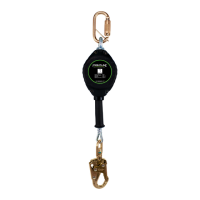
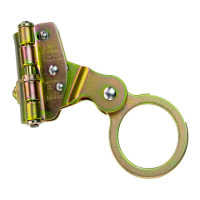
The Frontline PitchFast Roof Anchor (model RORS01) is an active fall protection system designed for use in personal fall arrest, fall restraint, and work positioning applications. This anchorage connector is intended to be a component of a complete personal fall protection system (PFAS) and is designed to meet or exceed applicable OSHA 1910, OSHA 1926, and ANSI Z359.18 (Type A) fall protection standards. It is crucial that users read and fully understand the instruction manual before using this product, as improper use or installation can lead to serious injury or death.
Function Description:
The RORS01 Roof Anchor provides a secure attachment point for lifelines, lanyards, or deceleration devices, enabling workers to safely tie-off while maintaining mobility and productivity. It is designed to be installed on structural wood trusses, metal, or concrete structures. In a personal fall arrest system, the anchor works in conjunction with an approved connecting device (such as a lanyard or self-retracting lifeline) and a full body harness to arrest a fall. For fall restraint applications, it limits a user's travel distance to prevent exposure to fall hazards. For work positioning, it supports an employee on an elevated vertical surface, allowing them to work with both hands free.
Important Technical Specifications:
- User Capacity: 1 person with a combined weight (clothing, tools, etc.) of no more than 310 lbs for ANSI compliance and 420 lbs for OSHA compliance.
- Service Temperature: -30°F to +130°F (-34°C to +54°C) minimum service temperatures.
- Breaking Strength: 5,000 lbs (22.2 kN) minimum breaking strength.
- Material: ASTM A36 Rated Steel.
- Finish: Electrostatic Paint / Hot Dip Galvanized.
- Dimensions: 3" x 11.4" x 1.2" (7.6 cm x 29 cm x 3 cm).
- Weight: 1.4 lbs (0.64 kg).
- Fasteners: (12) 3.5" Grip-Rite exterior screws or (12) 16D Galvanized framing nails.
- Roof Pitch Compatibility: Compatible with roof pitches from 0/12 to 4/12. The anchor cannot be installed on steeper roof pitches.
- Structural Requirements: The wooden substrate must be a roof truss structural member, a minimum of 3.5" thick, free from defects (cracks, decay, rot), and capable of withstanding a minimum breaking strength of 5,000 lbs (22.2 kN) per employee attached. Installation must comply with all Federal, State, and local regulations and be approved by a Qualified Person.
Usage Features:
- Versatile Applications: Suitable for personal fall arrest, fall restraint, and work positioning.
- Compatibility: Requires compatible connectors (approved snaphooks or carabiners) that meet OSHA and ANSI standards to prevent unintentional disengagement. Connectors must be of locking type.
- Single Connection Point: No more than one PFAS may be connected to a Fall Arrest Anchor at one time.
- Installation:
- Location: Identify a clean, obstruction-free anchor location.
- Positioning: Place the anchor in an upright position, centered over the sheathing and wooden truss.
- Fastening (Screws): Use (12) 3.5" Grip-Rite exterior screws. A minimum of 8 screws must fully penetrate the sheathing and into the structural wooden member (no less than 3.5" penetration into the structural member if insulation is present). The remaining 4 screws must also be fully drilled into the sheathing.
- Fastening (Nails): Use (12) 16D Galvanized framing nails. A minimum of 8 nails must fully penetrate the sheathing and into the structural wooden member (no less than 3.5" penetration into the structural member if insulation is present). The remaining 4 nails must also be fully nailed into the sheathing.
- Inspection: A qualified person must inspect and approve the installation before the anchor is used.
- Fall Clearance and Swing Fall Considerations: Users must calculate total fall clearance distance before use, considering lanyard/SRL length, anchor height, deceleration distance, worker height, D-ring shift, and a safety factor. Swing fall hazards must be evaluated, and the anchorage point should ideally be directly overhead to prevent injury from striking objects during a fall.
- Prohibited Connections: The manual explicitly illustrates and warns against non-compatible connections, such as connecting two snaphooks/carabiners to each other or to a single D-ring, loading the gate, attaching to an object that prevents full locking, attaching directly back into the component itself (unless specified), or attaching in a manner where the connector, gate, or release lever may become caught on the anchor.
- Directional Loading: The anchor must be installed with the connection point parallel to the user, and the direction of loading facing the user.
Maintenance Features:
- Pre-Use Inspection: The anchor and any other PFAS components must be inspected before each use by the authorized user or rescuer.
- Periodic Inspection: A competent or qualified person (other than the user) must conduct thorough safety inspections every 6 months or sooner, or as required by the authorized user or employer.
- Inspection Criteria: Inspections should include checking for:
- Legible safety labels/markings/tags.
- Defects such as corrosion, broken, bent, deformed, excessive wear, or defects in welded areas.
- Any evidence of damage or alterations affecting safety.
- Missing parts (e.g., fasteners).
- Any other unconformity.
- Out-of-Service Criteria: Any product that has been subject to a fall or impact, does not pass inspection, or has questionable safety/integrity must be immediately removed from service.
- Cleaning: Equipment exposed to rain/dirty water, concrete, paint, or other contaminants must be cleaned and dried before storage. Equipment chemically exposed that cannot be cleaned with water and soap must be removed from service.
- Storage: When not installed, products should be stored at room temperature in an indoor, clean area, away from sunlight, rain, and other environmental conditions. Avoid exposure to chemicals, oils, paint, concrete, or other contaminants that could compromise integrity.
- Transport: Products should be transported carefully to prevent damage from impact with other items or exposure to harmful substances/chemicals.
- Repairs: Repairs and maintenance can only be performed by Frontline Fall Protection. End users or other companies are not authorized to repair Frontline Fall Protection products.
- Documentation: All inspections must be documented in the Inspection and Maintenance Log provided in the manual.

 Need help?
 General

 To Next Page