22 23
must be performed at the installation site due to possible mis-
handling in shipment, or excessive pressure unknowingly be-
ing applied to the unit. Periodically check the whole system for
leaks, or immediately if the smell of gas is detected.
Before Testing:
Do not smoke while leak testing. Extinguish all open fl ames. Nev-
er leak test with an open fl ame. Make a soap solution of one part
liquid detergent and one part water. You will need a spray bottle,
brush, or rag to apply the solution to the fi ttings. For LP units,
check with a full cylinder. Remove the control knobs and battery
to disable accidental ignition. Open the drawer containing LP or
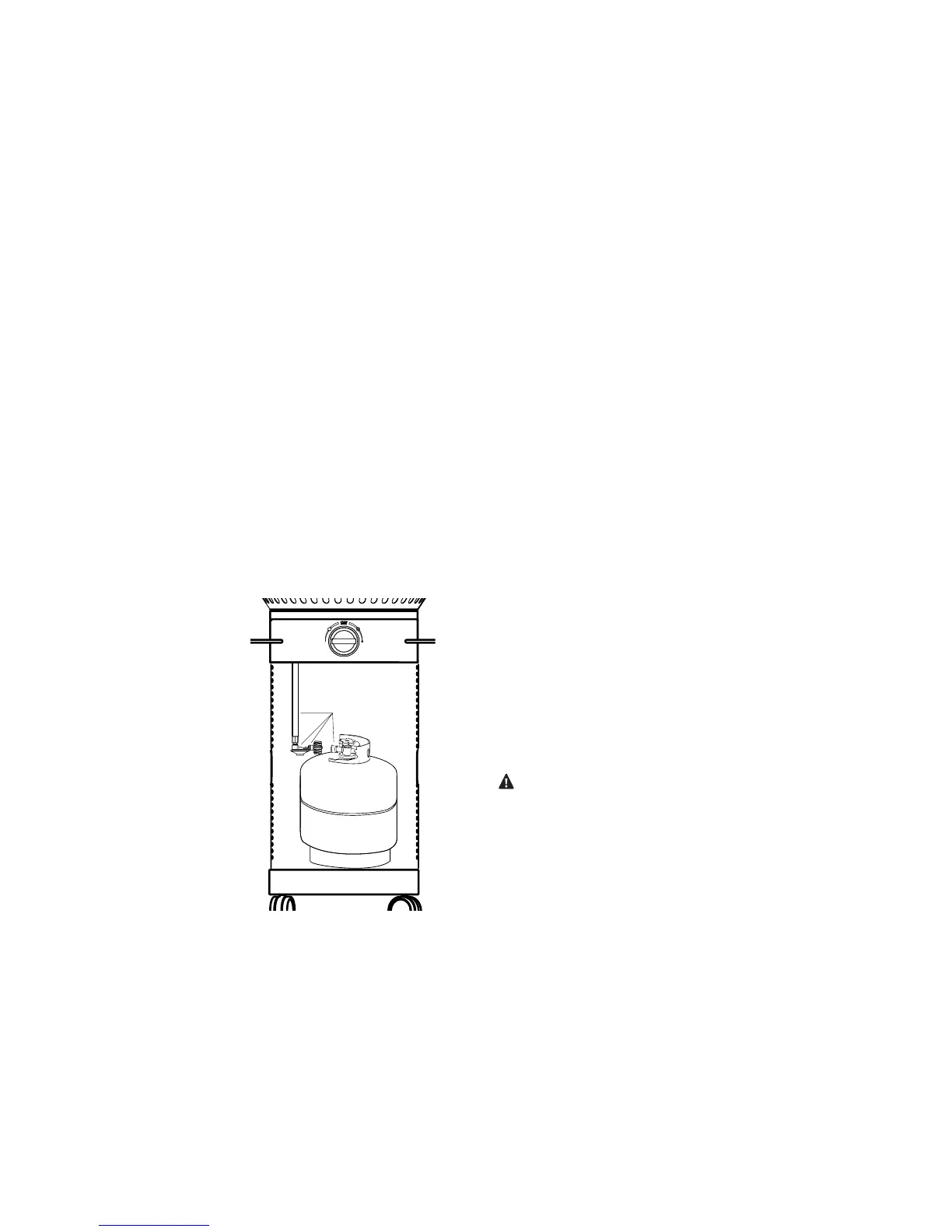
natural gas hook up, this is where all tests will be performed.
To Test:
Make sure all control valves are in the “OFF” position. Turn the gas
supply “ON”. Check all connections from the supply line, or LP
cylinder up to and including the manifold pipe assembly. Apply
the soap solution around the connection, valve, tubing and end of
the manifold. Soap bubbles will appear where a leak is present. If a
leak is present, immediately turn off gas supply, tighten any leak-
ing connections, turn gas on, and recheck. Check all the gas con-
nections at the base of the control valves where they screw into
the manifold pipe.
If you cannot stop a gas leak, turn off the gas supply and call your
local gas utility or the dealer you purchased the appliance from.
Only those parts recommended by the manufacturer should be
used on the grill. Substitution can void the warranty.
WARNING:
Do not use the grill until all connections have been checked and
do not leak.
Check all gas supply fi ttings for abrasions, cracks and leaks
before each use. It is recommended to keep a spray bottle fi lled
with soapy water near the shutoff valve of the gas supply valve.
Spray all the fi ttings. Bubbles indicate leaks. (FIG. 02)
already done so when disengaged. Your local LP fi lling station
should be equipped with the proper equipment to fi ll your tank.
Lp Tank Requirements:
A dented or rust LP tank may be hazardous and should be
checked by your local supplier. Never use a cylinder with a dam-
aged valve. Always check for leaks after every LP tank change. The
LP gas cylinder must be constructed and market in accordance
with specifi cations for LP gas cylinders of the U.S. Department
of Transportation (DOT or CAN/CSA-B339) and designed for use
with a Type 1 system only. Do not change the regulator and hose
assembly from that supplied with the unit or attempt to use a
Type 1 equipped regulator and hose assembly with a standard 510
POL tank/valve assembly. The cylinder must be provided with a
shut-off valve terminating in an LP gas supply cylinder valve outlet
specifi ed, as applicable, for connection Type 1. If the appliance is
stored indoors, the cylinder must be disconnected and removed
from the appliance. Cylinders
must be stored outdoors in a
well-ventilated area out of the
reach of children.
Note: When an LP unit is di-
rectly attached into an LP house
system, the step down regula-
tor MUST be used to reduce the
supply pressure to a max. 14”
W.C. and a min. 11” W.C. to the
grill regulator.
Leak Testing
General:
Although all gas connections
on the grill are leak tested at
the factory prior to shipment, a
complete gas tightness check
Leak Test Spots
Check for
abrasions, cracks
and leaks
FIG. 02


 To Next Page
 Loading...