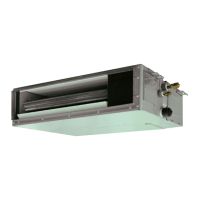
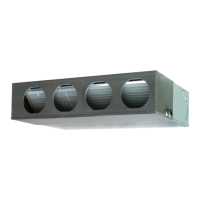
This document describes the Fujitsu General Airstage VRF system indoor unit (Duct type), specifically models ARUM24TLAV2, ARUM30TLAV2, and ARUM36TLAV2. It serves as an operating manual, providing essential information for safe and efficient use, maintenance, and troubleshooting.
Function Description:
The Airstage indoor unit is designed for cooling, heating, dehumidifying, and air-circulation in ordinary dwellings. It operates on a heat-pump principle, absorbing heat from outdoor air and transferring it indoors during heating mode. The unit is part of a VRF system, meaning multiple indoor units can be connected within the same system, with operating mode choices potentially limited depending on the system configuration. It features a microcomputer-controlled automatic defrosting function to prevent reduced operating performance in low outdoor air temperature and high humidity conditions. An oil recovery operation is periodically performed to return compressor oil to the outdoor unit.
Important Technical Specifications:
- Models: ARUM24TLAV2, ARUM30TLAV2, ARUM36TLAV2
- Power Source: 208/230 V ~ 60 Hz
- Available Voltage Range: 187 to 253 V
- Cooling Capacity:
- ARUM24TLAV2: 24,000 Btu/h (7.0 kW)
- ARUM30TLAV2: 30,000 Btu/h (8.8 kW)
- ARUM36TLAV2: 36,000 Btu/h (10.6 kW)
- Heating Capacity:
- ARUM24TLAV2: 27,000 Btu/h (7.9 kW)
- ARUM30TLAV2: 34,000 Btu/h (10.0 kW)
- ARUM36TLAV2: 40,000 Btu/h (11.7 kW)
- Sound Pressure Level (dB [A]):
- HIGH: 36 (ARUM24TLAV2), 40 (ARUM30TLAV2), 41 (ARUM36TLAV2)
- MED - HIGH: 34 (ARUM24TLAV2), 37 (ARUM30TLAV2), 39 (ARUM36TLAV2)
- MED: 32 (ARUM24TLAV2), 34 (ARUM30TLAV2), 37 (ARUM36TLAV2)
- MED - LOW: 30 (ARUM24TLAV2), 32 (ARUM30TLAV2), 34 (ARUM36TLAV2)
- LOW: 29 (ARUM24TLAV2), 30 (ARUM30TLAV2), 31 (ARUM36TLAV2)
- QUIET: 28 (ARUM24TLAV2), 28 (ARUM30TLAV2), 29 (ARUM36TLAV2)
- Dimensions (Height x Width x Depth): 10-5/8 in (270 mm) x 44-11/16 in (1,135 mm) x 27-9/16 in (700 mm)
- Weight: 86 lbs (39 kg)
- Operating Temperature and Humidity Range:
- Cooling/Dry Mode:
- Indoor Temperature: About 64 to 90 °F DB (18 to 32 °C DB)
- Indoor Humidity: About 80% or less
- Heating Mode:
- Indoor Temperature: About 50 to 86 °F DB (10 to 30 °C DB)
- Outdoor temperature range refers to the specification of outdoor units.
- Acoustic Noise Information: Maximum sound pressure level less than 70 dB (A) for both indoor and outdoor units, according to IEC 704-1 and ISO 3744.
- Standard Static Pressure: 0.16WG (40 Pa)
Usage Features:
- Control: The unit can be operated using optional control units, including wireless remote controllers (requiring a receiver unit), wired remote controllers, or simple remote controllers.
- Manual Auto Operation: In the event the remote controller is lost or unavailable (and a receiver unit is connected), the MANUAL AUTO button on the operating control panel allows for basic operation.
- Starting Operation: Pressing the MANUAL AUTO button sets the operating mode to AUTO, fan speed to AUTO, and setting temperature to 74°F (23°C). If AUTO mode cannot be selected, it will operate in the same mode as other indoor units in the system (or cooling if no other unit is operating).
- Stopping Operation: Pressing the MANUAL AUTO button again stops the operation.
- Emergency Heat: If enabled, pressing the MANUAL AUTO button during heating operation will activate the auxiliary heater as the primary heater, stopping the outdoor unit. The OPERATION Indicator Lamp (green) blinks during this mode. Pressing the button again cancels emergency heat.
- Priority State and Standby State: In systems with multiple indoor units, operating mode choices are limited. A "priority state" determines which mode (cooling or heating) can be selected. Units not in the priority mode will enter a "standby state" (OPERATION indicator lamp lights up, TIMER indicator lamp flashes) until the priority mode changes.
- Low Ambient Cooling: The outdoor unit's fans may switch to low speed or stop intermittently when outdoor temperature drops.
- Heating Performance: Heating performance may be reduced as outdoor air temperature drops. It is recommended to use the air conditioner with another type of heating appliance if insufficient heating performance is felt. Heating takes time to warm the entire room due to air recirculation.
- Microcomputer-controlled Automatic Defrosting: During heating in low outdoor air temperature and high humidity, the unit temporarily stops operation (4 to 15 minutes) for defrosting. The OPERATION indicator lamp (green) flashes during this process.
- Oil Recovery Operation: Periodically, the unit performs an oil recovery operation (about 10 minutes) to return compressor oil to the outdoor unit. The OPERATION indicator lamp (green) flashes during this time.
- Troubleshooting Indicators: Flashing lamps (OPERATION, TIMER indicators) can signal various conditions such as oil recovery, automatic defrosting, power outage recovery, trial operation mode, or standby state.
Maintenance Features:
- Cleaning the Air Filter: Regular cleaning of the air filter is essential to maintain airflow, operating efficiency, and reduce noise. Dust can be removed with a vacuum cleaner or by washing. After washing, the filter should be thoroughly dried in a shady place before reinstallation.
- General Cleaning:
- Always stop the unit and disconnect the power supply before cleaning.
- Do not use water hotter than 104°F (40°C), harsh abrasive cleansers, or volatile agents like benzene or thinner on the unit's body.
- Do not pour water or cleaning solvent directly onto the unit.
- Do not clean the inside of the unit yourself; consult authorized service personnel for internal cleaning.
- Extended Period of Non-Use: If the unit has not been used for an extended period, leave the breaker on for at least 12 hours before starting operation again.
Safety Precautions:
- General Use:
- Avoid prolonged direct exposure to the air conditioner's wind.
- Do not insert fingers or objects into the outlet port or intake grilles.
- Never turn off main and sub breakers during operation (except for emergencies) to prevent compressor failure and water leakage. Always stop the unit via the control unit, converter, or external input device first.
- Damaged power supply cords must be replaced by authorized service personnel.
- In case of refrigerant leakage, extinguish flames, ventilate the room, and contact authorized service personnel.
- Do not place animals or plants in the direct path of airflow.
- Do not direct airflow at fireplaces or heating apparatus.
- Do not block or cover the inlet and outlet ports.
- Do not climb on or place objects on the air conditioner.
- Do not set flower vases or water containers on top of air conditioners.
- Do not hang objects from the indoor unit.
- Do not place anything below the indoor unit that should not get wet.
- Always turn off the electrical breaker when cleaning.
- Do not expose the air conditioner directly to water or operate with wet hands.
- Check the condition of the installation stand for damage.
- Operate only with air filters installed.
- Do not drink the water drained from the air conditioner.
- Do not apply heavy pressure to radiator fins.
- Do not use flammable gases near the air conditioner.
- Do not touch the piping during operation.
- Ensure electronic equipment is at least 40 inches (1 meter) away from the units.
- This appliance is not intended for use by persons with reduced physical, sensory, or mental capabilities, or lack of experience and knowledge, unless supervised or instructed by a responsible person. Children should be supervised to ensure they do not play with the appliance.
- Installation:
- Do not attempt to install the air conditioner yourself.
- The unit contains no user-serviceable parts; consult authorized service personnel for repairs.
- Consult authorized service personnel for disconnection and installation when moving the unit.
- The unit must be earthed (grounded).
- Ensure proper drain work for drainage.
- Avoid installing near fireplaces or other heating apparatus.
- Take precautions to prevent access by infants when installing indoor and outdoor units.


 To Next Page

 General