
 Need help?
Do you have a question about the Fujitsu AS G09LLCA Series and is the answer not in the manual?
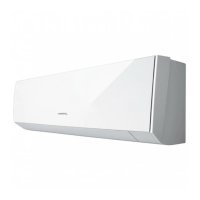
This document describes the service and operation of Fujitsu General Limited's SPLIT TYPE ROOM AIR CONDITIONER, specifically the WALL MOUNTED INVERTER type models AS*G09LLCA and AS*G12LLCA (indoor units) and AO*G09LLC and AO*G12LLC (outdoor units), which utilize R410A refrigerant.
The air conditioner offers various operational modes including Cooling, Heating, Dry, and Auto Changeover, each controlled by a room temperature thermistor in the indoor unit. The compressor's operation frequency is dynamically adjusted based on the difference between the set temperature and the current room temperature. In Cooling mode, the compressor frequency reaches maximum performance if the room temperature is 2°C higher than the set temperature and stops if it's some degrees lower. Within a ±2°C to -2.5°C range of the set temperature, the compressor frequency is controlled within specific minimum and maximum ranges (e.g., 18rps to 64rps for AO*G09LLCA). After 30 minutes of continuous operation above Maximum Frequency II, the maximum frequency is limited to Maximum Frequency II. Outdoor temperature and indoor fan mode also influence the maximum frequency in Cooling mode, with different limits for various outdoor temperature zones and fan settings (Hi, Me, Lo, Quiet).
Heating mode operates similarly, with maximum performance when the room temperature is 3°C lower than the set temperature and compressor stop when it's some degrees higher. Within a +2.5°C to -3°C range, the compressor frequency is controlled (e.g., 18rps to 120rps for both models). Maximum frequency in Heating mode is also limited by fan mode.
Dry mode adjusts compressor frequency based on temperature, set temperature, and room temperature variation, with an initial 61rps operation for 60 seconds after startup.
Auto Changeover mode automatically switches between Heating, Cooling, Dry, and Monitoring modes based on temperature changes, with a settable temperature range of 18°C to 30°C in 1°C steps. The system monitors thermostat OFF states for 6 minutes or longer to determine mode changes.
Indoor fan control allows for 5 airflow steps (Auto, Quiet, Lo, Me, Hi). In Auto mode, the fan speed adjusts based on room temperature relative to the set temperature (e.g., Hi mode if TR-Ts ≥ 2.5°C, Lo mode if 1°C > TR-Ts). In Heating mode, a "Cool air prevention control" limits the maximum indoor fan speed based on the indoor heat-exchanger sensor temperature to prevent cold drafts. "Moisture return prevention control" and "Indoor unit fan control for energy saving" are also implemented in Cooling and Dry modes, adjusting airflow based on specific conditions.
Outdoor fan control varies between AC and DC motors. For the specified models, the outdoor fan operates at 750rpm (AO*G09LLCA) or 820rpm (AO*G12LLCA) in Cooling and Heating modes, and 0rpm in Dry mode, with the fan turning on and off with the compressor, except during defrost.
Louver control includes Vertical Louver Control with 7 air direction ranges (1-3 for Cooling/Dry, 4-7 for Heating) and a Swing operation. Horizontal airflow direction is manually adjustable.
Timer operation control includes ON Timer, OFF Timer, Program Timer (combining ON and OFF timers), and Sleep Timer. The Sleep Timer automatically adjusts the set temperature (increases in cooling, decreases in heating) over time before stopping operation.
Other functions include Test Operation Control (for service checks), a 3-minute restart prevention for the compressor, Four-Way Valve Extension Select (for switching between cooling and heating), Auto Restart (memorizes operation contents after power failure), Manual Auto Operation (for remote control loss), Forced Cooling Operation (for test purposes), Compressor Preheating (to quickly discharge warm air on startup in cold conditions), Economy Operation (reduces output to ~70% of normal), and Powerful Operation (runs at maximum power).
Various protections are in place, such as Discharge Gas Temperature Overrise Prevention Control (decreases compressor frequency or stops it if discharge temperature is too high), Current Release Control (limits compressor frequency to prevent exceeding current limits), Antifreezing Control (decreases compressor frequency in cooling/dry if indoor heat exchanger temperature is too low), Cooling Pressure Overrise Protection (stops compressor and outdoor fan if outdoor heat exchanger temperature is too high), and High Temperature Release Control (adjusts compressor frequency in heating mode based on indoor heat exchanger temperature).
 General
| Brand | Fujitsu |
|---|---|
| Model | AS G09LLCA Series |
| Category | Air Conditioner |
| Language | English |


 To Next Page