•The
receiver
channel order
is
shown
in
Fig.
8.
Stick the channel tabs furnished with the set
to
the servo lead wires for identification.
•Use an extension cord matched to the fuselage.
•Wrap the receiver in sponge and fasten to the
fuselage with rubber bands.
•Install the receiver so that the antenna wire is as
straight as possible.
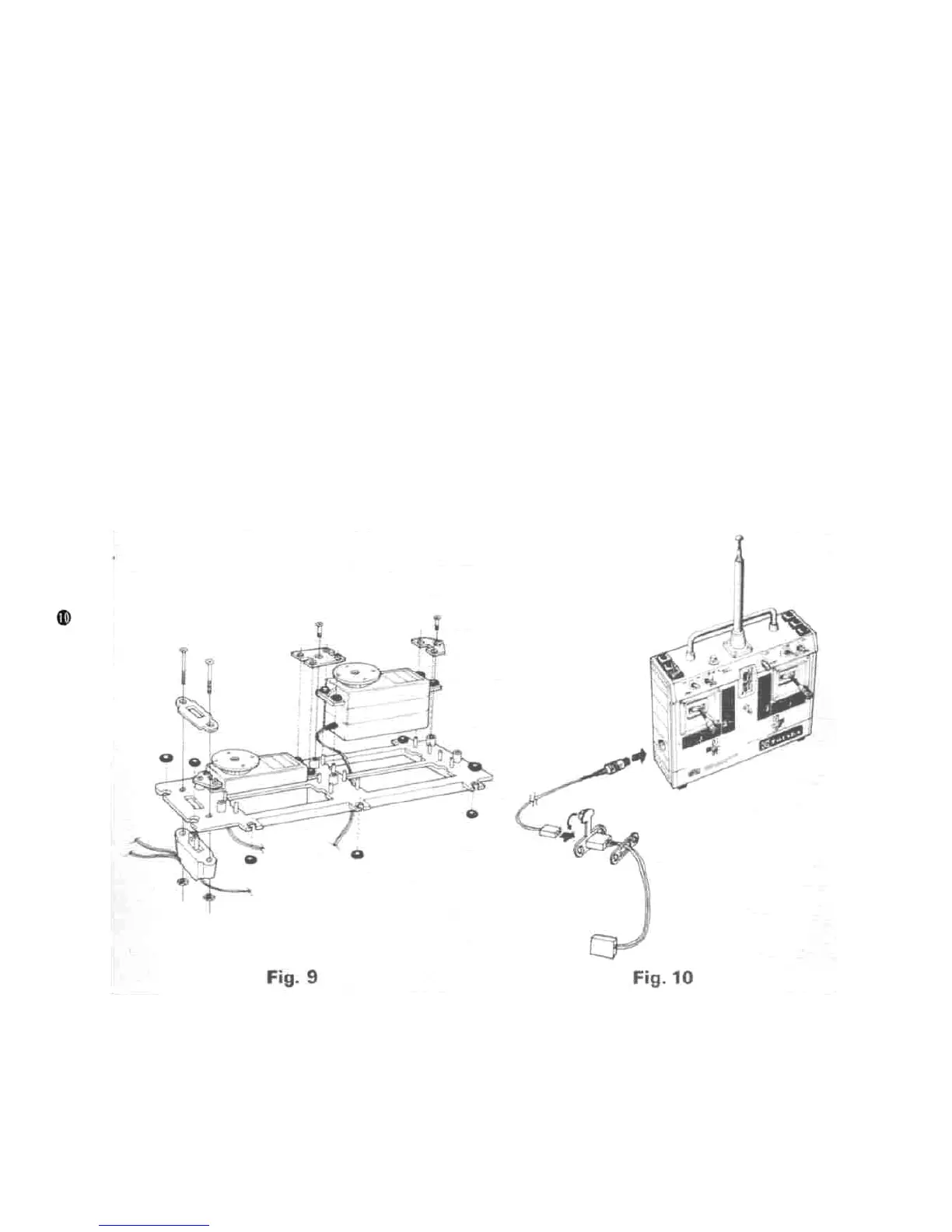
•Mount
the
servo
as
shown
in
Fig.
9.
•Mount
the
servos
so
that the flexible
wire,
hinges, and other steering mechanisms operated
smoothly.
Be especially careful when the steering angle is
large.
•When mounting the landing gear servo, match the
landing gear stroke and the landing gear servo
horn stroke precisely so that pulling and pushing
are neither excessive nor insufficient.
•Install
the
receiver
servo
NiCd battery
(NR-4H)
by wrapping it in sponge and attaching it to the
fuselage
with
rubber bands,
the
same
as
the
receiver.
•All
the
servos
can be controlled
from
the
receiver
(direct servo control system) by applying the
signals form the transmitter to terminal C of the
receiver. In this case the transmitter current drain
will drop to about 1/4 that when transmitting.
Connect the intermediate cord with lug to ter-
minal C and fastening it to the side of the fuselage
as shown in Fig. 8 beforehand.
•All
the
servos,
except
the landing
gear
servo,
are
designed and manufactured to the same standards
and can be used at any channel.
•Pay careful attention to noise.
This set is especially resistant to noise, but is not
completely noise-free.
The use of noiseless parts is recommended.
•When used in seaplanes and boats, pay careful
attention to waterproofing.
The servos are waterproof, but the receiver, con-
nectors, and NiCd battery are not. Place these
components in a vinyl bag and amply waterproof
the entire mechanism chamber.



 To Next Page