Need help?
Do you have a question about the FUTABA R3006SB and is the answer not in the manual?
Lists Futaba T-FHSS Air-2.4GHz system transmitters as compatible.
Provides guidelines for antenna placement, wire handling, and strain relief for optimal reception.
Alerts users to prevent short circuits and improper connections to avoid damage, heat, and fire.
Clarifies that only S.BUS2-capable devices can be connected to the S.BUS2 port.
Outlines FCC compliance rules and provides contact info for the responsible party in the USA.
Lists key technical specifications including size, weight, power requirements, and system type.
Explains how to switch between S.BUS and 6CH modes using the Mode switch.
Describes the S.BUS system for data communication to multiple servos on a single line.
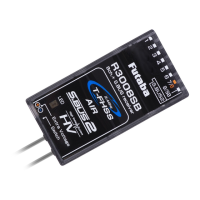
The Futaba R3006SB is a T-FHSS Air-2.4GHz bidirectional communication system receiver, designed for use with compatible Futaba T-FHSS Air transmitters. It features an S.BUS2 port, which allows for the utilization of an impressive array of telemetry sensors, as well as standard PWM output ports and S.BUS output ports. This receiver supports high voltage systems and offers dual antenna diversity for enhanced signal reception.
The R3006SB receiver facilitates wireless communication between your remote control system and your model. It receives control signals from the transmitter and translates them into commands for servos and other connected devices. The S.BUS2 port enables bidirectional communication, meaning it can not only receive control signals but also transmit telemetry data back to the transmitter from connected sensors. This allows users to monitor various parameters of their model in real-time, such as battery voltage, temperature, or altitude, directly on their transmitter display.
The receiver operates on the T-FHSS Air 2.4GHz frequency band, ensuring a robust and interference-resistant connection. Its dual antenna diversity system is a key feature, designed to maximize signal reception and promote safe modeling. By utilizing two antennas, the receiver can obtain RF signals from both, effectively mitigating signal loss due to orientation or environmental factors. This diversity system helps ensure a problem-free flight experience.
The R3006SB also supports different channel modes, allowing for flexible configuration depending on the user's needs. It can operate in a 6-channel conventional PWM mode or an S.BUS mode, which simplifies wiring by allowing multiple S.BUS compatible servos and devices to be connected to a single S.BUS port. The S.BUS system uses data communication to transmit control signals, where each S.BUS device executes only the commands for its own set channel. This intelligent system reduces the number of cables required and streamlines the setup process for complex models.
To ensure optimal performance and safety, several usage precautions and installation guidelines must be followed. The R3006SB receiver is exclusively compatible with Futaba T-FHSS Air capable transmitters and will not work with other Futaba systems like T-FHSS, S-FHSS, FHSS, FASST, or FASSTest.
For antenna installation, it is crucial to position the two antennas at a 90-degree angle to each other. This configuration is essential for the diversity system to function effectively and maximize signal reception. Users should avoid cutting or bundling the receiver antenna wire and refrain from bending the coaxial cable, as this can cause damage and impair performance. The antennas must be mounted in a way that assures they are strain relieved, preventing accidental disconnection or damage during operation. It is also recommended to keep the antenna as far away as possible from noise sources such as motors and ESCs (Electronic Speed Controllers) to minimize interference.
When installing the receiver in models with carbon fuselages, special attention is required. At least 30mm of the antenna tip must be fully exposed outside the carbon structure, as carbon can block RF signals. The exposed antenna portion should be secured to prevent it from moving around or retracting back inside the aircraft during flight.
The S.BUS2 port is designed for S.BUS2 capable devices only. Standard S.BUS servos and gyros should not be connected to the S.BUS2 port, as this could lead to abnormal heat, fire, or burning. Similarly, conventional system servos should not be connected to the S.BUS/S.BUS2 ports, as digital servos for conventional systems will not operate, and analog servos may cause abnormal heat or fire.
Linking the receiver to the transmitter is a straightforward process. The "Easy Link ID" feature allows for linking without pressing a button on the receiver. The transmitter and receiver should be brought within 20 inches of each other, the transmitter turned on and placed into linking mode, followed by turning on the receiver. The receiver will then wait for the linking process to begin. Once the receiver's LED changes from blinking red to solid green, linking is complete. It is vital to double-check that the receiver is linked to the correct transmitter, especially if multiple T-FHSS Air systems are operating in close proximity, to avoid dangerous situations. If the system type of the transmitter is changed, the receiver will need to be re-linked.
The channel mode can be changed by following a specific procedure involving the Mode switch on the receiver. This allows users to switch between 6-channel conventional mode and S.BUS mode. After changing the mode, it is essential to confirm the operation and cycle the receiver power.
The R3006SB receiver requires minimal maintenance, but certain precautions are necessary to ensure its longevity and reliable operation. The receiver should always be protected from vibration using foam rubber, Velcro, or similar mounting methods. It is also crucial to protect it from moisture, as water ingress can damage the internal electronics. Keeping the receiver away from conductive materials will prevent short circuits.
When connecting or disconnecting servos, it is important to ensure that the receiver power is OFF. Inserting or removing servo connectors while the receiver power is ON can lead to erroneous recognition of S.BUS connected servos, potentially causing them to stop operating.
For power supply, it is important to use a battery of the correct size for the amount and type of servos being used. If a BEC (Battery Eliminator Circuit) is utilized, it must be capable of delivering constant voltage and sufficient current for the receiver and servos. Dry cell batteries should not be used with this system.
The LED indicator on the receiver provides status information:
Monitoring the LED status can help diagnose basic operational issues. In case of an unrecoverable error, further troubleshooting or service may be required. Always ensure the power-up sequence is followed: transmitter first, then receiver, and always check the operation of all servos before flight to prevent potential accidents.
 General
| Product color | Black |
|---|---|
| Channels quantity | 6 channels |
| Radio Data System (RDS) | - |
| Internet radio | No |
| Supported radio bands | SW |


 To Next Page