EasyManua.ls Logo

FUTABA R3008SB - User Manual

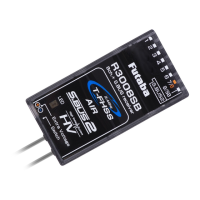
FUTABA R3008SB
2 pages
Print Icon
To Next Page IconTo Next Page
Loading...
Applicable systems: Futaba T-FHSS Air-2.4GHz system
transmitter
R3008SB
T-FHSS Air-2.4GHz Bidirectional Communication System
S.BUS2 / S.BUS Port and 8 Channels for Conventional System
Receiver
Compliance Information Statement
(for U.S.A.)
This device, trade name Futaba Corporation, model number R3008SB, complies with
part15 of the FCC Rules. Operation is subject to the following two conditions:
(1) This device may not cause harmful interference, and
(2) This device must accept any interference received, including interference that may
cause undesired operation.
CAUTION:
To assure continued FCC compliance:
$Q\FKDQJHVRUPRGL¿FDWLRQVQRWH[SUHVVO\DSSURYHGE\WKHJUDQWHHRIWKLVGHYLFHFRXOG
void the user's authority to operate the equipment.
7KLVHTXLSPHQWFRPSOLHVZLWK)&&UDGLDWLRQH[SRVXUHOLPLWVVHWIRUWKIRUDQ
uncontrolled environment.
7RPHHWWKH5)H[SRVXUHUHTXLUHPHQWVRIWKH)&&WKLVGHYLFHVKDOOQRWEHFRORFDWHGZLWK
another transmitting device.
The responsible party of this device compliance is:
Futaba Service Center
3002 N Apollo Drive Suite 1, Champaign, IL 61822 U.S.A.
7(/RU(PDLOIXWDEDVHUYLFH#KREELFRFRP6XSSRUW
56%6SHFLÀFDWLRQV
T-FHSS Air-2.4GHz system/S.BUS2 and S.BUS port and 8 channels for
conventional system receiver
• Dual antenna diversity
• Size: 0.98 x 1.86 x 0.56 in. (24.9 x 47.3 x 14.3 mm)
• Weight: 0.36 oz. (10.1g)
• Power requirement: 4.8V to 7.4V
• Battery F/S Voltage: It sets up with a transmitter
• Extra Voltage port: 0
70V DC
* Be sure that when using ESCs regulated output the capacity of the ESC must
meet your usage condition.
Thank you for purchasing a Futaba R3008SB T-FHSS Air-2.4GHz compatible receiver.
The R3008SBUHFHLYHUIHDWXUHVELGLUHFWLRQDOFRPPXQLFDWLRQ
with a T-FHSS Air-2.4GHz Futaba transmitter using the S.BUS2 port. Using the S.BUS2 port an impressive array of telemetry sensors may be utilized.
It also includes both standard PWM output ports and S.BUS output ports.
LED Indication
Green Red Status
Off Solid No signal reception
Solid Off Receiving signals
Alternate blink Unrecoverable error (EEPROM, etc.)
(Antenna installation)
90˚
Please refer the table below
for LED status vs receiver's
condition.
1M23N17490
6%86
SRUW
6%86SRUW 6%ك
6%86ك
6%866HUYR
6%86*\UR
6%86696HUYR
6%86*\UR
([WUD9ROWDJH
3RUW
0RGHVZLWFK
$QWHQQD
/('
6HUYRIRU FRQYHQWLRQDO
V\VWHP
&KDQQHORXWSXW
&KDQQHORXWSXW
%DWWHU\WR%
,WLVQRWXVHGIRUDOLQN
Itconnectsthebattery
forpower,etc.
Externalvoltageinput
cableofanoptionis
used.Thevoltageof
thebatterycanbe
displayedwitha
transmitter.
56%
7HOHPHWU\6HQVRU
6%86+8%
6%86+8%
6%86+8%
6%86+8%
7HOHPHWU\6HQVRU
7HOHPHWU\6HQVRU
Usage precaution
• Futaba T-FHSS Air system does not work with current Futaba T-
FHSS / S-FHSS / FHSS / FASST / FASSTest system.
• The R3008SB receiver can only be used with T-FHSS Air capable
transmitters.
Don't connect Extra Voltage before turning on a receiver.
WARNING
Changes or modification not expressly approved by the party
responsible for compliance could void the user’s authority to operate the
equipment.
The R3008SB receiver should be protected from vibration by foam
rubber, Velcro or similar mounting methods. Protect from moisture.
Keep away from conductive materials to avoid short circuits.
Antenna installation precaution
Don't cut or bundle the receiver antenna wire.
Don't bend the coaxial cable. It causes damage.
The antennas must be mounted in such a way to assure they are
strain relieved.
Keep the antenna as far away from the motor, ESC and other noise
sources as you possibly can.
Be sure that the two antennas are placed at 90 degrees to each other.
The R3008SB has two antennas. In order to maximize signal reception
and promote safe modeling Futaba has adopted a diversity antenna
system. This allows the receiver to obtain RF signals on both antennas
and fly problem-free.
Antenna installation for carbon fuselage
WARNING
You must leave 30mm at the tip of the antenna fully exposed. The ex-
posed antenna should be secured so that it cannot move around or back
inside of your aircraft.
S.BUS2 precaution
DANGER
Don't connect a connector, as shown right.
It will be a short-circuit, if it connected in
this way. A short circuit across the battery
terminals may cause abnormal heat, fire
and burning.
Don't connect servo for conventional system to S.BUS/S.BUS2 port.
Digital servo for conventional system
It does not operate.
• Analog
servo
It may cause abnormal heat, fire and burning.
WARNING
Only S.BUS2 capable devices may be connected the S.BUS2 port.
Standard S.BUS servos and gyros should not be connected the S.BUS2
port.
(Typical installation)
CH Mode B
Battery(7/B)Battery(7/B)
S.BUS2
S.BUS(8/SB)
S.BUS(8/SB)
5HFHLYHU
DANGER
Do not insert either a switch
or battery in this manner.
本產品符合低功率電波輻射性電機管理辦法
第十二條、第十四條等條文
規定
1.
經型式認證合格之低功率射頻電機,非經許可,公司、商號或使用者均
不得擅自變更頻率、加大功率或變更原設計之特性及功能。
2.
低功率射頻電機之使用不得影響飛航安全及干擾合法通信 經發現有干
擾現象時,應立即停用,並改善至無干擾時方得繼續使用。前項合法通
信,指依電信法規定作業之無線電通信。低功率射頻電機須忍受合法通
信或工業
,
科學及醫療用電波輻射性電機設備之干擾。
*DefaultsettingS.BUS,
don'tconnectservofor
conventionalsystem.
Question and Answer IconNeed help?

Do you have a question about the FUTABA R3008SB and is the answer not in the manual?

Summary

Usage Precautions

General Usage Safety

General precautions for receiver usage, including voltage, modifications, vibration, moisture, and conductive materials.

Antenna Installation

S.BUS2 Precautions

S.BUS2 Connection Warnings

Warnings regarding S.BUS2 port connections, including short circuits and incompatible servo types.

R3008 SB Specifications

Linking Transmitter

Receiver Linking Procedure

Step-by-step guide on how to link the R3008SB receiver to a T-FHSS Air transmitter.

Channel Modes

Changing Receiver Channel Modes

Instructions on how to select and set different channel modes for the R3008SB receiver.

T-FHSS Air System

S.BUS2 Functionality

Overview

The Futaba R3008SB is a T-FHSS Air-2.4GHz bidirectional communication system receiver, designed for use with compatible Futaba T-FHSS Air transmitters. It features an S.BUS2 port for telemetry sensors, an S.BUS output port, and 8 conventional PWM output ports.

Function Description:

The R3008SB receiver facilitates two-way communication with a T-FHSS Air-2.4GHz Futaba transmitter. The S.BUS2 port allows for the connection of various telemetry sensors, enabling data to be displayed on the transmitter. It also provides standard PWM outputs for conventional servos and an S.BUS output for S.BUS compatible devices. The receiver incorporates a dual antenna diversity system to maximize signal reception and ensure reliable operation.

Important Technical Specifications:

  • System: T-FHSS Air-2.4GHz system/S.BUS2 and S.BUS port and 8 channels for conventional system receiver.
  • Antenna: Dual antenna diversity.
  • Size: 0.98 x 1.86 x 0.56 inches (24.9 x 47.3 x 14.3 mm).
  • Weight: 0.36 oz. (10.1g).
  • Power Requirement: 4.8V to 7.4V.
  • Battery F/S Voltage: Configured with a transmitter.
  • Extra Voltage Port: 0 ~ 70V DC.
  • Channel Modes: Supports multiple channel allocations (Mode A, B, C, D) which can be configured by the user. Default is Mode B.

Usage Features:

  • Compatibility: Works exclusively with Futaba T-FHSS Air capable transmitters. It is not compatible with current Futaba T-FHSS, S-FHSS, FHSS, FASST, or FASSTest systems.
  • Easy Link ID: Allows linking to a compatible transmitter without pressing a link button on the receiver. The process involves bringing the transmitter and receiver close, turning on the transmitter in linking mode, then turning on the receiver. Linking is confirmed when the receiver's LED changes from blinking red to solid green.
  • S.BUS2: Extends S.BUS functionality with bidirectional communication, primarily for connecting telemetry sensors. Only S.BUS2 capable devices should be connected to this port; standard S.BUS servos and gyros are not compatible with the S.BUS2 port.
  • S.BUS: A data communication system that transmits control signals from the receiver to S.BUS compatible servos, gyros, or other devices. Multiple S.BUS devices can be connected to the same signal line, with each device executing commands for its own set channel. S.BUS servo channels can be set using an SBC-1 channel changer, CIU-2 USB serial interface, or programming software in the T10J transmitter.
  • Channel Mode Switching: The receiver's channel allocation can be changed by a specific sequence of button presses on the Mode switch while the transmitter is off. The LED indicates the current set status through flashing patterns.
  • Antenna Installation: Features two antennas that should be placed at 90 degrees to each other for optimal signal reception. For carbon fuselages, 30mm of the antenna tip must be fully exposed and secured to prevent movement.
  • LED Indication: The LED provides status feedback: Off (no signal reception), Solid (receiving signals), Alternate blink (unrecoverable error).
  • Extra Voltage Port: Allows connection of a battery for power or external voltage input cables from options, enabling the battery voltage to be displayed on the transmitter.

Maintenance Features:

  • Protection: The receiver should be protected from vibration using foam rubber, Velcro, or similar methods, and kept away from moisture and conductive materials to prevent short circuits.
  • Antenna Care: Do not cut or bundle the receiver antenna wire, and avoid bending the coaxial cable as it can cause damage. Antennas must be mounted with strain relief. Keep antennas as far as possible from motors, ESCs, and other noise sources.
  • Power-up Sequence: Always power up the transmitter first, followed by the receiver. When linking, ensure the motor's main wire is not connected and the engine is not operating to prevent serious injury.
  • S.BUS Servo Handling: Do not insert or remove servo connectors while the receiver power is ON, as S.BUS connected servos can be erroneously recognized and stop.
  • FCC Compliance: The device complies with FCC Rules Part 15. Users are cautioned against unauthorized changes or modifications to the device, which could void their authority to operate the equipment. The device must accept any interference received and must not cause harmful interference. It complies with FCC radiation exposure limits for an uncontrolled environment and should not be co-located with another transmitting device.

FUTABA R3008SB Specifications

General IconGeneral
BrandFUTABA
ModelR3008SB
CategoryTransmitter
LanguageEnglish

Related product manuals