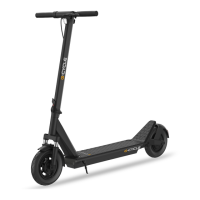
This document outlines the user manual for the G-CYCLE L8 Pro Electric Scooter, a recreational transporter designed for personal mobility. It provides essential safety instructions, assembly guidelines, operational procedures, maintenance tips, and troubleshooting information to ensure a safe and enjoyable riding experience.
Function Description
The G-CYCLE L8 Pro Electric Scooter serves as a personal electric vehicle, offering a convenient and eco-friendly mode of transportation. It is equipped with an electric motor that propels the scooter, controlled by a throttle on the handlebar. The scooter features a display that shows important information such as current speed, speed unit (mph or km/h), battery level, and indicators for front and rear lights. It incorporates both electric and foot/hand brakes for effective stopping, emphasizing the importance of using both for maximum braking capability in emergencies. The scooter is designed with a folding mechanism, allowing for easy storage and portability. It also includes a charging port for recharging its internal battery.
Usage Features
To operate the L8 Pro Electric Scooter safely and efficiently, users must adhere to several key features and procedures:
- Safety First: Always wear an approved helmet and other protective gear to minimize injury risk. Riders should be at least 14 years old, and those under 18 must ride under adult supervision. It is crucial to avoid riding under the influence of alcohol or drugs, or if suffering from conditions that impair balance or physical activity. The scooter should not be ridden by pregnant women or individuals whose weight exceeds the stated limits.
- Pre-Ride Check: Before each ride, inspect the scooter for loose fasteners and any abnormal sounds or alarms. If any issues are detected, stop riding immediately and contact support.
- Starting the Scooter: Power on the scooter by pressing the power button for two seconds. Check the battery level indicator on the display and charge the scooter if the battery is low.
- Initiating Movement: Stand on the deck with one foot and push off with the other to start gliding. For safety, the motor will not engage until the scooter reaches a speed of 1.8 mph (3 km/h). Once balanced, place the other foot on the deck and press the throttle on the right hand to accelerate.
- Speed Control: The scooter offers two speed levels (9 mph and 15 mph), which can be adjusted by pressing the power button once. The speed unit (mph or km/h) can be changed by quickly pressing the power button three times.
- Lighting: After turning on the scooter, quickly press the power button twice to activate or deactivate the LED front and rear lights.
- Cruise Control: To activate cruise control, quickly press the power button four times. If a certain speed is maintained for 8-10 seconds, the scooter will enter cruise control mode, indicated by two beeps. This mode ends when the brake or throttle is engaged, followed by a single beep.
- Braking: To slow down, release the throttle and squeeze the brake lever to engage mechanical braking. For emergency stops, always use both electric and foot/hand brakes to achieve maximum braking capability and reduce the risk of falls or collisions. Rapid braking, especially on low-traction surfaces, can lead to wheel slip or falls, so maintain a moderate speed and be aware of potential hazards.
- Turning: To turn, shift your body weight and slightly turn the handlebar in the desired direction.
- Environmental Awareness: Always be alert and scan both far ahead and in front of the scooter for obstacles and low-traction surfaces such as wet ground, loose sand, gravel, or ice. Avoid riding in snow, rain, or on wet, muddy, or icy roads.
- Public Spaces: When riding in public spaces, always comply with local laws and regulations. Yield to pedestrians, passing on the left whenever possible. When approaching pedestrians from the front, stay to the right and slow down. When approaching from behind, announce your presence and slow to walking speed when passing.
- Automatic Shut-off: The scooter will automatically power off after 5 minutes of inactivity to conserve battery.
- Charging: To charge, open the charge port cover, insert the charge plug, and close the cover when finished. Only use the manufacturer-supplied charger and a surge protector to prevent damage from power surges. The battery must be fully charged before use, and overcharging or undercharging should be avoided to preserve battery life.
Maintenance Features
Proper maintenance is crucial for the longevity and safe operation of the G-CYCLE L8 Pro Electric Scooter:
- Battery Maintenance: To ensure optimal battery life, charge the scooter promptly when the battery level is low. If the scooter is not used for an extended period, it is recommended to charge it once a month. Battery replacement or inspection should be performed by professionals. Store the battery at temperatures between 59-77°F (15-25°C). Avoid exposing the scooter to temperatures above 104°F (40°C) to prevent lithium battery failure or combustion. Do not store the scooter in a car during hot seasons.
- Tire Maintenance: Regularly inspect the tires for any abnormalities. Repair or replace damaged tires immediately to prevent further damage during rides. Frequently check the tightness of the screws on the wheels to ensure firmness and travel safety.
- Appearance Maintenance: Clean the scooter body with water and mild detergent. Avoid using irritating potions or chemical reagents, as these can damage the scooter. Do not wash the scooter with water when the power is turned on, as this can cause damage and pose a safety risk.
- Storage: Store the scooter in a reasonable location, away from direct sunlight and rain, as it is an electronic product and requires protection from the elements to ensure safe performance.
- Modifications: Do not modify the electric scooter with non-G-CYCLE-approved parts or accessories. Unauthorized modifications can interfere with the scooter's operation, potentially causing serious injury or damage, and may void the limited warranty.
- Troubleshooting: The manual provides a section for common issues and their solutions, including problems with the motor, charging, and turning on the scooter. Error codes (E1-E9) are also listed to help diagnose specific issues such as brake errors, accelerator errors, communication errors, overcurrent protection, undervoltage protection, overvoltage protection, Hall errors, and controller faults.

 Need help?
 General

 To Next Page