13
12
For washing in the dishwasher the following cutlery/dishes
Are not suitable
Cutlery with wooden, horn china or
mother-of-pearl handles
Plastic items that are not heat resistant
Older cutlery with glued parts that is not
temperature resistant
Bonded cutlery items or dishes
Pewter or cooper items
Lead crystal glass
Steel items subject to rusting
Wooden platters
Items made from synthetic fibre
WARNING!
Do not let any item extend through bottom
Are of limited suitability
Some types of glasses can become
dull after a large number of washes
Silver and aluminium parts have a
tendency to discolour during washing
Glazed patterns may fade if machine
washed frequently
NOTE:
new dishes please ensure that they are suitable for dishwashers.
Do not put in items that are dirty with cigarette ash, candle wax, lacquer or paint. If you buy
NOTE:
use dishes that are unsuitable for dishwashers. This is important for good results and for reasonable
energy consumption.
Please do not overload your dishwasher. There is only space for 13 standard dishes. Do not
Before loading the dishes, you should:
Remove any large amounts of left-over food.
Soften remnants of burnt food in pans
Loading Cutlery and Dishes
When Loading the Dishes and Cutlery, Please Note:
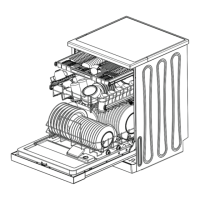
Dishes and cutlery must not impede the rotation of the spray arms.
Load hollow items such as cups, glasses, pans etc. with the opening downwards so that water cannot
collect in the container or a deep base.
Dishes and items of cutlery must not lie inside one another, or cover each other.
■To avoid damage to glasses, they must not touch.
■Load large items which are the most difficult to clean into the lower basket.
■The upper basket is designed to hold more delicate and lighter dishware such as glasses, coffee and
tea cups.
Long bladed or sharp items such as carving knives
must be positioned horizontally in the upper basket.
stored in an upright position are a potential hazard,
and
Attention!
Damage to Glassware and other Dishes
Possible causes:
■Type of glass or manufacturing process.
Chemical composition of detergent.
■Water temperature and duration of dishwasher programme.
■
Suggested remedy:
■Use glassware or porcelain dishes that have been marked dishwasher safe by the manufacturer.
■Use a mild detergent that is described as kind to dishes. If necessary, seek further information from
detergent manufacturers.
■Select a programme with a low temperature.
■To prevent damage, wait a few minutes after the programme has ended before removing glass and
cutlery from the dishwasher.
At the End of the Wash
When the working cycle has finished, the buzzer of the dishwasher will sound for 6 times, then stop.
Turn off the appliance using the "Power" button, and open the door of the dishwasher.
Wait a few minutes before unloading the dishwasher to avoid handling the dishes and utensils while
they are still hot and more susceptible to breakage. They will also dry better.
Cutlery Basket and Fork shelf
Cutlery should be placed in the cutlery basket with handles at the bottom: If the basket
has side baskets, the spoons should be loaded individually into the appropriate slots,
especially long utensils should be placed in the horizontal position at the front of the
upper basket.
Cutlery basket
Type
Item
Tea spoons
Dessert spoons
Soup spoons
Forks
Knives
Serving fork
1
2
3
4
5
6
7
8
Serving spoons
Gravy ladle
2 2 2 2 5 4
3 6 6 6 6 3
6 3 3 63
2
2 2
2
2
6
3
3
6 6 6 6
3 3 3 6
3
2 2
3
2
2
3 6
Door side
Fork shelf
Cutlery basket
Door side
1
7
8
8


 To Next Page