Need help?
Do you have a question about the Galanz W60B1A401J-AE5 and is the answer not in the manual?
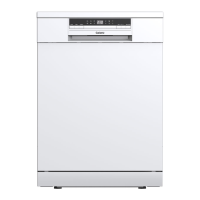
This document describes the Galanz W60B1A401J-AE5 Dishwasher, providing comprehensive information on its function, usage, and maintenance.
The Galanz dishwasher is designed for domestic use, efficiently cleaning dishes and utensils. It operates by spraying hot water and detergent onto items, followed by rinsing and drying cycles. The appliance features a water softener system to remove minerals and salts from hard water, preventing deposits on dishes and ensuring optimal cleaning performance. Detergent and rinse aid are dispensed automatically during the wash cycle. The dishwasher includes a heating element to facilitate effective cleaning and drying. It is equipped with a filter system to trap food particles and debris, preventing them from recirculating and ensuring clean wash water. The appliance also incorporates safety features such as a door lock and overflow protection.
The dishwasher offers a user-friendly control panel with various buttons and indicators. The "Power" switch turns the appliance on/off. The "Program" key-press allows users to scroll through different wash cycles, with a corresponding light indicating the selected program. A "Delay" button enables users to set a delayed start time for any cycle, up to 24 hours. The "Start/Pause" button initiates or pauses the wash cycle. For safety, a "Child lock" button can be activated to prevent unintended operation. Indicators on the panel notify users when salt or rinse aid needs refilling, and a "3 in 1" indicator lights up when this additional function is selected. Digital display shows the remaining running time, malfunction codes, and delay time.
The dishwasher offers several wash programs:
Before starting a wash cycle, users need to load the dishes into the upper and lower baskets, ensuring items are placed upside down or at a slant to allow water to run off. Sharp knives and utensils should be loaded with handles up or horizontally in the upper basket to prevent injuries. Detergent and rinse aid dispensers should be filled. The water softener needs to be adjusted according to the local water hardness, which can be set from H0 to H7 using the "Delay" and "Program" buttons. The rinse aid dispenser has adjustable settings (1-6) to optimize drying and prevent spots or streaks.
The dishwasher is designed with a cutlery tray and folding racks in the lower basket to accommodate larger items. The upper basket's height can be adjusted to create more space. Users are advised to scrape off large food remnants before loading and to avoid overloading the dishwasher. After the wash cycle, the dishwasher signals completion with a buzzer. It is recommended to wait a few minutes before unloading to allow dishes to cool and dry better, starting with the lower basket to prevent water from dripping onto clean dishes.
Regular maintenance is crucial for the dishwasher's performance and longevity. The filter system, consisting of a coarse filter, a flat (main) filter, and a micro filter, should be inspected and cleaned after each use. To clean the filters, users need to contrarotate and lift the coarse filter, then lift the flat filter, remove any trapped food particles, and rinse them under running water. A cleaning brush can be used for thorough cleaning of the coarse and micro filters. It is important to reassemble the filters correctly and ensure they are in place before running the dishwasher.
The spray arms should also be cleaned regularly to prevent clogging from hard water chemicals. They can be removed by unscrewing a nut, washed in soapy water, and cleaned with a soft brush.
For the exterior, the control panel should be cleaned with a lightly dampened cloth and then dried thoroughly. A good appliance polish wax can be used for the exterior. Abrasive cleaners, scouring pads, or sharp objects should not be used on any part of the dishwasher. The door edges should be cleaned with a soft, warm, damp rag, avoiding spray cleaners to protect electrical components.
If the dishwasher is left in an unheated place during winter, it should be prepared for freezing conditions by cutting off electrical power, turning off and disconnecting the water supply, draining water from the inlet pipe and water valve, and removing the filter from the tub to use a sponge to soak up any remaining water in the sump.
Periodic cleaning of the seals with a damp sponge is recommended to prevent odors caused by trapped food remnants. If the appliance needs to be moved, it should ideally be kept in a vertical position, or tilted onto its back if necessary.
In case of malfunctions, the dishwasher displays error codes (E1-E7) to indicate specific issues such as door open, water inlet/drainage malfunction, temperature sensor malfunction, overflow/leakage, or abnormal heating. Users are advised to consult the troubleshooting tips in the manual before calling for service, as many common problems can be resolved independently. For instance, issues like cloudiness on glassware, yellow/brown film on surfaces, or white film can often be addressed by adjusting detergent usage, water hardness settings, or cleaning methods.
 General
| Type | Freestanding |
|---|---|
| Noise Level | 49 dB |
| Control Type | Electronic |
| Color | White |
| Child Lock | Yes |
| Height | 845 mm |
| Width | 59.8 cm |
| Depth | 600 mm |
| Delay Start | Yes |

 To Next Page