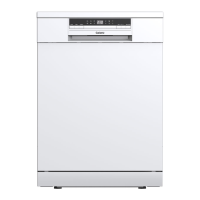
Need help?
Do you have a question about the Galanz W60A1A401D and is the answer not in the manual?
Safety checks and disposal of packaging materials at the time of delivery.
Safety guidelines and connection requirements during appliance installation.
Safety instructions for operating the dishwasher correctly and safely.
Steps to take after each wash cycle to maintain the appliance.
Safety instruction to unplug the appliance before cleaning or maintenance.
Guidance on suitable cleaning agents for the dishwasher's exterior and interior.
Recommendations for safely moving the dishwasher.
Advice on cleaning seals to prevent odors and potential hazards.
Preparations for the dishwasher before leaving for a holiday.
Guide to identifying and resolving common dishwasher issues without a service engineer.
Instructions on how to activate the service diagnostic cycle for troubleshooting.
Guide to easily correct minor problems, saving time and money.
Instructions to review charts to potentially avoid calling for service.
List of error codes and their meanings for diagnosing malfunctions.
Electrical wiring diagram for the dishwasher, showing component connections.
Diagram illustrating the connections on the Printed Circuit Board Assembly (PCBA).
Individual circuit diagrams for diagnosing appliance malfunctions.
Flowchart for diagnosing and resolving water inlet related issues.
Flowchart for diagnosing and resolving water drainage issues.
Flowchart for diagnosing and resolving temperature sensor issues.
Flowchart for diagnosing and resolving overflow issues.
Flowchart for diagnosing and resolving water leakage issues.
Table detailing technical specifications like width, depth, height, and power.
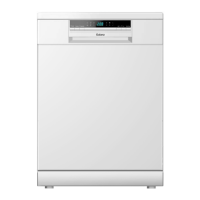
This document is a service manual for a Galanz domestic dishwasher, specifically models W60A1A401D and W60B1A401D. It provides comprehensive information on the dishwasher's features, safety precautions, wash cycles, maintenance, fault finding, malfunction diagnostics, and troubleshooting.
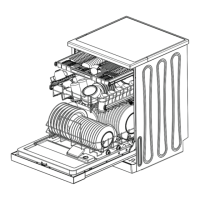
The Galanz domestic dishwasher is designed to efficiently clean household dishes and cooking utensils. It operates with an electronic control system and includes a water softening function to prevent the formation of incrustation. The appliance features a concealed heater to avoid burning and offers a super-capacity for 12 or 14 place settings, depending on the model. The dishwasher is designed to provide effective washing and drying performance, with specific models achieving A grade for energy consumption, washing efficiency, and drying efficiency according to European standards (W60A1A401D) or A+ grade for energy consumption (W60B1A401D).
The dishwasher offers various wash cycle programs tailored to different levels of soiling:
The dishwasher also incorporates a delay washing function, allowing users to schedule wash cycles at a more convenient time. The appliance is intended for use by adults for its specified purpose. It should not be installed outdoors or exposed to rain and elements. Users are advised not to place heavy objects or stand on the door when it is open, as this could cause the appliance to tip forward. The water inside the dishwasher is not suitable for drinking, and solvents should not be used inside the appliance due to explosion risk. Care should be taken when opening the door during operation to avoid water squirting out, and the heating element should not be touched during or after a wash cycle.
Regular maintenance is crucial for keeping the dishwasher in optimal shape and preventing common problems.
After Every Wash: After each wash cycle, it is recommended to turn off the water supply to the appliance and leave the door slightly ajar. This practice helps to prevent moisture and odors from being trapped inside, contributing to the longevity of the seals and overall freshness of the appliance.
Removing the Plug: Before performing any cleaning or maintenance tasks, always remove the plug from the socket to ensure safety and prevent electrical risks.
Cleaning Products: For cleaning the exterior and rubber parts of the dishwasher, only a cloth and warm soapy water should be used. Solvents or abrasive cleaning products are not recommended. For removing spots or stains from the interior surface, a cloth dampened with water and a little white vinegar, or a cleaning product specifically designed for dishwashers, can be used.
Moving the Appliance: If the dishwasher needs to be moved, it should ideally be kept in a vertical position. If absolutely necessary, it can be positioned on its back.
Seals: Food remnants trapped in the seals can lead to odors. Periodic cleaning of the seals with a damp sponge will help prevent this issue. It is also important not to leave the door in an open position, as this can present a tripping hazard.
When Going on Holiday: Before extended periods of inactivity, such as holidays, it is recommended to run an empty wash cycle. Afterward, remove the plug from the socket and turn off the water supply. This helps to maintain the appliance's condition and prevent odors.
Troubleshooting and Diagnostics: The manual provides extensive troubleshooting guides for common issues, such as the dishwasher not starting, the drain pump not stopping, unusual noises, improper cleaning results, white stains on crockery, dishes not drying, dull glasses, tea stains, rust traces on cutlery, clouded glassware, yellow or brown film on surfaces, detergent cup lid issues, detergent remnants, steam, black or gray marks, water standing in the tub, and leaks.
The dishwasher also features an error code display system to alert users to specific malfunctions:
A service diagnostics cycle can be initiated by pressing the "Delay" buttons and connecting the power line. After two short buzzer signals, the Power, Rinse, Salt, and Delay indicators will light up, indicating entry into the service diagnostic cycle. This cycle allows for checking various components like the inlet valve, dispenser, washing pump, heater, drain pump, and softener.
The manual also includes detailed wiring diagrams and strip circuits for power-up, washing motor, heater element, drain pump, fill and overflow, dispenser, and softener, which are crucial for qualified specialists performing repairs. It emphasizes that repairs should only be carried out by qualified personnel to avoid equipment damage and danger to the user. Users are advised to unplug the dishwasher or disconnect power before performing resistance checks on components.
 General
| Type | Freestanding |
|---|---|
| Capacity | 12 place settings |
| Number of Programs | 6 |
| Color | White |
| Place Settings | 12 |
| Energy Rating | A+ |
| Child Lock | Yes |
| Dimensions (H x W x D) | 845 x 598 x 600 mm |
| Programs | Normal, Intensive, Eco, Glass, Rapid |

 To Next Page