Need help?
Do you have a question about the Garmin STRIKER PLUS 4 ICE FISHING BUNDLE and is the answer not in the manual?
Ensure correct spade connector is used for the power/data port to prevent damage or faulty wiring.
Provides tips on battery charging, including full charge duration and low-temperature effects.
Instructions for installing the ice fishing transducer, including mounting and cable routing.
This document provides installation instructions and important safety information for the Garmin STRIKER™ PLUS 4 ICE FISHING BUNDLE. It covers assembling the portable mount, connecting and stowing cables, charging the battery, placing the portable mount in its bag, and installing the ice fishing transducer.
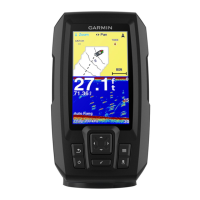
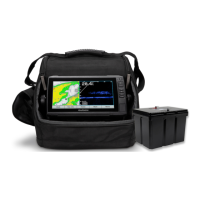
The Garmin STRIKER™ PLUS 4 ICE FISHING BUNDLE is a portable fishfinder system designed for ice fishing. It includes a fishfinder device, a portable mount, a user-replaceable sealed lead-acid battery, an ice fishing transducer, and a charger. The system is designed to be easily transportable and set up for use in cold environments.
The device functions as a fishfinder, utilizing a transducer to emit and receive sonar signals to detect fish and underwater structures. The portable mount holds the fishfinder device, battery, and transducer, making the entire system self-contained and easy to deploy. The battery powers the fishfinder, allowing for extended use without external power. The included charger is specifically designed to recharge the sealed lead-acid battery. The ice fishing transducer is optimized for use in ice fishing scenarios, typically by being submerged directly into the water through a hole in the ice.
The portable mount is assembled using a Phillips screwdriver and includes a handle for easy carrying. The fishfinder device snaps into a cradle on the swivel mount, which in turn is fastened to the portable mount. This design allows for quick setup and removal of the device. Cables for power and the transducer are connected to specific ports on the device, with keying to ensure correct alignment. Once connected, the cables can be neatly stowed around the handle of the portable mount to prevent tangling and damage during transport.
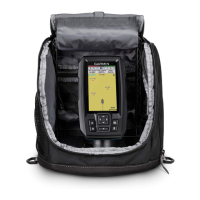
The system is designed for portability, with the entire assembled unit fitting into an included bag. This bag protects the device from elements and makes it easier to carry. The bag features loops for tethering and a zippered pocket for storing accessories like the wall charger. The battery is placed in a dedicated compartment within the portable mount, secured by hook and loop straps. The transducer is placed in a recessed space when not in use.
For ice fishing, the transducer cable is threaded through a float, and a float stop is snapped onto the cable. This allows the user to adjust the transducer's depth so it hangs beneath the bottom edge of the ice. Once connected to the device, the transducer is dropped into the water to begin operation.
The device uses a user-replaceable, sealed, lead-acid battery. Important safety guidelines are provided for battery handling, including avoiding sparks, flames, or heat, and not incinerating, disassembling, or damaging the battery. Users are warned against swallowing, touching, or inhaling the contents of an open battery and are advised to flush with water if contact with acid occurs. The battery should not be submerged or shorted, and should be kept away from children.
Battery replacement should only be done with the correct replacement battery to avoid risks of fire or explosion. The battery should only be charged with the included charger and not in an unventilated area. Storage should be in a cool, dry, and well-ventilated area, avoiding gas-tight containers. The battery should not be left exposed to heat sources or in high-temperature locations, such as in an unattended vehicle, to prevent damage. Organic solvents or other non-recommended cleaners should not be used on the battery. Disposal of the battery must be done in accordance with local laws and regulations.
Charging the battery involves connecting an all-in-one cable to the battery terminals (red to positive, black to negative), then connecting the cable to the wall charger, and finally plugging the wall charger into an outlet. The wall charger indicates charging status with an orange light (charging) and a green light (fully charged). A full charge for a completely discharged battery takes approximately 10 to 12 hours at room temperature.
Battery life is influenced by factors such as backlight brightness, temperature, and battery age. Users can extend battery life by lowering backlight brightness. Frequent recharging without complete discharge is recommended to extend the battery's life expectancy. For best results, the battery should be charged prior to use, as sealed lead-acid batteries slowly lose charge during storage. The document also notes that these batteries do not hold charge as long in cold temperatures. The batteries are fully recyclable.
The document emphasizes the importance of connecting the correct spade connector to the correct battery terminal to prevent damage to the battery or device, or bodily harm. Similarly, when connecting the power and transducer cables to the device, users must align the divot on each connector to the keying on each device port and push until fully seated to ensure proper connection.
 General
| Display Size | 4.3 inches |
|---|---|
| Display Resolution | 480 x 272 pixels |
| GPS | Yes |
| Battery Life | Up to 10 hours |
| Water Rating | IPX7 |
| Ice Fishing Flasher | Yes |
| Water Temperature Log and Graph | Yes |
| Display Type | Color |
| Sonar Type | CHIRP |
| Frequency | 77/200 kHz |
| Depth Capability | Up to 1600 ft in freshwater |
| Waypoints | 5000 |
| Operating Temperature | -20°C to 70°C |
| Transmit Power | 200 W RMS |

 To Next Page