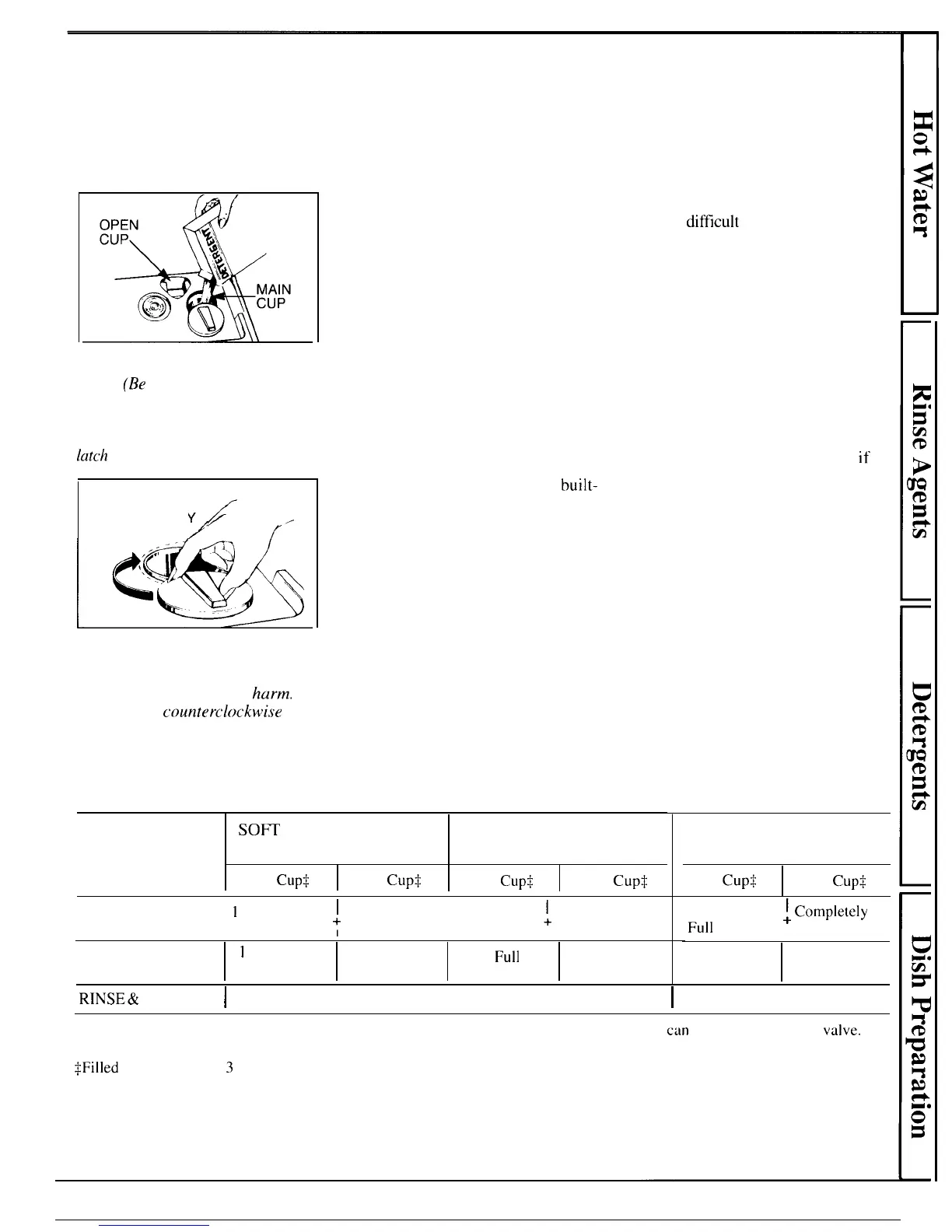
You’ll find two detergent
dispensers on the inside door of
your dishwasher. There are two
because some cycles use two
washes.
See “Detergent Usage Guide”
below.
(Be
sure the Cycle Indicator
Dial is at OFF position before
adding detergent. Otherwise, the
detergent cup lid will not close and
latch
properly.)
GRASP HANDLE, , .
ROTATE
AND
/
CLOSE TIGHTLY
/
[“
How to prepare the dishes
for washing
If this is your first dishwasher, or if
you’re replacing a much older
model, you may wonder how much
preparation your dishes need.
Actually very little. Pre-rinsing of
normal food soils is not necessary.
With common sense and a little
practice you’ll soon know what
foods to remove. Here are some
guidelines:
1. Scrape off bones, seeds, skins,
toothpicks and other hard solids. It
is also best to remove hard shelled
vegetables, meat trimmings, leafy
vegetables and crusts. Remove
excessive quantities of oil or
grease.
2. Remove large quantities of any
food. Your dishwasher has a
built-
in soft food disposer that
pulverizes soft food bits and
flushes them away. It can handle
small amounts of soft foods, but
large amounts will be difficult to
handle.
Close the main cup.
NOTE: Detergent cup may be
opened manually with no
harm.
Turn handle
~ounterc’l(~ckwi.~e
until it releases. A snapping sound
is normal when it opens.
Detergent Usage Guide (powder or liquid)
3.
Try to remove food scraps and
place dishes in dishwasher before
soil has a chance to dry and become
hard. Dishes with dried-on soil are
more
diff]cult
to wash and may not
come clean in the NORMAL
WASH cycle. Remember to use
your RINSE & HOLD cycle for
small “holding” loads.
Note: The foods mentioned above
are examples only. Other foods not
mentioned may also need to be
removed from your dishes. You
may also want to consider
removing foods such as mustard,
mayonnaise, vinegar, lemon juice
and other foods that can cause
discoloration of stainless steel
if
allowed to remain on dishes for a
long period of time.
When using the POTSCRUBBER
cycle, less
preparation is required
before loading. The POTSCRUBBER
cycle can wash heavily-soiled dishes
and remove dried-on and baked-on
SO~
WATER MEDIUM WATER
(O-3 grains hardness) (3-7 grains)
CYCLES Main
Cup$
Open
Cup*
Main
Cup$
Open
Cup$
soils from pots, pans and casseroles.
Items with burned-on soils may not
come clean and the dishwasher cannot
remove burn marks or restore fading
caused by overheating during cooking.
I
POTSCRUBBER and
I
Tablespoon
I
1
Tablespoon
Half Full
~
Half Full
NORMAL WASH
minimum
~
minimum
LIGHT WASH
1
Tablespoon
None
Half
Ful]
None
minimum
HARD WATER
(7- 12 grains*)
Main
Cup~
Open
Cup*
Completely
~
Completely
Full
Full
Completely
None
Full
I
I
I
RINSE&
HOLD
Use no detergent Use no detergent
Use
no detergent
* 12 grains and up is extremely hard water. A water softener is recommended. Without it, lime
can
build up in the water
valve.
The water valve may stick while open and cause flooding.
~Filled
Main Cup holds
3
tablespoons; Filled Open Cup holds 2 tablespoons.
7



 To Next Page