
 Need help?
Do you have a question about the GE MiCOM P40 Agile P14N and is the answer not in the manual?
Provides details on the Feeder Management IED, including version history and publication reference.
Comprehensive listing of software and hardware version changes with descriptions and technical documentation.
The GE MiCOM P40 Agile P14D, P14N, P94V is a Feeder Management IED (Intelligent Electronic Device) designed for comprehensive protection, control, and monitoring in electrical power systems. This device is part of GE Energy Connections' Grid Solutions, offering advanced functionalities for various feeder applications.
The MiCOM P40 Agile series provides robust protection for feeders, encompassing a wide range of fault conditions. It includes overcurrent protection, which is fundamental for detecting and isolating phase and earth faults. The device supports both definite time and inverse definite minimum time (IDMT) characteristics, allowing for flexible coordination with upstream and downstream protection devices. Directional overcurrent functions are also available, enhancing selectivity in complex network configurations, particularly in meshed or ring systems.
Earth fault protection is a critical aspect of the P40 Agile's capabilities, with options for both residual and sensitive earth fault detection. This is crucial for identifying high impedance earth faults that might not be detected by standard overcurrent elements, thereby improving overall network safety and reliability. The device incorporates wattmetric directional earth fault protection, which provides enhanced sensitivity and selectivity for earth faults, especially in compensated or unearthed networks.
Voltage-related protection functions are integral to the P40 Agile. It offers undervoltage and overvoltage protection, safeguarding equipment from abnormal voltage conditions. The undervoltage programmable curve allows for customized responses to voltage sags, while the voltage-controlled overcurrent (VCO) function adapts overcurrent settings based on system voltage, ensuring optimal protection performance during voltage disturbances. The series also includes underfrequency and overfrequency protection, essential for maintaining system stability during abnormal frequency events.
The P40 Agile supports various communication protocols, including IEC 61850, DNP3, and Modbus. This enables seamless integration into modern substation automation systems, allowing for remote monitoring, control, and data exchange. The IEC 61850 implementation includes features like GOOSE messaging for high-speed peer-to-peer communication between IEDs, enhancing protection schemes and interlocking functionalities. DNP3 over Ethernet (DNP3oe) and Modbus over RS485 provide versatile options for SCADA integration and data acquisition.
Beyond protection, the device offers extensive control capabilities. It supports circuit breaker control, including trip and close commands, and incorporates circuit breaker fail protection to ensure prompt isolation of faults even if the primary breaker fails to operate. The device can manage multiple setting groups, allowing for dynamic adaptation of protection parameters to different network operating conditions or configurations.
Measurement and monitoring functions are comprehensive, providing real-time data on currents, voltages, power, and frequency. This data is crucial for operational awareness, fault analysis, and system planning. The device records events and disturbances, capturing detailed information about fault occurrences, protection operations, and system anomalies. These records are vital for post-fault analysis and troubleshooting.
Specialized functions like High Impedance Fault (HIF) detection are available, particularly in the P14DZ variant. This feature is designed to detect subtle fault currents associated with downed power lines or other high impedance conditions, which are often difficult to detect with conventional protection. The HIF detection includes burst count and adaptive threshold mechanisms to improve reliability and reduce false trips.
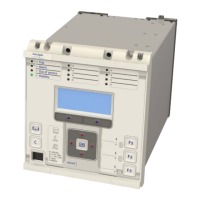
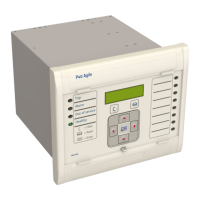
The MiCOM P40 Agile is designed for user-friendly operation and configuration. It features a local HMI (Human Machine Interface) with an LCD display, providing clear indications of relay status, alarms, and measured values. The HMI allows for local access to settings, event records, and disturbance records, facilitating on-site commissioning and maintenance. Function keys provide quick access to common operations and navigation through menus.
The device's configuration is managed through dedicated software tools, which allow for graphical programming of protection schemes using logic elements. This flexibility enables users to tailor the protection and control logic to specific application requirements. The ability to download settings files and manage multiple setting groups simplifies the process of adapting the relay to different operational scenarios or network changes.
Communication interfaces, including Ethernet and serial ports (RS485), support various connection methods for remote access and integration into substation automation systems. The device's support for Courier tunneling over DNP3oe allows for secure and efficient data exchange. The integration with SCADA systems enables centralized monitoring and control, enhancing operational efficiency and situational awareness.
The P40 Agile also incorporates features that improve its resilience and reliability in the field. For instance, it addresses issues related to communication loss, ensuring that critical protection functions remain operational even during network disturbances. The device's ability to handle various data model extractions and object variations in IEC 61850 ensures compatibility with diverse client systems.
Maintenance of the MiCOM P40 Agile is facilitated by several built-in features and design considerations. The device includes diagnostic capabilities that report internal errors and operational issues, such as "Error/Lockout" events, which help in identifying and troubleshooting problems. Alarm indications on the HMI provide immediate alerts for abnormal conditions, allowing operators to take prompt action.
The version history of the device's hardware and software indicates continuous improvements and bug fixes, ensuring that the relay remains robust and reliable over its operational life. Updates address issues such as IEC 61850 connection/disconnection problems, DNP3oe crashes, incorrect data model mappings, and measurement inaccuracies. These updates are crucial for maintaining optimal performance and compatibility with evolving system requirements.
The device's ability to generate maintenance records, especially when a gateway is configured in DNP, aids in tracking the operational history and identifying potential issues over time. This systematic record-keeping supports proactive maintenance strategies.
Specific fixes related to protection functions, such as issues with CB Fail trip operation under transient offsets or incorrect assertion of HIF functions, ensure that the device's core protection capabilities are reliable. Addressing issues like incorrect burst count or hysteresis settings for HIF detection improves the accuracy and dependability of specialized protection schemes.
The support for new hardware boards and redundancy features, such as PRP/HSR (Parallel Redundancy Protocol/High-availability Seamless Redundancy) and RSTP (Rapid Spanning Tree Protocol), enhances the device's availability and fault tolerance, reducing downtime during network failures or maintenance activities. These features are critical for applications requiring high reliability.
Furthermore, the device's design addresses issues related to data consistency across different interfaces (e.g., Modbus, IEC 61850, HMI), ensuring that operational data is accurately represented and accessible for maintenance and analysis. The resolution of issues like incorrect rounding of negative measurements or inconsistent language text strings contributes to a more reliable and user-friendly maintenance experience.
 General
| Frequency | 50/60 Hz |
|---|---|
| Operating Temperature | -25°C to +70°C |
| Communication Ports | RS485, Ethernet |
| Type | Numerical Protection Relay |
| Rated Voltage | 24-250 V DC |
| Protection Functions | Overcurrent, Earth Fault, Negative Sequence, Thermal Overload |
| Communication Protocols | IEC 61850, Modbus, DNP3 |
| Weight | 2 kg (approximate) |


 To Next Page