The GPT-4378-HP emulates an HP82240B in text AND
graphics printing.
The transmission range reaches 20 cm - 1 meter.
Command Set
Due to a command patch, the GeBE commands
remain usable, if 80hex are added to the command
operator, e.g.: Switch to double height:
ESC "H+80hex" "1" = ESC C8hex "1"
Graphics
A transmitted HP graphics byte is zoomed to the
GeBE-FLASH
®
printer mechanism for adjusting. Each
pixel is trippled in the direction of printing.
In horizontal direction, two sequential pixels are tripp-
led, but each third pixel is just doubled. This results in
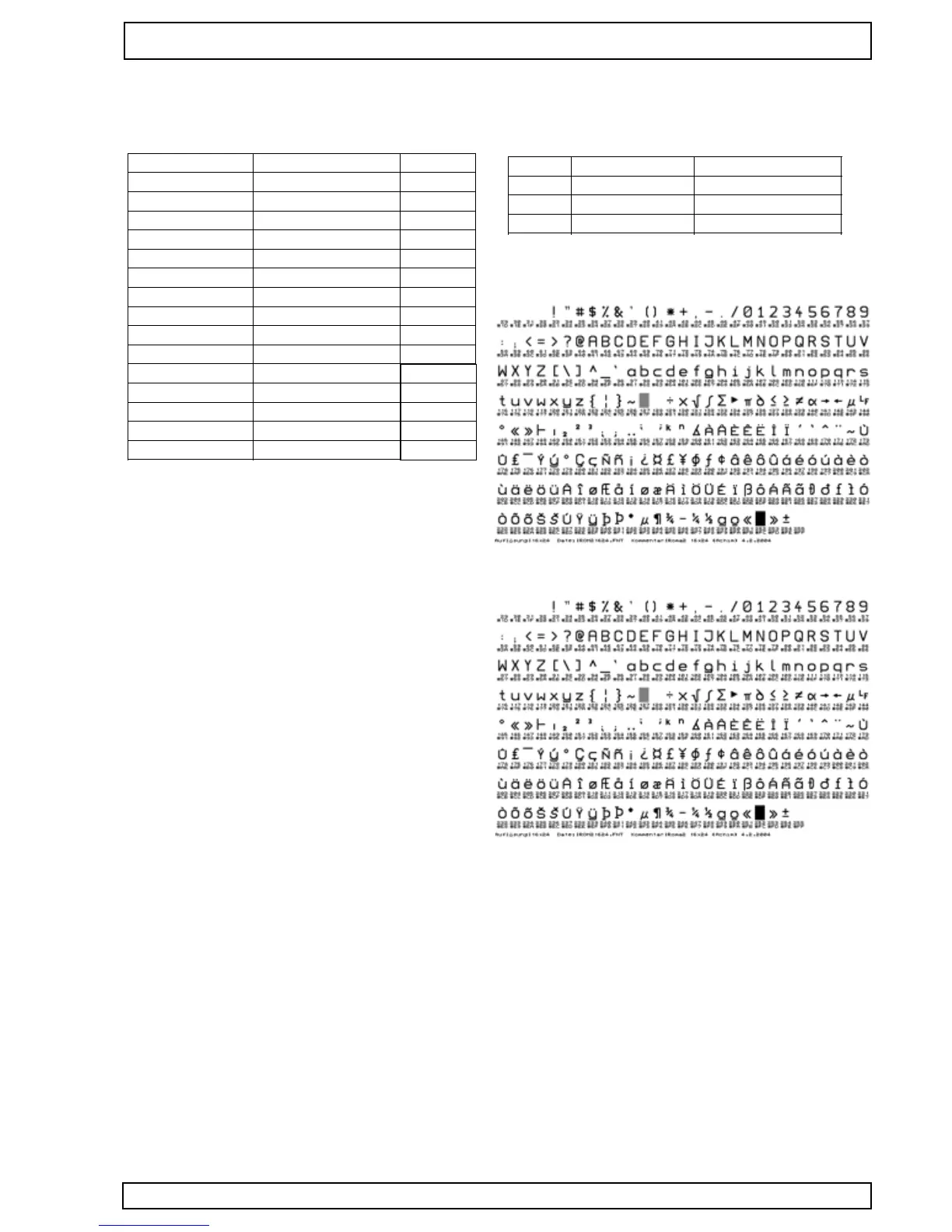
a zoom factor of 2.66:1. This allows special characters
to be printed as graphics.
HP-Ir Protocol
While the GeBE-IR protocol and the IrDA protocol act
bidirectionally, the HP-IR protocol only works unidirec-
tionally, e.g. the printer receives print data, but it can-
not send messages back (e.g. buffer full). For this rea-
son, the timing of the data transmission is tuned, so
the printer is guaranteed to always be able to print out
the data received through the HP-IR interface without
the loss of any data. The transmission speed is limited
to app. 800 baud.
When defective characters are received, they are
corected, if possible, or replaced with a ? character, if
they are uncorrectable. A buffer overflow is indicated
through the character FChex.
Use of the Sleep Mode
After the sleep time set in the menu has passed, the
printer turns itself off.
(standard value = 10 minutes).
The IR receiver is off during sleep mode. Therefore, the
device has to be turned on explicitly for printing. The
power consumption is only about 18µA in this mode.
However, for longer periods of inactivity, the printer
should be turned off completely by holding down the
NEXT/OFF key.
5.3 HP IR Interface
Data Transmission Format for Failure-Free Operation
of the GeBE-FLASH
®
:
The IR receiver of the GeBE-FLASH
®
has the ability to
inhibit failures due to ambient light. However, continously
sent data of more than 140 bytes without a pause
between the bytes may cause the printer to become
sensitive to ambient light. The optical filter that is instal-
led as a standard will reduce this effect, but it cannot
completely cancel it. It is therefore recommended to
increase the specified interframe delay from 600µs to at
least 1.5 ms after a continous data transmission of no
more than 140 bytes. A general interframe delay of 1.5
ms between the transmitted bytes would be even better.
Generally, this should not be a problem regarding the
print speed, since most pint data is sent in blocks with a
waiting period between the blocks, in order to prevent
older, slower printers from being overrun with data.


 To Next Page