
 Need help?
Do you have a question about the gefran 1600 and is the answer not in the manual?
Details panel mounting dimensions and fixing methods.
Specifies power supply voltage and frequency options.
Describes generic output types and relay/logic configurations.
Details isolated transmitter supply voltage and current.
Outlines digital input configurations for NPN/PNP signals.
Explains current transformer and potentiometer input configurations.
Covers RS422/485 and RS232 serial communication options.
Lists available thermocouple and RTD input types.
Accesses information display for unit status and versions.
Allows access to control parameters for tuning and configuration.
Configures serial communication settings like baud rate and protocol.
Sets input type, scale, and linearization for sensors.
Configures output allocation and behaviour for alarms and control.
Manages password protection for configuration access.
Sets protection codes to disable specific functions or access.
Configures hardware settings, including input/output assignments and features.
Enables custom linearization for main or auxiliary input signals.
Allows setting custom parameters for the "dAtA" menu.
Accesses user calibration routines for outputs and inputs.
Details current transformers for measuring current.
Describes RS232 interface for PC configuration.
Details various jumper settings for configuration and features.
Configures digital inputs, outputs, and supply via DIP switches.
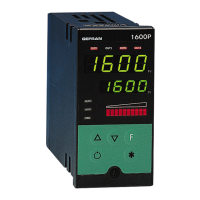
The GEFRAN 1600/1800 controller is a versatile device designed for precise process control in industrial environments. Its compact design allows for easy panel mounting, with specific cut-out dimensions provided for single or side-by-side installations. For enhanced protection, an IP65 faceplate level can be achieved by applying the supplied gasket to the front edge of the device.
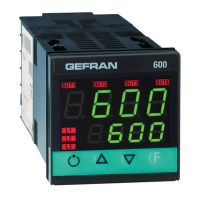
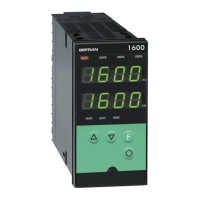
The controller features a clear display with two sets of four digits, indicating process variables and setpoints, along with various function indicators for operational modes such as Manual, Automatic, and Remote Setpoint. Five mechanical keys (including *, Man/Aut, INC, DEC, F) facilitate navigation and parameter adjustment. The "Raise" and "Lower" keys allow for incremental or decremental changes to numerical parameters, with speed proportional to the key press duration. The operation is non-cyclic, meaning values will not wrap around once maximum or minimum limits are reached. An Auto/Man key enables automatic/manual adjustment selection, active only when the PV display shows the process variable.
The device offers a wide range of control actions, including PID, Self-tuning, and On-Off, with configurable cycle times. It supports various main input types such as Thermocouples (TC), Resistance Temperature Detectors (RTD), and PTC, with configurable scale ranges and decimal point positions. Auxiliary inputs can be configured for remote setpoint, analog remote manual, analog power reset, or current transformer input for Heater Break (HB) alarm. Digital inputs allow for external control signals.
The controller includes several alarm functions, such as maximum, minimum, symmetrical, absolute, or relative alarms, as well as Load Break Alarm (LBA) and Heater Break (HB) alarms. These alarms are configurable and can be masked during warm-up or reset from the faceplate or an external contact. The HB alarm, requiring a current transformer input, detects variations in load current and can be configured to trip if the current falls below or rises above a setpoint during the ON or OFF time of the control output. The LBA alarm detects interruptions in the control loop, such as short-circuited probes or broken loads, and limits power output when active.
A Soft-start function, when enabled, gradually increases power output over a preset time, acting as an alternative to self-tuning and activating upon power-up. This function is reset by switching to Manual control. The device also supports a Timer function with two setpoints, enabling timed operations based on external contacts or alarm conditions. The Multiset function allows for the setting of four setpoints, selectable via digital input combinations, with a configurable gradient for smooth transitions between setpoints.
Custom linearization for main or auxiliary inputs can be configured, allowing for precise correction of sensor readings. The device also supports serial communication via RS422/485 or RS232 interfaces, with configurable baud rates and protocols (GEFRAN / MODBUS). Analog retransmission signals are available for monitoring process variables or control outputs.
The GEFRAN 1600/1800 controller is designed for robust performance, but proper maintenance is crucial for its longevity. Repairs should only be performed by trained and specialized personnel, and power to the device must be disconnected before accessing internal parts. The device case should not be cleaned with hydrocarbon-based solvents (such as petrol or trichloroethylene), as these can compromise the mechanical reliability of the device. Instead, a cloth dampened with ethyl alcohol or water should be used for cleaning the external plastic case.
The device complies with CE marking for EMC conformity (EN61000-6-2 for immunity in industrial environments and EN50081-1 for emission in residential environments) and BT (low voltage) conformity (73/23/CEE modified by 93/68). The 1800 model specifically conforms to EN55011 for radiated emissions in industrial environments. GEFRAN provides a service department for support, and the warranty does not cover defects resulting from improper use or non-compliance with the provided instructions.
 General
| Communication | RS485 Modbus RTU |
|---|---|
| Category | Controller |
| Operating temperature | 0...+50 °C / 32...122 °F |
| Inputs | Thermocouple, RTD, mV, V, mA |
| Outputs | Relay |
| Display | Dual |


 To Next Page