
 Need help?
Do you have a question about the General ARHG36LMLA and is the answer not in the manual?
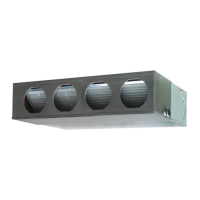
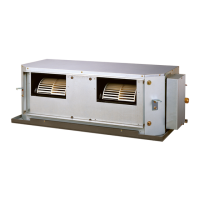
This document serves as a comprehensive service manual for Fujitsu General Limited's split-type air conditioner, specifically for duct-type models operating at 50Hz. It covers both indoor units (ARHG36LMLA, ARHG45LMLA) and outdoor units (AOHG36LATT, AOHG45LATT), providing essential information for installation, operation, and maintenance.
The Fujitsu General split-type air conditioner is designed to provide efficient cooling and heating for various indoor environments. As a duct-type system, it integrates seamlessly into a building's ventilation system, distributing conditioned air through a network of ducts and grilles, making it an ideal choice for discreet and uniform climate control across multiple rooms or larger spaces. The system utilizes R410A refrigerant, a common and environmentally conscious choice in modern air conditioning.
The core function of the system involves a closed-loop refrigerant cycle. During cooling operation, the indoor unit's heat exchanger absorbs heat from the indoor air, which is then transferred by the refrigerant to the outdoor unit's heat exchanger, where it is dissipated into the ambient air. Conversely, during heating operation, the cycle is reversed, with the outdoor unit absorbing heat from the outside air and transferring it to the indoor unit to warm the living space. The system incorporates an inverter-driven compressor, which allows for variable speed operation, enabling precise temperature control, enhanced energy efficiency, and quieter performance compared to traditional on/off compressors.
Key components facilitating this function include the indoor and outdoor heat exchangers, a 4-way valve for switching between cooling and heating modes, an expansion valve for regulating refrigerant flow, and a compressor that circulates the refrigerant. Pressure sensors and thermistors strategically placed throughout the system monitor various parameters such as refrigerant pressure, discharge temperature, and ambient temperatures (room, pipe, outdoor, heat exchanger, compressor, and heat sink), providing crucial data for the control unit to optimize performance and detect anomalies.
The indoor unit's fan motor ensures effective air circulation within the conditioned space, while the outdoor unit features multiple fan motors (upper and lower) to manage heat exchange with the external environment. The control unit, comprising main PCBs in both indoor and outdoor units, orchestrates the entire operation, processing sensor inputs, controlling motor speeds, and managing the refrigerant cycle to maintain desired indoor conditions.
The air conditioning system is designed for user convenience and operational flexibility. It can be controlled via a wired remote control, offering a centralized point of command for setting temperatures, operating modes, and fan speeds. For installations where a wired remote is not preferred, a wireless remote control option is also available, providing similar functionalities.
The system supports various operational modes, including cooling, heating, and fan-only operation, allowing users to tailor climate control to their specific needs. The inverter technology ensures that the system can quickly reach the desired temperature and then maintain it with minimal fluctuations, contributing to a comfortable indoor environment.
A notable usage feature is the "Test Run" function, which is crucial for post-installation verification. This function allows technicians to systematically check the system's operation, including the functionality of the 3-way valves, fan motors, and compressor, in both cooling and heating modes. During a test run, the system can be monitored for proper performance, and any issues can be identified and addressed before full operation. The test run also includes options for "Low Noise" and "Peak Cut" modes, which can be selected based on local setting functions, offering flexibility in operation to minimize noise or manage power consumption during peak demand periods.
The system also incorporates a "Pump Down" procedure, which is a critical usage feature for refrigerant collection when the indoor or outdoor unit needs to be moved or serviced. This procedure ensures that the refrigerant is safely contained within the outdoor unit, preventing its release into the atmosphere and facilitating maintenance or relocation without environmental impact. The pump down process is guided by the display board, indicating the status of the operation and ensuring proper execution.
Maintenance of the Fujitsu General air conditioning system is facilitated by several built-in features and diagnostic tools. The most prominent maintenance feature is the "Error Detection" system. Both wired and wireless remote controls provide error codes that indicate specific malfunctions within the system. For wired remote controls, error codes are displayed directly on the unit's screen, while for wireless remote controls, the indoor unit's photo detector lamp blinks in specific patterns to convey the error. This diagnostic capability allows technicians to quickly pinpoint the source of a problem, reducing troubleshooting time and enabling more efficient repairs.
The error codes cover a wide range of potential issues, from serial communication errors between units to specific sensor malfunctions (e.g., discharge temp. sensor, compressor temp. sensor, outdoor temp. sensor, pipe temp. sensor), fan motor errors, inverter errors, and refrigerant system issues (e.g., high pressure, low pressure, 4-way valve error). This detailed error reporting is invaluable for effective maintenance and repair.
The manual also provides detailed circuit diagrams for both indoor and outdoor PCBs, as well as a refrigerant system diagram. These diagrams are essential maintenance tools, allowing technicians to understand the electrical connections and refrigerant flow paths, which are critical for diagnosing complex issues, replacing components, and ensuring the system operates as intended. The diagrams illustrate the placement of various thermistors, pressure sensors, and other critical components, aiding in their identification and testing during maintenance procedures.
Furthermore, the manual includes a comprehensive list of parts for both indoor and outdoor units, complete with part numbers and descriptions. This makes it easy for maintenance personnel to identify and order the correct replacement parts, ensuring that repairs are carried out with genuine components. Accessories such as drain pipes, drain caps, and one-touch bushes are also listed, highlighting components that may require periodic inspection or replacement as part of routine maintenance. Optional parts like remote sensor units and long-life filters are also mentioned, indicating potential upgrades or replacements that can enhance the system's performance or extend maintenance intervals.
The design of the units, as shown in the dimensions and exploded views, suggests accessibility to key components for servicing. For example, the indoor unit's intake cover and main panel can be removed to access internal components, while the outdoor unit's service panel provides access to the main PCB, compressor, and other critical parts. This thoughtful design simplifies maintenance tasks, from routine cleaning to more complex component replacements.
 General
| Brand | General |
|---|---|
| Model | ARHG36LMLA |
| Category | Air Conditioner |
| Language | English |


 To Next Page